Remember when AI marketing tools were just fancy ChatGPT wrappers that could barely write a decent email subject line?
Those days are long gone.
I’ve been tracking the AI marketing space for the past couple years and 2026 feels like the year everything finally clicked. We’re not just talking about better copywriting anymore—these tools are running entire campaigns, optimizing ad spend in real-time and honestly doing stuff that would’ve taken entire teams just 24 months ago.
The artificial intelligence revolution in marketing is far beyond the simple content generation. The newest work by MIT Sloan says that we are experiencing what they term agentic AI, which is instruments that do not simply accept an order but literally reason over issues and implement stepwise responses.
Why 2026 Is Different (And Why You Should Care)
This is what struck me: The most useful AI marketing tools in 2026 will not be attempting to do it all anymore. Rather, they are becoming extremely good at certain things.
Take Writesonic, for example. They have created this insane integration with Ahrefs that fetches the discussion boards and trending topics on Reddit in real-time and directly embedded them into their content editor. When you are writing about, e.g. productivity apps, it is not merely indicating generic keywords, but demonstrating what people are in fact discussing on r/productivity this week.
The 2026 predictions of AI by PwC indicate that the personalized experiences have become a prerequisite and not a privilege of consumers who wish to be treated in a personalized manner. These new tools are finally living up to that promise without the need to have a PhD in data science.
The other big shift? Multi-model intelligence. The intelligent tools are no longer coupled to GPT-4. They will do their research in Claude 3.5, analysis in Gemini 2.0 and finally polish off their content using GPT-4o. It is as though it has a team of specialists rather than a generalist.
The Category Breakdown: What Actually Works
Let me walk you through what I’m seeing work for real teams in 2026.
Content Creation & Copywriting
| Tool | Best For | Key Strengths | Pricing (2026) | Best Users |
|---|---|---|---|---|
| Writesonic | Full-funnel content at scale | Real-time data (Ahrefs/Reddit), brand voice, WordPress publish | Free → $16/mo | Agencies, content teams |
| Jasper | Long-form + brand voice | Templates, campaigns, team workspaces | ~$39–99/user/mo | Enterprise, SaaS |
| Copy.ai | GTM workflows + sales copy | Prospecting, email sequences, forecasting | Custom (demo required) | B2B sales-led teams |
| Claude 3.5 / ChatGPT-4o | Best-in-class writing & ideation | Reasoning, coding, analysis | $20/mo (Pro) | Everyone (daily driver) |
Writesonic keeps showing up in my conversations with marketing teams. The brand voice training is scary good—I watched it nail the tone for a SaaS company after analyzing just 10 blog posts. But here’s the kicker: it publishes directly to WordPress and tracks how content performs in Google’s AI Overviews.
SEO & Content Optimization
| Tool | Best For | Standout Feature | Pricing |
|---|---|---|---|
| Surfer SEO | On-page optimization + AI search | Real-time content editor + NLP keywords | $89/mo+ |
| Semrush | All-in-one (keyword → execution) | Content Marketplace + AI writing | $129.95/mo+ |
| Ahrefs | Competitor & backlink intelligence | Most accurate index | $29/mo (Starter) |
| SE Ranking | Budget-friendly + AI Overviews | AI Overview tracking | ~$39/mo |
Surfer SEO earned it’s spot as the #1 recommendation here because it’s obsessed with one thing: getting your content to rank in AI search results. The real-time editor shows you exactly what Google’s algorithms are looking for and the NLP keyword suggestions go way beyond basic terms.
Social Media Marketing
The social space got interesting fast. Buffer’s still great for small teams, but if you’re serious about social listening, Sprout Social’s sentiment routing is next level. It’ll automatically flag negative mentions and route them to your customer service team before they become Twitter disasters.
| Tool | Best For | AI Features | Pricing |
|---|---|---|---|
| Sprout Social | Enterprise social listening | Sentiment, routing, reply suggestions | $249/mo+ |
| Buffer | Small teams & creators | Caption + hashtag generator | Free → $6/channel/mo |
| Hootsuite (OwlyGPT) | Unified inbox + trends | Trend detection, sentiment | $99/mo+ |
| ContentStudio | Discovery + scheduling | Smart queues, AI image gen | ~$49/mo |
Video & Visual Content
This category exploded in 2026. Everyone’s chasing the TikTok/Shorts economy and the tools finally caught up:
- Synthesia → Avatar videos in 140+ languages (perfect for training content).
- Canva Magic Studio → All-rounder with text-to-video and Magic Expand.
- Crayo → Faceless content for TikTok/Reels/Shorts.
- Runway Gen-4 / Pika 2.0 → Cinematic video generation.
- Photoroom → eCommerce product photography.
Crayo’s worth calling out here. It’s built specifically for faceless content—think those viral “3 ways to improve your morning routine” videos. You feed it a script, it generates visuals, adds trending music and exports in the right aspect ratios for every platform.
My Top 8 Picks for 2026
After digging through all this, here’s what I’d actually recommend:
- Writesonic – Best all-in-one content platform
- Surfer SEO – Best for SEO/content optimization
- Claude 3.5 Sonnet – Best raw intelligence & writing quality
- Canva Magic Studio – Best for visuals & quick social content
- Sprout Social – Best social media suite
- Zapier / Gumloop – Best automation layer
- Semrush – Best for large-scale SEO & competitive research
- Synthesia – Best for scalable video
Gumloop’s the dark horse here. It’s this no-code platform for building AI agents that can scrape data, generate content and execute workflows. I’ve seen teams use it to automatically research competitors, write product descriptions and update their CRM—all while they sleep.
Quick Decision Framework: What Fits Your Situation
This is where it gets practical. Your choice really depends on your team size and what’s keeping you up at night.
Solo marketer / small business → Writesonic + Canva + Buffer + Zapier
Total monthly cost: Around $50-80. Covers content, visuals, social and basic automation.
Content-heavy SaaS → Jasper/Surfer + Semrush + Synthesia
You need serious SEO firepower and scalable video content for product demos.
Agency → Writesonic + Surfer + Whatagraph + Sprout Social
Client reporting and social listening become critical at agency scale.
eCommerce/DTC → Writesonic + Photoroom + Crayo
Product photography and viral video content drive sales.
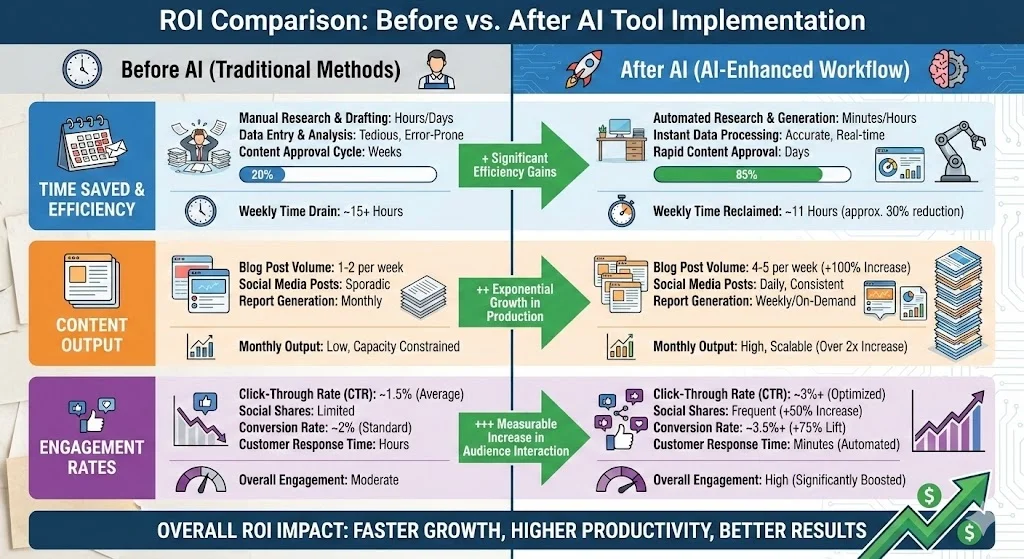
As Forbes notes about AI reshaping marketing teams, the successful teams aren’t necessarily the ones with the biggest budgets—they’re the ones that picked the right combination of tools for their specific problems.
The Bottom Line
Look, I’ll be honest. The AI marketing space still feels like the Wild West sometimes. New tools launch every week and half of them disappear just as quickly.
But the ones that made this list? They’re solving real problems for real businesses. They’re not just shinier versions of what we had before—they’re fundamentally changing how marketing gets done.
The key is starting small. Pick one category that’s your biggest pain point. Maybe it’s content creation because you’re drowning in blog post deadlines. Maybe it’s social media because you can’t keep up with posting schedules.
Start there. Get comfortable. Then expand.
Reddit discussions about AI marketing tools consistently show that the teams getting the best results aren’t using 15 different tools—they’re using 3-4 tools really, really well.
Just remember: AI tools are incredibly powerful, but they’re still tools. They won’t fix bad strategy or replace human creativity. Use them to amplify what you’re already good at, not as a crutch for what you’re not.