Running paid ads for online casinos isn’t like pushing toothpaste or sneakers. You can’t just toss money at Google Ads, slap together some flashy banners, and watch the deposits roll in. The whole game changed when platforms started locking down gambling ads harder than a Vegas vault.
- Why Most Casino PPC Campaigns Tank Before They Launch
- Google’s Certification Gauntlet
- Meta’s Authorization Process
- Ad Formats That Actually Convert
- Keywords That Drive Deposits vs. Keywords That Waste Money
- Budget Reality Check
- Compliance Pitfalls That Get Accounts Banned
- Platform-Specific Tactics
- What Wins in 2025
Operators promoting the best new online casinos need more than flashy creatives—they need platform authorization, compliant landing pages, and targeting that respects both age gates and geographic restrictions. Miss any of these boxes and your ad account gets torched before you see a single click.
The online gambling market is projected to hit $25 billion in 2024, which sounds great until you realize that means every operator and their mother is now fighting for the same eyeballs. Competition drove casino keyword costs through the roof—some UK advertisers saw CPCs hit £180 per click for premium terms. That’s not a typo.
Why Most Casino PPC Campaigns Tank Before They Launch
Most operators fail before their first ad even runs. They skip the boring stuff—certifications, compliance docs, license uploads—and wonder why Meta suspends their account or Google disapproves every ad they submit.
Here’s what kills campaigns:
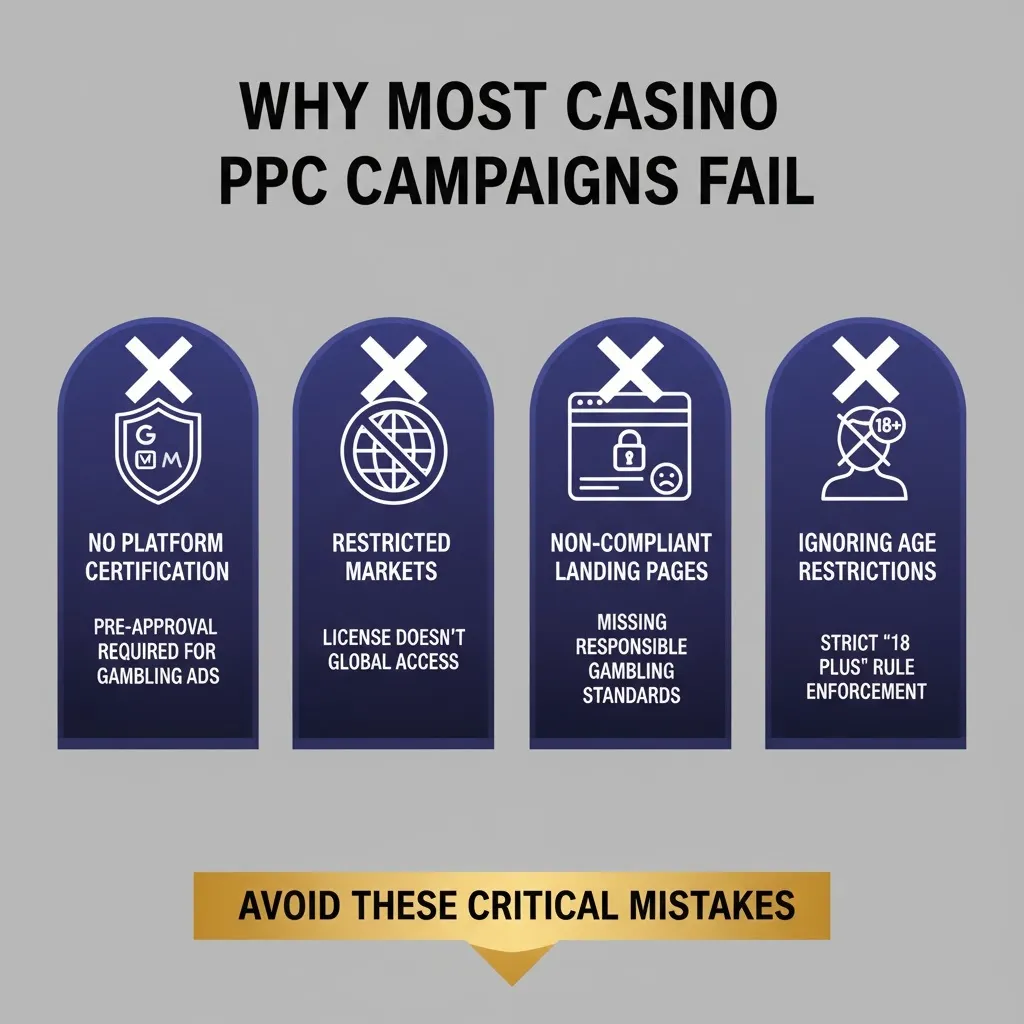
- No platform certification. Both Google and Meta require pre-approval before you can run gambling ads. You can’t backdoor your way in. Google needs your gambling license, business documentation, and proof you’re legally allowed to operate in the countries you’re targeting. Meta’s process is similar but runs through their Business Suite. Skipping this step means your ads never see daylight.
- Targeting restricted markets. You might hold a license in Malta, but that doesn’t mean you can advertise everywhere. Google blocks gambling ads in countries like China, Egypt, Hong Kong, India, Indonesia, and a dozen others. Meta has its own list of unsupported markets that includes similar territories. Try to sneak ads into these regions and you’re looking at account suspension.
- Landing pages that don’t meet responsible gambling standards. Platforms check where your ads lead. If your landing page doesn’t include responsible gambling resources, age verification language, or links to problem gambling help organizations, your ad gets rejected. These aren’t suggestions—they’re requirements baked into platform policies.
- Ignoring the 18+ rule. This one should be obvious, but operators still screw it up. You cannot target anyone under 18. Period. Meta and Google both enforce this hard, and violations trigger immediate account bans. Some jurisdictions require 21+ targeting, so check local laws before you set age parameters.
Google’s Certification Gauntlet
Google runs three types of gambling certifications: one for private operators, one for state-run entities, and one for social casino games. Private operators—which covers most online casinos—need to submit official gambling licenses, business documentation, and the specific website URL they want to advertise.
The certification is tied to that exact URL. You can’t certify example.com and then run ads for different-example.com. Google checks. You also need separate certifications for each country you target. Want to run ads in the UK, Germany, and Spain? That’s three separate applications.
Google tightened things up in November 2024 with new recertification requirements. If anything material changes—your license gets renewed, you add new product offerings, or your regulatory compliance status shifts—you must recertify. Fail to do that and Google considers it a policy violation under their Circumventing Systems policy. That’s code for “we’re nuking your account.”
Material changes include switching from casino-only to sports betting, updating your license, or changing the legal structure of your business. Non-material changes like updating your payment processor or office address don’t trigger recertification.
Process-wise, you fill out Google’s online gambling application form in the Ads Help Center. Include your gambling license documentation, business registration proof, and detailed info about the countries you’re targeting. Google reviews your application, which can take days or weeks depending on how backlogged they are. Once approved, you can start building campaigns, but your ads still go through normal review before they run.
Meta’s Authorization Process
Meta rolled out stricter gambling ad rules in July 2025 to crack down on unlicensed and offshore operators flooding Facebook and Instagram. The new system requires authorization through the Permissions and Verifications tab in Meta Business Suite.
You select your role—operator, affiliate, or aggregator—and upload your gambling license plus proof that you’re legally allowed to operate in your target territories. Authorization is granted to specific ad account IDs, not to your entire business. If you create a new ad account, you go through the process again.
One authorization covers all jurisdictions where you’re licensed, except for Meta’s unsupported markets. That list includes Azerbaijan, Bangladesh, Egypt, Hong Kong, India, Indonesia, Korea, Kyrgyzstan, Malaysia, Mongolia, Myanmar, Pakistan, Philippines, Saudi Arabia, Singapore, Taiwan, Thailand, and Vietnam. Even if you hold a license in one of these countries, you can’t run Meta ads there.
The authorization process also hit influencers and affiliates. If a creator promotes gambling in their content, they need to register as an affiliate and get Meta’s approval before posting sponsored gambling content. Direct operator ads don’t need influencer clearance, but if an influencer is running the ad themselves, they’re on the hook for compliance.
Social casino games—those free-to-play slots and poker apps with no real-money prizes—don’t need authorization. But they still can’t target anyone under 18, and they must include disclaimers that success in social games doesn’t translate to real-money gambling.
Ad Formats That Actually Convert
Casino operators waste money testing formats that don’t match user intent. Not every ad type works in gambling, and the platforms restrict certain options anyway.
- Search ads dominate for high-intent traffic. When someone searches “best online casino bonus” or “no deposit slots,” they’re ready to play. Search ads capture that intent directly. The challenge is cost—casino keywords run expensive because competition is brutal. Terms like “best online casinos” get 5,700 searches monthly in the US with a keyword difficulty of 53. That’s manageable, but broader terms push CPC into the stratosphere.
- Long-tail keywords save your budget. “Best casino in Las Vegas for slots” or “no wager bonus casinos 2025” cost less per click and target users closer to conversion. Generic terms like “casino” or “slots” burn money fast because half the clicks come from people just browsing.
- Display ads work for brand awareness, not direct response. Banner ads on Google’s display network or programmatic buys through platforms like Adelphic put your casino in front of millions. But these clicks rarely convert immediately. Display ads build familiarity so when users eventually search for an online casino, yours comes to mind. Expect lower click-through rates and higher CPAs compared to search.
- Video ads capture attention but require compliance reviews. Video content holds viewer attention longer than static images. YouTube allows gambling ads if you’re Google-certified, but new restrictions rolled out in March 2025 ban any mention or display of non-Google-approved gambling services in videos. That means you can’t reference competitor brands or show their logos in your ad creative, even for comparison purposes.
- Video ads work best for telling a story—showing gameplay, highlighting big wins (with disclaimers), or walking users through your bonus structure. Keep them short. Attention spans are trash, and anything over 30 seconds loses viewers.
- Carousel ads on Meta let you showcase multiple games or promotions in one unit. Each card in the carousel can link to a different landing page, which helps if you’re running multiple offers. These perform well on Instagram and Facebook because users are used to swiping through content. But remember—your ad creative still needs to comply with all responsible gambling requirements.
- Remarketing is dead on Google for gambling. Google specifically blocks remarketing lists and audience targeting for gambling advertisers. You can’t pixel users who visited your site and chase them around the internet with ads. This hurts because remarketing typically delivers the best ROI in most industries. In gambling, you’re stuck with cold traffic acquisition.
Meta allows some retargeting, but it’s limited. You can build custom audiences based on website visits or engagement, but you need to be careful about how you structure these lists. Targeting users who abandoned the signup process with a “come back” bonus offer works. Hammering them with ads every hour doesn’t.
According to a report from VegasSlotsOnline marketing manager, In the early days of online gambling, we relied heavily on SEO, more then Ads, and affiliate banners. Those banner still matter, but they no longer own the spotlight. He also added that Reddit is also a new platform for them and also the searches “” on X (formerly Twitter).
Keywords That Drive Deposits vs. Keywords That Waste Money
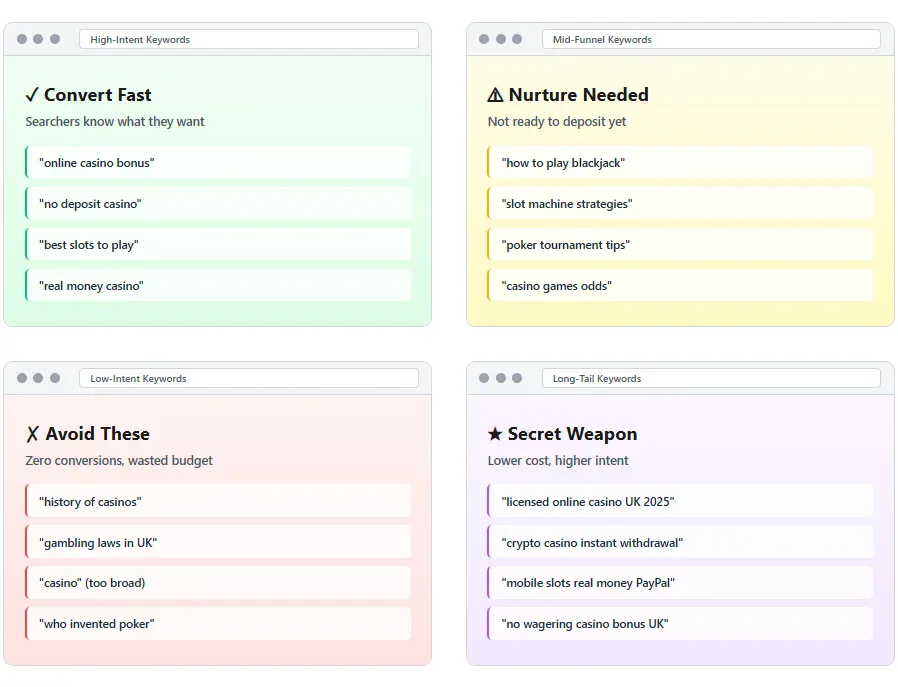
Casino PPC lives and dies on keyword selection. Pick wrong and you’ll burn through your budget with zero deposits to show for it. Pick right and you’ll pull high-intent players who actually convert.
High-intent keywords include “online casino bonus,” “no deposit casino,” “best slots to play,” and anything with “real money” in the search term. These searchers know what they want. They’re comparing options, hunting for promotions, or ready to deposit. CPCs run high—think $10-$50+ depending on the geo—but conversion rates justify the cost.
Around 40% of casino PPC claims come from workers with less than one year of tenure at an employer, which tells you something about the labor market. But it also highlights that PPC in gambling pulls quick conversions. Users don’t spend months researching. They search, click, sign up, and deposit within hours.
- Mid-funnel keywords like “how to play blackjack,” “slot machine strategies,” or “poker tournament tips” attract educational searches. These users aren’t ready to deposit yet. They might convert eventually, but you’re paying for clicks from people still learning. Only bid on these if you have budget to spare and a content strategy that nurtures users from awareness to signup.
- Avoid informational keywords completely. “History of casinos,” “gambling laws in [country],” or “who invented poker” pull zero conversions. These searches come from students doing homework or people killing time. They won’t deposit. Add them as negative keywords immediately.
Negative keywords save more money than most operators realize. If you’re running broad match or phrase match campaigns, Google will show your ads for tangential searches that waste spend. Add terms like “free,” “demo,” “practice,” “fake,” “illegal,” and “for fun” to your negative list. You want real-money players, not people looking for free games.
- Long-tail keywords are your secret weapon. Instead of bidding on “online casino” (expensive, competitive, low intent), go after “licensed online casino UK 2025” or “crypto casino instant withdrawal.” These terms cost less, face less competition, and target users who’ve already narrowed their search.
Keyword research tools like Ahrefs or SEMrush help, but don’t ignore your own search query reports. Google shows you exactly what searches triggered your ads. Mine this data weekly. You’ll find gems you didn’t think to bid on and trash you need to block.
Budget Reality Check
Casino PPC isn’t cheap. If you’re thinking $500/month will move the needle, you’re wrong. Most operators need at least $5,000-$10,000 monthly to compete in established markets like the UK or US states where sports betting is legal.
California’s workers’ comp insurance costs around $1.38-$1.45 per $100 of payroll as of 2024. That’s got nothing to do with casino PPC, but it’s a good reminder that regulated industries always cost more to operate. Gambling ad costs follow the same pattern—regulation, compliance, and competition drive prices up.
Average CPC in casino advertising ranges from $5-$50 depending on the keyword and geo. Premium terms in competitive markets hit triple digits. If your average conversion rate is 2.5% (which is decent for gambling), and your CPC is $20, you’re paying $800 to acquire one depositor. Make sure your customer lifetime value supports that math.
Set realistic CPA targets based on your LTV. If your average player deposits $500 in their first three months and your margin is 30%, you can afford a CPA of around $150 and still be profitable. Push beyond that and you’re bleeding money.
Track performance at the keyword level, not campaign level. Some keywords convert at 5% with a $10 CPC. Others convert at 0.5% with a $40 CPC. Kill the losers fast and double down on winners.
Compliance Pitfalls That Get Accounts Banned
Operators lose accounts not because their ads suck, but because they violate compliance rules they didn’t know existed.
- Trademark violations. You can’t use competitor brand names in your ad copy unless you have permission. Google and Meta will disapprove ads that mention trademarks you don’t own. This includes using “like [Competitor Name]” comparisons or referencing specific casino brands in headlines. Stick to generic terms.
- Misleading bonus claims. If your ad says “100% deposit bonus up to $500,” that language better match what’s on your landing page. Bait-and-switch bonus offers trigger complaints, and platforms take those seriously. Include clear terms or link directly to your promotions page.
- Aggressive language around guaranteed wins. Ads can’t promise users they’ll win money. “Guaranteed jackpot” or “easy money” copy gets flagged. Gambling involves risk, and your ads need to reflect that. Talk about entertainment, game variety, or bonus value—not guaranteed payouts.
- No responsible gambling messaging. Your landing pages must include resources for problem gambling. Links to organizations like BeGambleAware, GamCare, or the National Council on Problem Gambling are non-negotiable. Platforms check for this during ad review.
- Age-restricted targeting failures. If your targeting accidentally includes 17-year-olds because you set minimum age to 18 but forgot to exclude users whose birthdays fall in the next month, you’re violating policy. Be paranoid about age targeting. Set it to 19+ if you want extra cushion.
Platform-Specific Tactics
Google Ads:
- Use exact match keywords for high-intent terms to control spend
- Enable conversion tracking properly or you’re flying blind
- Test ad extensions (sitelinks, callouts) to increase CTR
- Run search campaigns first, display second
- Monitor search query reports weekly and update negative keywords
Meta Ads:
- Leverage Lookalike Audiences (built from pixel data of depositors)
- Test carousel ads with different game screenshots or bonus offers
- Use video ads to showcase gameplay—keep them under 15 seconds
- Target users interested in “online gaming,” “casino games,” or competitor brands
- Schedule ads during peak deposit times (evenings and weekends)
Microsoft Ads:
- Bing’s gambling ad approval is faster than Google’s
- CPCs typically 20-30% lower than Google for similar keywords
- Older demographic skew—target users 35+
- Integration with LinkedIn targeting for higher-income users
What Wins in 2025
The operators cleaning up in casino PPC aren’t the ones with the biggest budgets. They’re the ones who:
- Get certified fast and stay compliant. Platforms prioritize advertisers who follow the rules. Build a compliance checklist and review it monthly.
- Focus on LTV, not just CPA. A $200 CPA looks bad until you realize that player deposits $2,000 over six months. Track cohort behavior and optimize for long-term value.
- Test relentlessly. Ad copy, landing pages, bonus offers, targeting—everything gets tested. Winners scale. Losers get cut.
- Diversify traffic sources. Google and Meta are great, but don’t ignore Bing, programmatic display, or affiliate partnerships. Relying on one channel is risky, especially in an industry where policy changes can kill your ads overnight.
- Mobile-first creative. Over 70% of gambling happens on mobile devices. Your ads and landing pages better load fast and look good on phones, or you’re leaving money on the table.
Running casino PPC in 2025 means playing by stricter rules than ever. But operators who master the compliance game, target the right keywords, and optimize for lifetime value will outspend and outlast the competition. Just don’t expect it to be easy—or cheap.