This analysis comes from working with a Thailand-based e-commerce client. Real data, real experience.
- The Market Nobody’s Talking About
- Market Overview at a Glance
- Mobile Dominates (And We Mean Actually Dominates)
- E-Commerce Competition Table
- Search Behavior Worth Understanding
- Social Media Integration
- Digital Marketing Spend
- Economic Fundamentals
- AI Adoption Shifting the Landscape
- Startup Ecosystem
- What This Means for SEO Investment
The Market Nobody’s Talking About
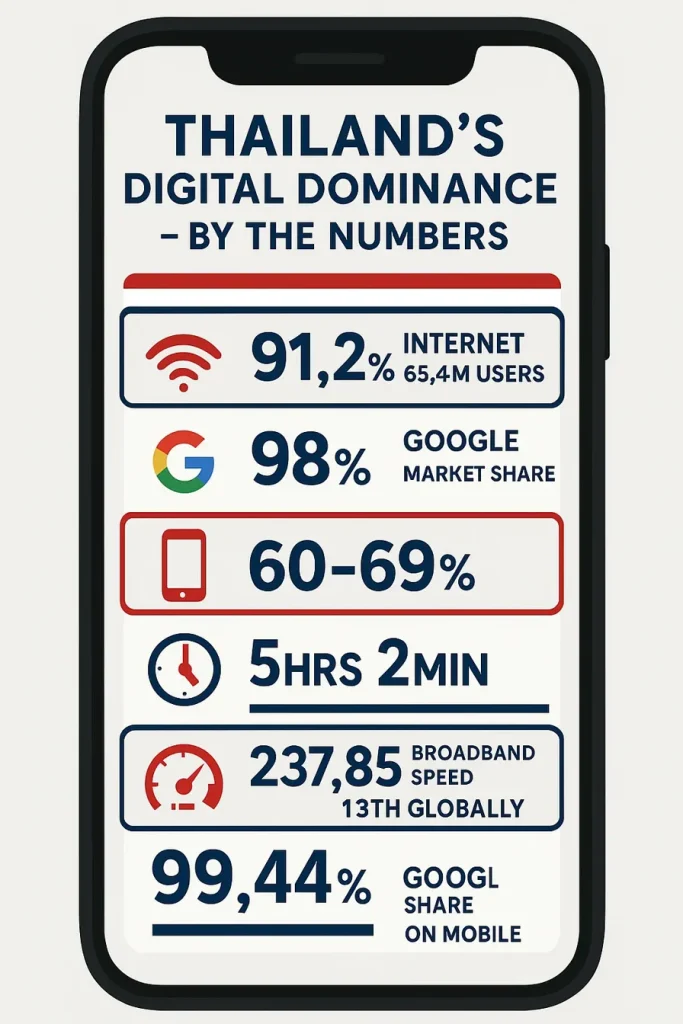
91.2% of Thailand’s 71.6 million people are online. That’s 65.4 million potential customers scrolling, searching, buying. The country ranks 13th globally for broadband speeds at 237.85 Mbps—faster than the United States. Mobile speeds jumped 50.4% in one year to 61.21 Mbps.
Google owns 97.5% of desktop search traffic. On mobile? 99.44%. You’re not doing “search engine optimization” here. You’re doing Google optimization.
Market Overview at a Glance
| Metric | Number | What It Means |
|---|---|---|
| Internet users | 65.4M (91.2%) | Nearly everyone’s online |
| Google market share | 97.5-99.44% | Bing and Yahoo combined get 2% |
| Mobile traffic | 60-69% | Desktop is secondary |
| Smartphone ownership | 98.5% | Laptop ownership: 36% |
| E-commerce market | $26-30B | Growing 14% yearly |
| Active online shoppers | 43.5M | 66.6% buy weekly |
| SMEs operating online | 100% | All 3.2 million of them |
| Digital ad spend | $874M | Up 8% in 2024 |
Language Realities You Can’t Ignore
The most-searched query in Thailand: “แปลภาษา” (translate language). Gets 14.99 million searches monthly. Only 27% of Thais speak English. The country ranks between 97th-101st out of 111 countries for English proficiency.
Thai content outperforms English by 35-40% on engagement. Bilingual content drives 25-40% more organic traffic than English-only pages. But here’s where it gets complicated—40% of searches mix Thai-English keywords. “คาเฟ่ Bangkok” or “ที่พัก near BTS.” Urban searchers blend languages based on context.
Thai script has no spaces between words. It’s tonal. Text runs 15% longer than English for the same meaning. Voice search hit 35% adoption in Bangkok, and conversational Thai queries don’t translate from English keyword strategies. Northern Thai, Southern Thai, Isan dialects create regional variations most foreign SEO teams miss completely.
You can’t translate your English site and call it localization.
Mobile Dominates (And We Mean Actually Dominates)
Daily mobile usage: 5 hours 2 minutes out of 7 hours 58 minutes total internet time. That’s 63% of online life happening on a phone screen. Thailand ranks second globally for mobile usage time.
Mobile connections total 99.5 million for 71.6 million people—139% penetration from multiple SIM cards per person. 5G coverage reached 95%+ of the population by 2024, among Southeast Asia’s fastest rollouts.
Android holds 67.67% market share, iOS at 32.05%. That relatively high iOS percentage reflects Thailand’s growing middle class, but you’re still building for Android-first.
68% of all search activity occurs on mobile devices. Over 80% of online sales happen on mobile, with 65% of transactions in-app.
E-Commerce Competition Table
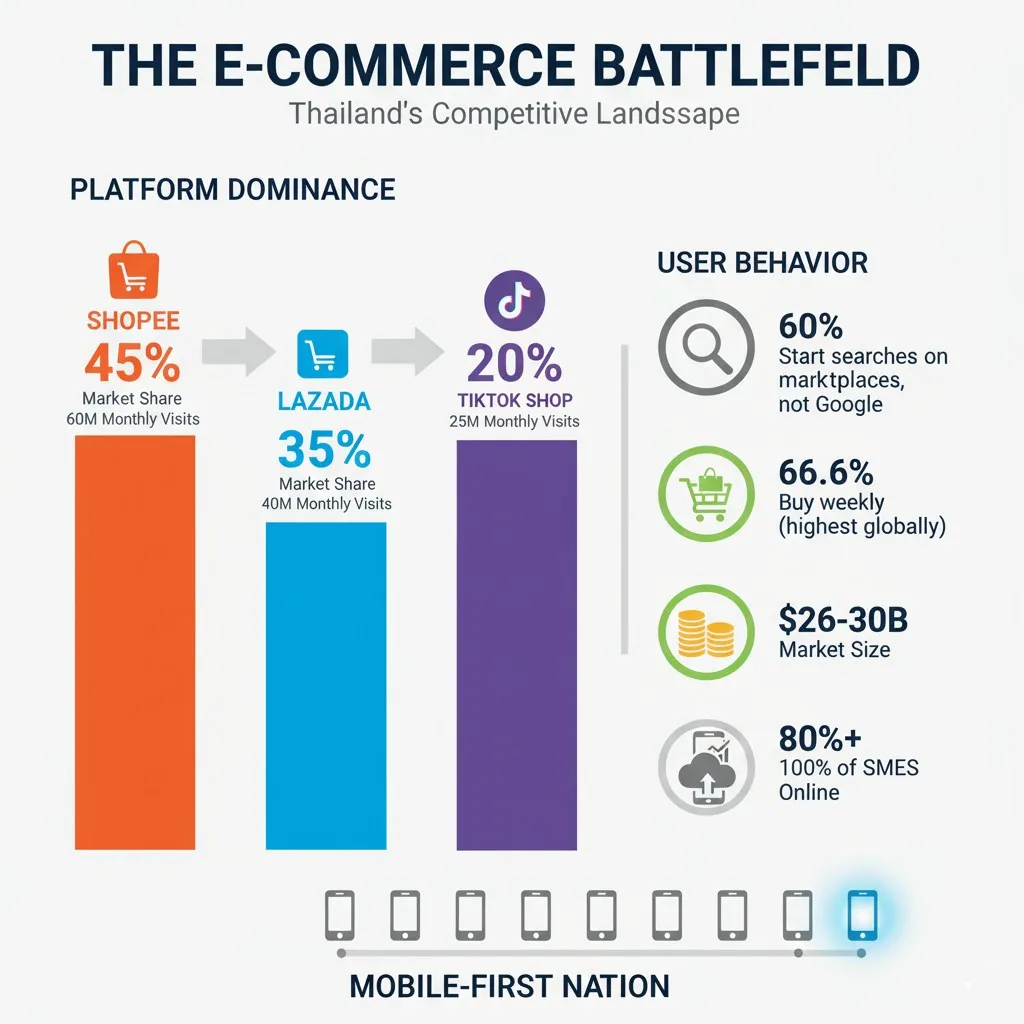
| Platform | Monthly Visits | Market Share | Revenue (2024) |
|---|---|---|---|
| Shopee | ~100M | 75% usage | Combined: 78.255B baht |
| Lazada | 77.41M | 67% usage | (both platforms) |
| TikTok Shop | Growing fast | 51% usage | 16% of ad spend |
Over 60% of Thai online shoppers start product searches on Shopee or Lazada, not Google. But brand awareness and initial discovery still happen through search engines at 54.7%. You need visibility in both Google search results and marketplace algorithms.
Cross-border e-commerce represents 30% of total market. Nearly 50% of online shoppers made cross-border purchases. December 2024 regulatory changes allow products under 1,500 THB to ship directly without import duties or Thai product certification. Domestic merchants just lost their regulatory protection.
Search Behavior Worth Understanding
Search engines serve as primary channel for brand discovery at 54.7%, ahead of mobile apps (48.3%) and social networks (44.4%).
Top searches paint the picture:
- Weather queries: 13+ million combined monthly.
- YouTube, Facebook dominate entertainment.
- Canva gets heavy search volume.
- Shopee alone: 1.83 million searches monthly.
- ChatGPT: 1.57 million monthly searches.
That ChatGPT number matters. It indicates rapid AI adoption among Thai users, though Google maintains its near-monopoly currently.
“Near me” searches in Thai grew 150% year-over-year. Voice search creates different query structures than typed searches—conversational Thai phrasing requires its own optimization approach.
YouTube reaches 47.6 million users (72.8% of internet users), growing 7.7% yearly. Video content frequently appears in Google search results. Video optimization is part of comprehensive SEO strategy here, not a separate channel.
Social Media Integration
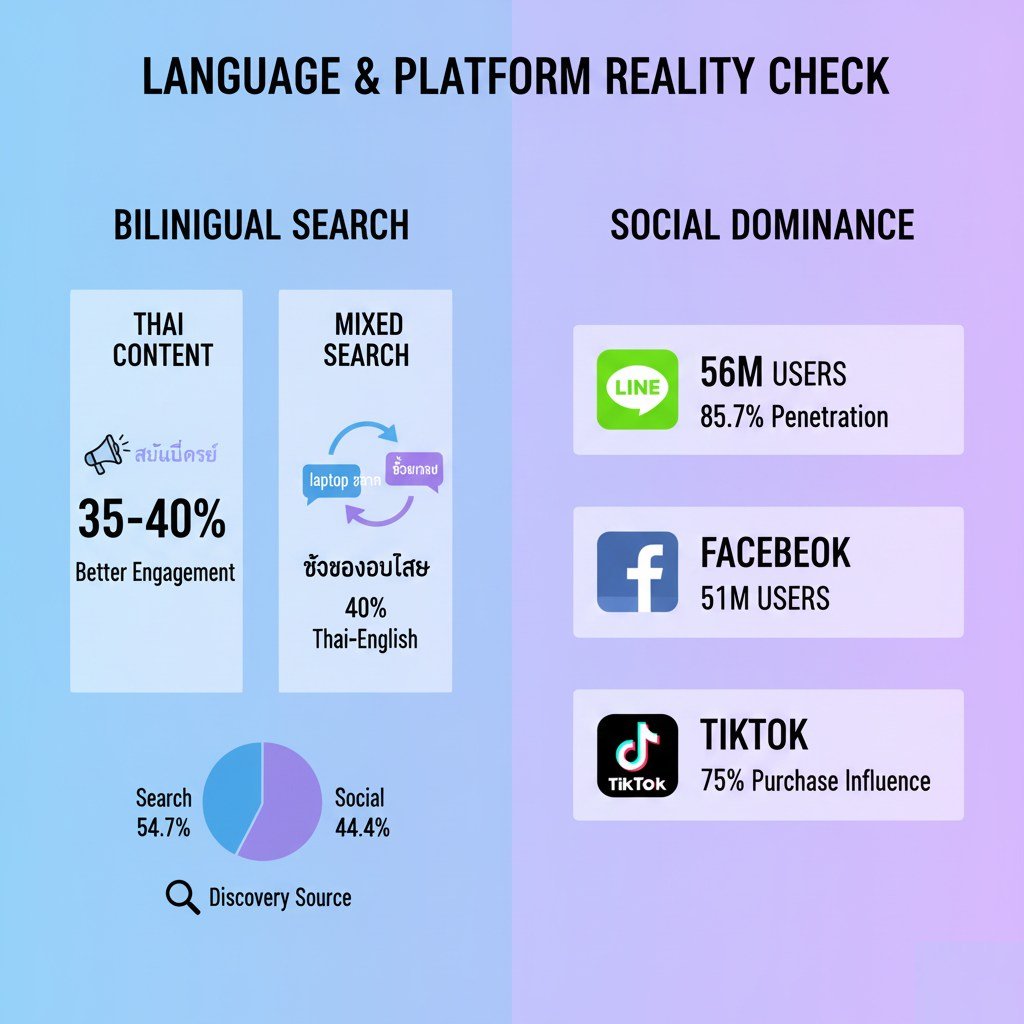
Social media users: 51 million (71.1% of population). Daily usage: 2 hours 35 minutes on social platforms.
Platform Breakdown
- LINE — 56 million monthly active users (78.2% of total population, 85.7% of internet users). LINE isn’t just messaging. It’s LINE Pay for digital payments, LINE Shopping for e-commerce, LINE Official Accounts for business communication, LINE Today for news. Businesses without a LINE Official Account miss the majority of Thai internet users.
- Facebook — 51 million users (71.1% of population). Shows 33.4% user preference rating, highest among social platforms, with 91% penetration among internet users. Facebook Messenger adds 35.9 million users for business-consumer communication.
- TikTok — 75% influence on purchase decisions. Surpasses every other platform. TikTok captured 16% ad market share (5.51 billion baht) in 2024, surpassing YouTube’s 15% to claim second place after Meta’s 26%.
- Instagram — 18.5 million users (25.8% of population), female-skewed audience (58.4%).
- LinkedIn — Fastest growth at 18% year-over-year, reaching 5.9 million members for B2B opportunities.
Search engines lead discovery at 54.7%, but social networks follow at 44.4%. 89% of consumers acknowledge social media influences buying decisions. Customer journeys begin with search discovery, progress through social media research during that 2 hours 35 minutes daily usage, then increasingly convert directly within social platforms.
Digital Marketing Spend
Total digital marketing spend hit 31.5 billion baht ($874 million) in 2024, growing 8% year-over-year. 2025 projections indicate 10% growth to 34.5 billion baht.
Channel Breakdown by Spend
| Channel | Amount | Share | Growth |
|---|---|---|---|
| In-app advertising | $620M | 30.3% | 10.7% |
| Search advertising | $489M | 23.8% | 15.2% |
| Social media advertising | — | 28.8% | — |
Search ad market of $489 million with double-digit growth demonstrates robust demand for paid search visibility. That’s budget flowing through the same platforms where organic visibility matters.
Industries driving digital ad spending: skincare/beauty leads with 6.13 billion baht (21% increase), automotive at 2.98 billion baht, non-alcoholic beverages at 2.5 billion baht. E-commerce advertising surged 59% growth in 2024.
Mobile advertising projected to generate 64% of total digital ad spending by 2028. Programmatic buying will represent 74% of digital advertising revenue by same year.
Economic Fundamentals
Thailand’s GDP grew 2.5-2.7% in 2024 with projections for 2.9% growth in 2025. Digital economy growth of 5.7% in 2024 exceeded overall GDP growth by 2.4x.
Thailand hosts approximately 3.2 million MSMEs representing 99.5% of all firms. These MSMEs contribute 35.3% of GDP and employ 69.5% of the national workforce. 100% of Thai SMEs moved operations online. New business registrations hit 85,300 in 2023.
Digital transformation depth varies though. A Cisco study found 31% of SMEs remain “Digital Indifferent” with minimal transformation efforts, while 51% are “Digital Observers” with tactical rather than strategic digital initiatives. That gap represents both challenge and opportunity for SEO providers who can guide businesses through transformation stages.
Government support includes the National AI Strategy (2022-2027) with approximately $216 million allocated. Thailand 4.0 economic strategy emphasizes innovation-driven economy and digital transformation as core priorities.
Infrastructure investments: 260 billion baht expected in data center investments between 2024-2027. Major cloud providers (Microsoft, Google, Amazon) announced multi-billion dollar investments in Thai digital infrastructure in late 2024.
AI Adoption Shifting the Landscape
ChatGPT usage in Thailand surged with 4x growth in weekly active users over the past year, driven primarily by 18-24 age group. The generative AI market reached $179.50 million in 2024 with projections to hit $1,773 million by 2030—46.48% CAGR.
62% of Thais use generative AI in personal and professional lives. 83% of Thai employees believe AI will transform their jobs, though 27% express concerns about job security. Business adoption lags consumer usage: only 18% of Thai businesses adopted AI while 73% remain in consideration phases.
This creates dynamics for search behavior going forward. AI search tools might fragment Google’s dominance eventually, though no signs of that yet.
Startup Ecosystem
Thailand’s startup ecosystem includes approximately 2,100 ventures and ranks 54th globally, showing 12.7% ecosystem growth year-over-year. Regional positioning: 4th in Southeast Asia behind Singapore, Indonesia, Malaysia.
Total fundraising reached $500+ million in 2024 across 266 deals. Average deal size recovered to $9 million. Funding stages show seed rounds dominating at 73%, Series A at 15.9%, pre-seed at 6.3%.
Fintech leads sector investment with 26% of total seed investments, followed by blockchain technology at 20%. Major 2024 deals included Ascend Money raising $195 million, GuildFi securing $140 million.
Corporate Venture Capital has become increasingly dominant. Major Thai conglomerates including SCG, CP Group, PTT launched venture arms providing strategic value beyond capital through corporate partnerships and market access.
What This Means for SEO Investment
Thailand presents opportunities backed by converging factors: 91.2% internet penetration, 98% Google market share, 54.7% of consumers discovering brands through search, $489 million in search advertising spending growing 15.2% annually.
Market fundamentals are exceptional—13th globally for broadband speeds, mobile-first behavior with 60%+ of traffic, high engagement at 9+ hours daily internet usage. The $26-30 billion e-commerce market growing 14% annually with 43.5 million active consumers and 100% of SMEs operating online generates sustained demand for search visibility.
What Actually Works
- Authentic localization, not English transplants. With only 27% English proficiency and 60% of users preferring native language content that performs 35-40% better than English, Thai language optimization is mandatory. The complexity lies in mixed-language queries (40% of searches) requiring bilingual sophistication.
- Mobile optimization as primary focus. 60-69% of web traffic, 68% of search activity, 98.5% smartphone ownership, 5+ hours daily mobile usage. Websites must deliver exceptional mobile experiences with fast loading on mobile networks.
- Platform strategy integrating search and social. Search engines lead discovery at 54.7% but social media closely follows at 44.4%, with 89% of consumers influenced by social media for purchases. LINE is essential with 56 million users (85.7% of internet users).
- Local market knowledge proves critical. Shopee and Lazada control 79-84% of e-commerce with 100+ million monthly visits between them, meaning marketplace optimization matters as much as Google SEO for product sales.
The market is large, growing, digitally sophisticated, and underpenetrated by international SEO expertise. The government’s commitment to reaching 30% digital economy contribution to GDP by 2030, combined with the digital sector growing at 2-3x overall GDP rates, suggests this opportunity will strengthen over the next 3-5 years.
Thailand offers exceptional SEO opportunities, but only for those willing to understand Thai language, culture, consumer behavior, and platform preferences rather than applying generic international playbooks.