Online trust is no longer optional. It’s a part of what determines whether a business appears in search results, receives clicks, or converts visitors into customers.
- Presence with a Physical Address & Contact Info
- Google My Business Integration
- On-Site and Off-Site Product Reviews
- Social Media Signals Recognition
- What Google Looks for Beyond The Above Ones?
- Additional Trust Factors That Influence Rankings
- The Importance of Consistency Across the Web
- Frequently Asked Questions
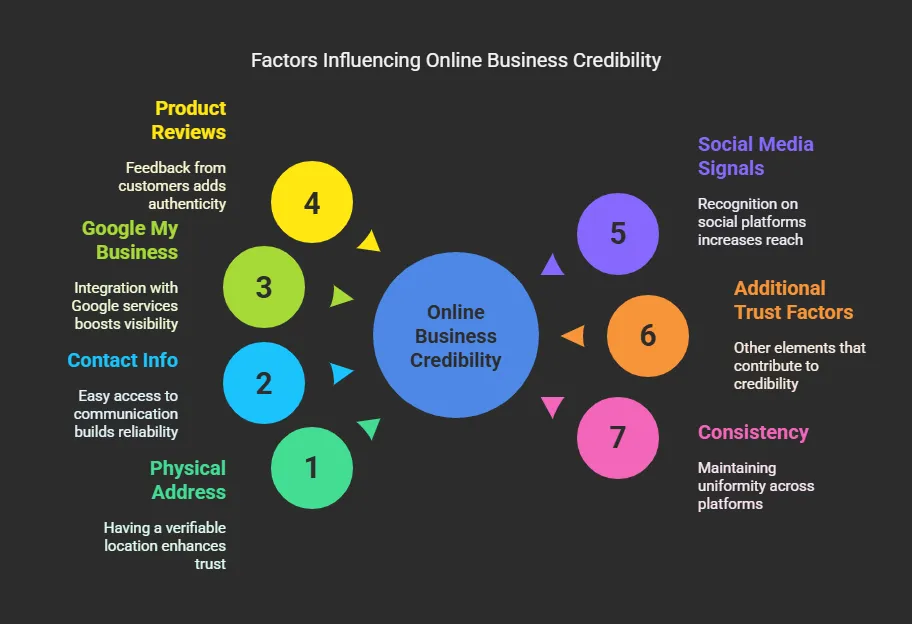
When Google assesses the credibility of a business, it doesn’t rely on just one factor. Instead, it evaluates a combination of signals that paint a picture of how real, trustworthy, and consistent a brand appears across the web.
I’m not talking about backlinks here – if this was about backlinks, they’d be sitting at the top of this list as the father of all credibility signals. But Google’s gotten way smarter about spotting real businesses versus fly-by-night operations, and they’re using signals that most business owners completely ignore.
These credibility factors work behind the scenes to determine whether Google trusts your business enough to show it to searchers. Miss these signals, and your SEO efforts hit a ceiling no amount of keyword optimization can break through.
But this isn’t just about pleasing search engines. Real users also notice when a brand lacks authenticity, and that can lead to lower engagement and reduced conversions.
Presence with a Physical Address & Contact Info
Google’s algorithm assumes that legitimate businesses exist in the real world, not just online. When you display complete contact information – physical address, phone number, business hours – you’re essentially proving you’re not running a scam operation from your bedroom.
Here’s Google’s backend thinking process:
- Verification through multiple touchpoints: Google cross-references your address with postal databases, phone directories, and local business registrations.
- Consistency checking across platforms: They compare your address on your website against your Google Business Profile, social media accounts, and citation sources.
- Local search integration: Physical addresses help Google understand your service area and show your business for location-based searches.
- Trust through transparency: Businesses that hide their location trigger Google’s scam detection algorithms.
Google knows that fake businesses avoid providing real addresses because they can’t handle the legal accountability. Real businesses proudly display their location because they have nothing to hide.
One effective workaround is using a virtual mailbox. According to The Farm Soho, businesses offering virtual mailboxes and business address services can help you secure a professional, U.S.-based address. This gives your business a physical footprint that satisfies both algorithmic and human expectations.
This can also help you comply with business registration regulations. As stated on the Small Business Administration website, an address is required to register many types of corporations in the US. You can leverage the services of virtual mailbox providers to get a business address in the USA.
This can also help you manage mail, receive packages, and handle legal documents, all without needing to be physically present. This kind of service is particularly useful for small teams and independent professionals who need to build credibility quickly.
Google My Business Integration
Google My Business isn’t just a listing – it’s Google’s direct pipeline into your business credibility. Since Google owns this platform, they trust GMB data more than information on your website, which you could easily fake.
Google uses GMB as their ground truth:
- They compare user-uploaded photos against business-uploaded photos to spot inconsistencies.
- They analyze review patterns and reviewer profiles to identify fake reviews.
- Regular posts and photo updates signal an active, legitimate business.
- How quickly you respond to questions affects your credibility score.
When your GMB profile stays active and authentic, Google treats your entire online presence as more trustworthy.
On-Site and Off-Site Product Reviews
Google doesn’t trust the reviews on your website nearly as much as reviews on third-party platforms. You control your website reviews – you can delete bad ones or write fake good ones. Third-party review sites don’t give you that control.
Google now shows review panels pulling data from Trustpilot, Better Business Bureau, Scamadviser, and other independent platforms. They’re saying “we don’t trust what you say about yourself, but we trust what others say about you.”
Google’s review evaluation:
- They compare reviews across multiple sites to spot fake patterns.
- They check if reviewers have legitimate profiles and review histories.
- Detailed, specific reviews carry more weight than generic comments.
- How you respond to negative reviews signals professionalism.
Businesses with consistently good third-party reviews get more trust than those with perfect on-site reviews but terrible external ratings.
Social Media Signals Recognition
Google absolutely understands and processes social media signals. Your social media presence provides real-time credibility data that’s harder to fake than website content.
Google’s social signal processing:
- Established accounts with consistent posting patterns signal legitimate businesses.
- They can detect fake followers and engagement, so buying metrics backfires.
- Your business information should match across all platforms and your website.
- Photos, tags, and mentions from real customers provide credibility signals.
- Meaningful conversations show active customer relationships.
Google connects these social signals through consistent business information and links back to your website. They’re building a picture of your business’s real-world presence and customer relationships.
The algorithm figures that legitimate businesses have authentic social media because they serve real customers who naturally engage and share. Fake businesses struggle to maintain convincing social activity over time.
What Google Looks for Beyond The Above Ones?
While having accurate know about signals is bit impossible, as Google examines a wider set of trust signals to evaluate whether a business should be taken seriously.
A clear privacy policy, terms and conditions, a secure (HTTPS) connection, and a responsive website all contribute to this picture. These are the kinds of elements that show your site is not only well-maintained but also committed to user safety and transparency.
Trustworthiness also extends to how your brand interacts with the digital world. Are you mentioned by other reputable websites as a recommendation?
Remember paid recommendations are often catched by Google, Go for real backlinks instead of generating paid links on low-domain authority websites. According to Search Engine Land, Google’s March 2024 update impacted websites that practiced paid backlink building. Therefore, websites should focus on outreach efforts, strategic content creation, and relationship building.
Google sees these as supporting evidence that your business is legitimate. Even something as simple as having a custom domain email address instead of a generic one can affect the perception of professionalism and authenticity.
Additional Trust Factors That Influence Rankings
Google is one of the most used search engines. According to a BrightLocal survey, the top three platforms to research businesses are Google, Google Maps, and a business’s own website. Moreover, around 62% of consumers won’t do business with a company having incorrect information online.
This survey indicates the importance of building trust through various other factors except contact details.
Beyond what Google sees directly, user behavior plays a growing role in how your credibility is judged. High bounce rates and low engagement can indicate that people don’t trust or value what they see on your site. On the other hand, longer visits, more page views, and frequent return traffic suggest that your business is seen as trustworthy and helpful.
Social proof also matters. Positive reviews on Google Business Profile, Yelp, and industry-specific directories signal that others have had good experiences with your brand. The quality and tone of those reviews can influence both search performance and customer behavior. Responding to feedback, especially negative reviews, demonstrates accountability, which further improves perception.
The Importance of Consistency Across the Web
Consistency is one of the most reliable ways to build trust online. This applies to everything from your business name and logo to your phone number and address. Google looks for uniformity in your business’s information across various platforms, such as your:
- Website
- Social media pages
- Online directories
- Third-party review sites
If your contact details vary from one listing to another, it can cause confusion, not just for users but also for search engines.
This issue becomes more complex for businesses that operate from outside the United States but aim to serve a U.S.-based audience. In these situations, inconsistencies are more likely to occur, especially when there’s no physical presence in the country.
Search engines use location-based data to determine whether a business is relevant to local searchers. Without consistent and location-appropriate details, your chances of appearing in local search results drop significantly.
Frequently Asked Questions
Yes, outdated design can create a negative impression and lead to higher bounce rates. If visitors feel your site looks old or isn’t mobile-friendly, they may leave quickly, signaling to Google that your site isn’t providing value. A modern, responsive design improves usability and reflects that your business is active and professional.
Google pays attention to how accessible and helpful a business appears. Clearly displaying support channels like chat, email, or phone contact can increase user trust and reduce friction. It also suggests your business is legitimate and prepared to assist customers, which supports overall credibility.
If managed well, yes. A moderated comment section can encourage community engagement and show that your content attracts real interest. However, neglecting these areas or allowing spam comments can hurt your image. Google may also see unmoderated comments as a sign of poor site quality.
In short, credibility is multi-layered. And Google uses these layers to decide who rises in the rankings and who gets left behind. Brands that invest in the right credibility signals, starting with a real, trustworthy presence, often see stronger long-term results. Even small tweaks, like adding a proper business address, can make a difference in how users and algorithms respond to your brand.