We all learned the same thing years ago—two types of links exist in SEO: nofollow and dofollow. Dofollow passes PageRank, nofollow doesn’t. Simple, right? Well, things have changed a lot now like these days now I hear people claiming backlinks don’t work anymore. I wonder what makes them think that.
If the SEO ecosystem is a car, backlinks are the fuel that makes it move.
Here’s my counter: Pick any transactional or informational search term. Look at the first page. In cases where AI Overviews don’t appear, you’re seeing maybe 6-10 organic results (excluding videos or image pack). Now imagine you just published a page covering 100% of the topic in terms of quality content, images, etc. Perfect information architecture, better than competitors, answers every question. That page would still rank at position 6.
Now tell me—what do you do to move up?
Obviously, you need links. You might argue with me: “Create more related posts and give internal links” or “Link from your homepage.” But what are those? Links. Internal links are still links. And again what if internal links done then obviously you got the card of backlinks.
To move from position 6 to 3, 2, or 1, you need to put in effort. When you’re competing against established sites, backlinks move the needle. That’s the reality.
Content became a basic commodity the moment AI could generate it. What separates ranking positions now? Links. Off page or On Page but the links. Not random spam links—relevant, powerful, authority links from sites that matter.
How Links Have Evolved with the Internet
The internet evolved. Links evolved with it.
I’m not talking about the dofollow/nofollow distinction anymore. I’m describing how different types of links actually work now versus how they worked five years ago. The value, the impact, the algorithmic treatment—all of it shifted.
Google’s relationship with different link sources changed dramatically. Forum links that used to trigger manual penalties now rank page one. Guest posts that worked regardless of quality now only work when they’re genuinely good. Social links that barely registered now appear in branded search results alongside your website.
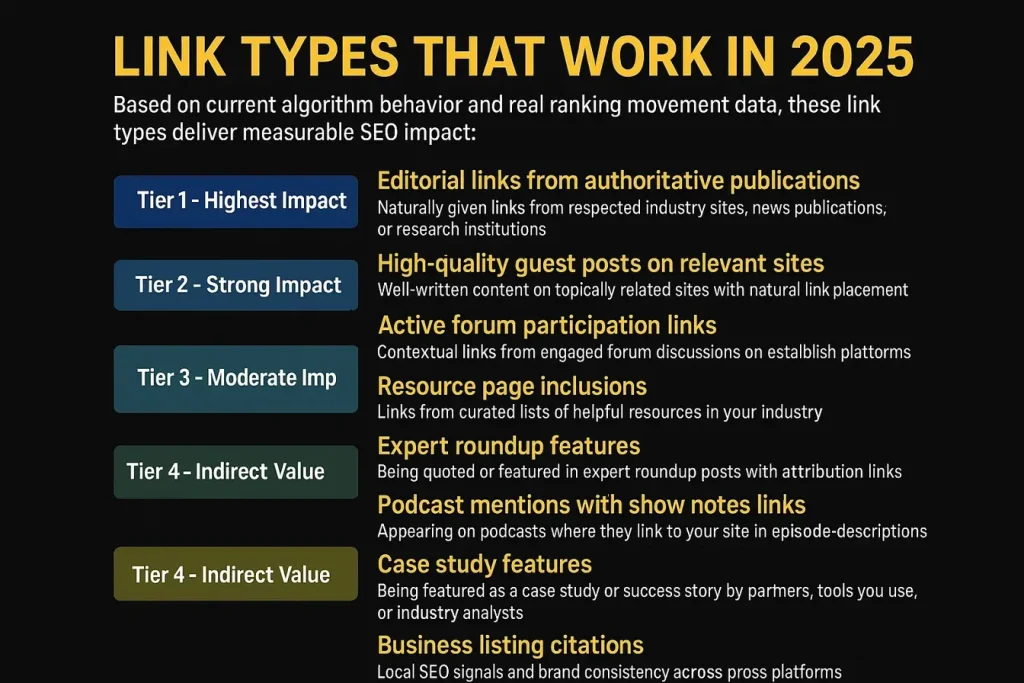
The types of backlinks that matter in 2025 aren’t the same ones that mattered in 2020 or below. Understanding which ones actually move rankings—and which ones waste your time—determines whether your link building works.
Blog Backlinks / Editorial Links
I personally think if a link is given naturally from a publication, blog, or website to research done by your company, a study you published, or a quote from your expert—that’s the most powerful link type that exists.
Why editorial links dominate:
When a journalist or blogger links to you without being asked, it’s because your content provided value they couldn’t find elsewhere. That signal tells Google: “This resource is worth referencing. People in this industry recognize it as authoritative.”
Editorial links come from:
- News articles citing your research or data
- Industry publications referencing your expert commentary
- Bloggers linking to your comprehensive guides as sources
- Academic papers or case studies mentioning your work
- Journalists quoting your executives in their reporting
What makes them work:
These links appear within relevant, contextual content. The author chose to link because it strengthened their own article. The anchor text is natural—often your brand name or the title of your research. The surrounding content relates to your topic. Every signal screams “legitimate reference.”
Google’s algorithm can distinguish between a link earned through quality and a link placed through outreach. Editorial links pass the most authority because they’re editorially given, not requested.
How to earn them:
Create research worth citing. Original data, industry surveys, unique case studies, expert analysis that doesn’t exist elsewhere. When you publish something genuinely new or comprehensive, journalists and bloggers need it for their own content.
Monitor brand mentions without links using tools like Ahrefs or Mention. When someone references your research but doesn’t link, reach out politely: “Thanks for mentioning our study on [topic]. We noticed the reference—would you mind adding a link so readers can see the full data?”
Build relationships with journalists in your industry before you need coverage. Follow them, share their work, provide expert commentary when they ask for sources. When you launch something noteworthy, they’ll remember you.
Publish original research consistently. One-off studies get temporary links. Regular research programs build lasting editorial relationships and continuous link growth.
Guest Posts (When Done Right)
I don’t think guest posts work if the content is written purely for backlink purposes or you just threw your target keyword into spammy anchor text. But if the guest post is niche-related, published on a relevant blog, and the link is added organically within valuable content? That works 100% and remains powerful.
You might ask: “What’s different? These tactics are old. What’s new?”
What changed:
Earlier, guest posts benefited you even with spam content. Throw up a 500-word article with exact-match anchor text, get your link, move on. Those days ended. Based on my research and experience, spam guest posts don’t work anymore, instead they tank you — only quality ones give the benefit. That’s the difference.
Google’s algorithm evaluates guest posts differently now:
- Content quality matters significantly
- Topical relevance between the guest post and the linking domain matters
- Over-optimized anchor text triggers filters
- Author credibility and consistency across publications matters
- Link placement within genuinely helpful content versus obvious link insertion
What works in 2025:
Write guest posts that would perform well even without your link. Provide unique value to the host site’s audience. Your expertise should shine through—readers should want to check out your site because you clearly know what you’re talking about, not because you stuffed a keyword link.
The link should fit naturally within the content. If you’re writing about conversion optimization and mention A/B testing tools, linking to your A/B testing guide makes sense. Forcing a link to your “best SEO services in Chicago” page in an article about email marketing? Obvious and ineffective.
Guest posting strategy that actually works:
Target sites your ideal customers read, not just sites with high Domain Authority. If you are a SEO agency willing to rank for SEO service keywords search SEO guest post website. For example link from a SEO niche publication with seo and digital marketing readers in your industry beats a link from a general marketing blog with DR 70 that nobody in your space reads.
Sites Publishing daily, weekly, or monthly builds genuine authority association. Readers start recognizing you as a regular contributor, which builds topical authority signals.
Use natural anchor text. Your brand name, “this guide,” “research shows,” or descriptive phrases like “comprehensive analysis of user behavior” work better than exact-match keywords. Save exact-match anchors for when they genuinely fit the sentence structure.
Create content the host site’s audience actually needs. Study their existing content, read comments, check what performs well. Fill gaps they haven’t covered or provide deeper analysis on topics they’ve touched lightly.
Thanks to Suzanne Harrison from AI Rank tracker tool for confirming this with her experience.
UGC Links from Forums (The Surprise Winner)
This evolved dramatically. Forum links used to cause manual link spam penalties or algorithm demotions. But Google’s relationship with forums completely changed, and I’d rank this as a top-tier link source now.
You see random forums ranking in position 1-3, even outranking niche expert sites. I wonder what’s happening. People asking questions but not even getting answers. I don’t know if this is slightly off-topic, but it’s crazy—users searching for solutions and Google ranks pages where other people ask the same question instead of ranking actual solutions from expert bloggers or professionals.
The chain looks like this: You have a question. You visit a page to read… the same question you just typed. No answer. Just discussions.
I searched “how to create a custom sitemap for 10000+ URLs manually” because I wanted a trick or easy method to do this without paid tools.
What ranked?
AI Overview says:
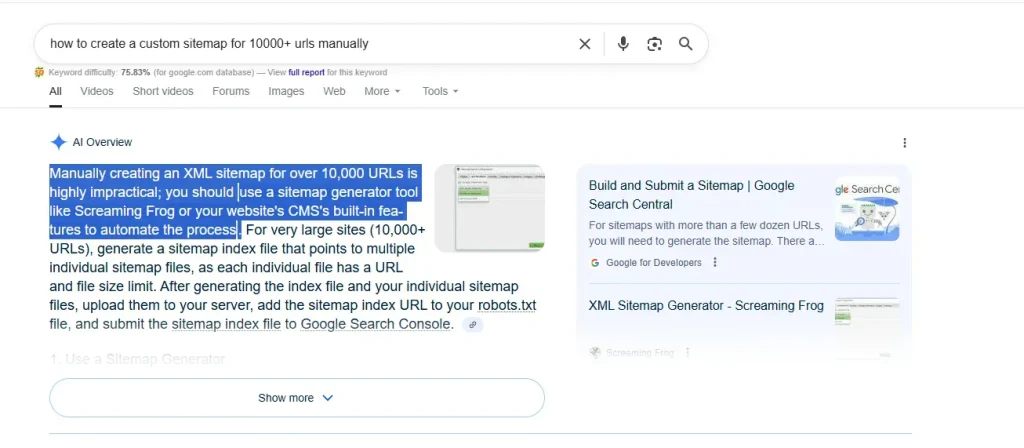
“Manually creating an XML sitemap for over 10,000 URLs is highly impractical; you should use a sitemap generator tool like Screaming Frog or your website’s CMS’s built-in features to automate the process.”
Then
- https://moz.com/community/q/topic/9645/sitemap-for-dynamic-website-with-over-10-000-pages
- https://developers.google.com/search/docs/crawling-indexing/sitemaps/build-sitemap#:~:text=For%20sitemaps%20with%20more%20than%20a%20few%20dozen%20URLs%2C%20you,of%20third%2Dparty%20sitemap%20generators.
- https://stackoverflow.com/questions/11382458/how-to-create-a-sitemap-for-growing-site-that-potentially-will-have-huge-amount
Moz community thread where someone asks the question—but where’s the actual trick?
Then Google’s own documentation that explains XML sitemap structure but doesn’t give me the shortcut I’m looking for.
Or what sense of Stackoverflow was this, it was one question only which was not even answering or having mine question.
I know this went off-topic, but it connects to why forum links matter. These forums rank first position. Getting backlinks from threads discussing topics related to your service or tool means visitors who need solutions find you. If your website provided that tool, method, or service, you’d get visits and conversions.
Why forum links work now:
Google wants diverse content types in results. Forums provide “real people discussing real problems” signals that algorithm updates prioritize. Reddit, Quora, niche industry forums—they all rank higher than they did three years ago.
Forum links pass authority when:
- The forum has genuine engagement and active discussions
- Your link answers a specific question or solves a problem mentioned in the thread
- You’re a regular contributor, not someone who showed up to drop a link
- The context is relevant—linking to your SaaS tool in a thread asking “what tools solve [problem]” works; dropping your link in unrelated threads doesn’t
How to build forum links effectively:
Join forums where your target customers actually hang out. Don’t spam links. Contribute genuinely for weeks before ever linking to your own content. Build a reputation as someone helpful.
When someone asks a question your content answers perfectly, share the link with context: “I wrote a detailed guide on this exact process—[link]. The section on [specific thing they asked about] should help.”
Create content specifically to answer common forum questions. If you see the same question appearing repeatedly across forums, write the definitive answer on your site, then share it when that question comes up again.
Focus on established forums with real traffic, not new forums created for SEO purposes. Reddit, industry-specific forums that have existed for years, professional communities—these matter. Random forum profiles created last month don’t.
Social Links (The Visibility Multipliers)
Earlier, Google scraping social media and indexing those profiles had limited SEO value. That evolved significantly.
Search for any brand name now. You’ll see their X/Twitter profile, TikTok posts, LinkedIn company page ranking alongside their website. I’m not talking about direct dofollow link value here. Social links function as voters or supporters that help your brand visibility in the top 10 results.
Someone searches for your brand or even searches via AI—what appears? Your website, then a list of your social profiles. Direct benefit to your branding. Even if someone searches looking for reputation information or criticism, your owned social profiles help control the narrative.
What social signals actually do:
They don’t pass PageRank like traditional backlinks. But they contribute to:
- Brand entity recognition in Google’s Knowledge Graph
- SERP real estate control for branded searches
- Social proof signals that influence click-through rates
- Traffic sources that can lead to natural backlink acquisition
- Content distribution that gets your material in front of link-worthy audiences
Social link strategy for SEO:
Maintain active, consistent profiles on platforms your audience uses. You don’t need every platform—focus where your customers actually spend time.
Link to your content from social posts regularly. These links drive traffic, and that traffic signals content quality. High engagement on social shares can lead to people discovering your content and linking to it from their own sites or blogs.
Build your social following genuinely. Larger, engaged audiences mean your content reaches more people who might link to it. The indirect link acquisition from social distribution matters more than any direct SEO value from the social links themselves.
Optimize your social profiles completely. Full descriptions, links to your website, consistent branding across platforms. When these profiles rank for your brand name, they should present professional, trustworthy information.
Use social listening to find link opportunities. When people discuss topics you’ve covered, share your content. Some of those shares convert to editorial links when bloggers or journalists discover your material.
The Reality Check
Links still work. They work differently than they did five years ago, but they remain fundamental to ranking. Google’s entire original algorithm was built on link analysis, and while hundreds of other factors exist now, links continue carrying significant weight.
Content quality is table stakes—you need excellent content to compete at all. But excellent content without links sits at position 6, not position 1. You need both.
Focus on link types that deliver actual value: editorial links from quality publications, well-executed guest posts, genuine forum contributions, and social profile optimization for brand visibility. Avoid spam tactics that waste time or risk penalties.
The goal isn’t building links—it’s building authority. Links are how Google measures authority, but the substance matters more than the count. Ten relevant, authoritative links outperform 100 random directory listings.
Build links consistently, diversely, and naturally over time. That’s what moves the needle from position 6 to position 1.