You’ve probably heard the term “KPIs” thrown around in every marketing meeting. When it comes to influencer marketing, these Key Performance Indicators are your north star – they tell you whether that investment in that fitness influencer or beauty guru was worth every penny.
- When to Prioritize Different KPIs in Influencer Marketing
- Reach: Perfect for Brand Awareness Campaigns
- Engagement: Essential for Community Building & Product Feedback
- Click-Through Rate (CTR): The Bridge Between Interest and Action
- Conversions / Sales: The Ultimate Proof of Influencer ROI
- Brand Mentions / Awareness: Beyond Basic Reach
- Follower Growth: The Most Direct Measure of Audience Expansion
- Cost Per Result (CPR): Demystifying Efficiency Metrics
- Sentiment Analysis: Measuring the Emotional Impact of Influencer Content
- Bringing It All Together: The Strategic KPI Approach
I’ve run dozens of influencer campaigns, and I’ve learned that while tracking everything feels safe, it’s usually just overwhelming. Let me walk you through what KPIs actually matter and why some deserve more attention than others.
What Are Influencer Marketing KPIs (And Why They Matter)
Influencer marketing KPIs are specific metrics that help measure campaign performance against your objectives. Think of them as your campaign’s report card.
For example, when NUUN Hydration partnered with marathon runners on Instagram, they didn’t just want pretty photos. They specifically tracked how many followers clicked through to their website and ultimately purchased using influencer-specific discount codes. This allowed them to attribute over $250,000 in sales directly to their influencer program.
Let’s quickly review the most commonly tracked metrics:
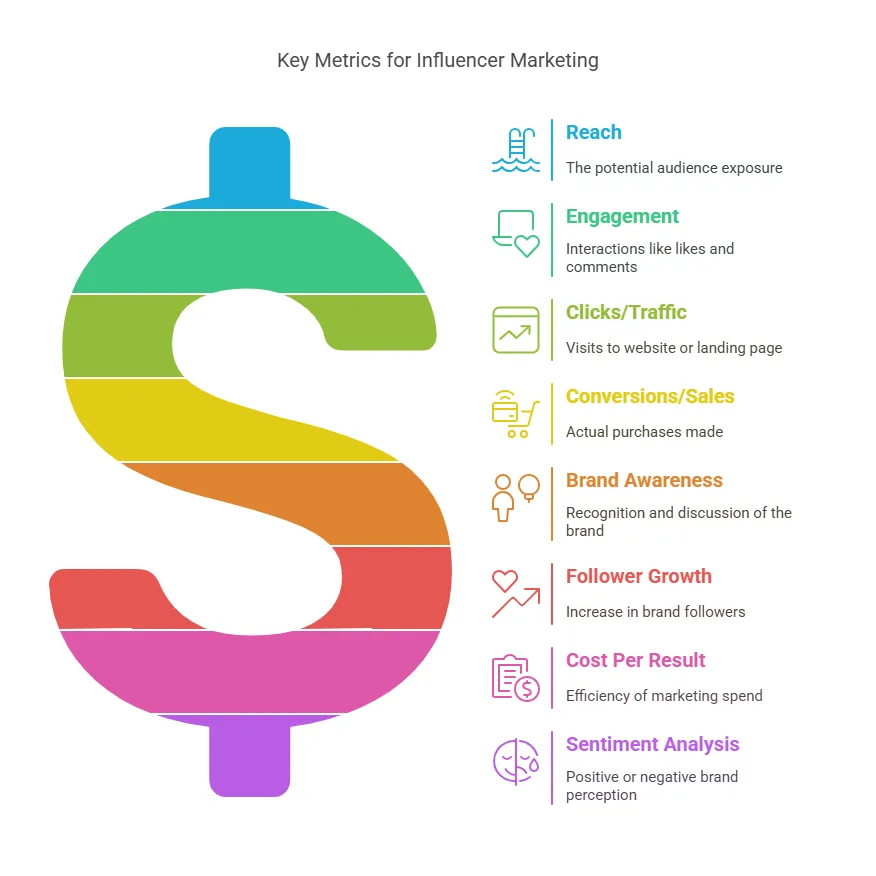
- Reach: How many eyeballs potentially saw your content through the influencer. When that travel influencer posts about your hotel from a stunning infinity pool, are 5,000 or 500,000 people seeing it?
- Engagement: The likes, comments, shares, and saves your influencer content receives. This shows if people actually cared enough to take action, not just scroll past.
- Clicks/Traffic: The number of people who were interested enough to visit your website or landing page after seeing the influencer content.
- Conversions/Sales: The holy grail – people who actually pulled out their credit cards after seeing that influencer unbox your product.
- Brand Awareness: The increase in people talking about your brand or recognizing it after your influencer campaign.
- Follower Growth: How many new followers your brand gained directly from the influencer’s audience.
- Cost Per Result: How efficiently you’re spending your marketing budget across different influencers and campaigns.
- Sentiment Analysis: How positively (or negatively) people are responding to your brand through the influencer partnership. + Qualitative feedback: Are the influencer’s posts on-brand, authentic, and well-received?
When to Prioritize Different KPIs in Influencer Marketing
Reach: Perfect for Brand Awareness Campaigns
Reach becomes your priority KPI when you’re launching a new product or entering a new market. I learned this firsthand when working with a skincare startup that was virtually unknown. We partnered with three mid-tier beauty influencers, and while their engagement wasn’t spectacular, their combined reach of 1.2 million viewers introduced the brand to an entirely new audience.
The Digital Marketing Institute emphasizes reach as a primary KPI specifically for evaluating the visibility of influencer content in brand awareness campaigns. When your primary goal is getting your name out there, reach trumps all other metrics.
Take Casper mattresses’ early influencer strategy. They focused almost exclusively on reach with podcasters who had massive audiences but didn’t obsess over conversion tracking initially. Their goal was simple: make Casper a household name first, worry about direct sales attribution later.
A 2025 Influencer Marketing Hub Report surveying 800 industry professionals confirmed that reach and impressions remain key metrics for brand awareness campaigns. These metrics are often included in influencer media kits to set campaign expectations.
Would tracking conversions or engagement have been wrong here? Not wrong, but premature. When nobody knows who you are, measuring purchases puts the cart before the horse. Build awareness first, measure purchase intent later.
Engagement: Essential for Community Building & Product Feedback
I prioritize engagement metrics when I need to build a community around my brand or gather authentic product feedback. This KPI shines when you want quality over quantity in your audience interactions.
A systematic review of 43 scholarly articles published in the Journal of Consumer Research (Aldlimi, 2025) found that engagement metrics like comments, shares, and saves are core indicators of influencer effectiveness. High engagement reflects genuine audience connection that goes beyond passive viewing.
When my client, a plant-based protein brand, needed to understand how consumers would react to their new formulation, we prioritized engagement over reach. We partnered with fitness micro-influencers who had smaller but highly interactive audiences. Their followers asked detailed questions about ingredients, taste, and mixability—providing invaluable product feedback through comments that guided our final formulation.
Reports indicate that 68% of marketers track engagement metrics to measure campaign effectiveness according to a Q3 2023 Pulse Survey. This approach works especially well for brands building communities rather than just seeking one-time purchases.
Think of Glossier—their influencer strategy has always emphasized engagement over immediate conversions. By tracking comments and creating dialogues with consumers, they’ve built a cult-like following that provides continuous product feedback.
In situations where loyal community matters more than massive awareness, engagement becomes your north star KPI.
Click-Through Rate (CTR): The Bridge Between Interest and Action
Click-Through Rate becomes the priority KPI when your influencer campaign aims to drive specific actions beyond the social platform itself. AdParlor identifies CTR as a vital KPI specifically for measuring the percentage of impressions that resulted in clicks.
Consider the case of Ritual vitamins, which partnered with health and wellness influencers during their launch. While their posts generated impressive engagement (likes and comments), the campaign’s success hinged on whether followers actually clicked through to learn about the science behind the product. With a CTR of 4.2% (well above the industry average of 1-2%), Ritual could confirm that curiosity was translating into investigative action, even before measuring final conversions.
Later.com (2025) explains CTR as a key KPI for tracking traffic, providing a formula (CTR = clicks / impressions × 100) and noting its importance in assessing how well influencer content drives users to a brand’s site. This matters tremendously when your objective is education-first marketing.
What distinguishes CTR from engagement metrics is that fine line between passive appreciation and active interest. Fashion brand Everlane discovered this distinction when their sustainability campaign generated thousands of likes but disappointing click-throughs. The audience enjoyed the content aesthetically but wasn’t motivated to learn more about their ethical manufacturing—signaling that the messaging needed refinement.
OMR Reviews notes that CTR serves as part of a broader KPI set for comparing influencer marketing to other digital channels, emphasizing its role in measuring traffic generation. This comparison capability makes CTR invaluable when determining channel efficiency.
If I had relied solely on engagement metrics for a B2B software client’s thought leadership campaign, I would have missed the fact that while their educational infographics received modest likes, they achieved an exceptional 7.8% CTR to detailed whitepapers. This revealed that while the content wasn’t “social-media-sexy,” it was highly effective at driving qualified traffic.
In the recent Glossier Play launch, their team tracked both engagement and CTR, discovering that while makeup tutorial videos received higher engagement, product close-ups drove significantly higher CTR. This insight completely reshaped their creative strategy for subsequent campaigns.
CTR becomes your non-negotiable KPI when:
- You’re driving traffic to educational content that explains complex products.
- Your campaign objective involves getting users off social media and onto. your owned platforms.
- You need to compare influencer efficiency against other digital channels.
- The customer journey requires multiple touchpoints before conversion.
Remember: while engagement shows people care about the content, CTR confirms they care enough about your product to take the next step.
When I’m running campaigns where the goal is driving traffic to valuable content—like guides, tutorials, or educational resources—I focus relentlessly on click metrics and traffic.
Click metrics matter most when you have a longer customer journey that requires education before purchase. For high-consideration products or services, immediate conversion expectations are often unrealistic.
Conversions / Sales: The Ultimate Proof of Influencer ROI
When your primary goal is driving immediate revenue, conversion metrics become your most important KPI. According to Upfluence (2022), 42.3% of marketers use conversions and sales to measure campaign success, emphasizing the use of unique promo codes and affiliate links to track conversions and attribute revenue to specific influencers.
The cookware brand Our Place mastered this KPI-focused approach when they launched their Always Pan. Rather than obsessing over reach or even engagement, they provided each influencer with unique tracking links and personalized discount codes. This allowed them to identify which influencer partnerships generated actual sales, not just social buzz. Their data revealed that micro-influencers with smaller but highly engaged audiences drove a 3x higher conversion rate than celebrities with massive followings.
A Q3 2023 Pulse Survey found that 50% of marketers track conversions via link traffic or promo codes. Home Depot exemplified this strategy in their partnership with The Mother Chick, using tracked URLs to directly attribute sales to the collaboration. This approach gave them clear ROI numbers that justified continued investment in influencer marketing.
When I prioritize conversion metrics, I’m essentially saying: “I don’t just care if people see or like the content—I care if they buy.” This works beautifully for direct-to-consumer brands with straightforward purchase paths and limited-time offers where urgency drives action.
Had Home Depot focused primarily on engagement metrics in their Mother Chick partnership, they might have mistakenly concluded the campaign underperformed. The posts received moderate likes but drove significant sales through the tracked links—proving that sometimes audience action speaks louder than social signals.
Conversion tracking becomes your essential KPI when:
- You need to justify influencer marketing budgets to finance teams.
- Your campaign features direct response elements like limited-time offers.
- You’re testing different influencer tiers to optimize spending.
- Your product has a simple, direct purchase journey.
Brand Mentions / Awareness: Beyond Basic Reach
Brand mentions and awareness metrics take reach measurement to a more sophisticated level. While reach simply counts eyeballs, brand mention tracking measures active references to your brand across platforms—indicating deeper impact.
Kolsquare identifies brand mentions as a key indicator of brand visibility and recognition in influencer marketing. This goes far beyond passive views and measures how your brand becomes part of conversations.
When Glossier launched in the UK market, they could have simply measured the reach of their influencer partners. Instead, they tracked brand mentions across social platforms in the weeks following their campaign. The result? A 340% increase in unpaid mentions of “Glossier” across Twitter, Instagram, and TikTok—evidence that their influencer strategy had created genuine word-of-mouth momentum rather than just passive exposure.
The critical difference between reach and brand mentions is the element of conversation penetration. Reach tells you how many people potentially saw your content once. Brand mentions reveal how many people are actively talking about you without being paid to do so.
Had Glossier focused exclusively on reach metrics, they would have missed the incredible snowball effect their influencer campaign created. While their paid influencers reached about 3.5 million followers directly, the subsequent unpaid mentions reached an estimated 12 million users—demonstrating the campaign’s true extended impact.
Brand mention tracking becomes your priority KPI when:
- You’re entering new geographic markets where awareness is low.
- Your goal is to create organic conversation about your product.
- You’re launching something innovative that benefits from word-of-mouth explanation.
- You want to measure the secondary ripple effects beyond your direct influencer partnerships.
In these cases, the most valuable outcome isn’t just that people saw your influencer content, but that they were compelled to mention your brand independently afterward—the marketing equivalent of striking gold.
Follower Growth: The Most Direct Measure of Audience Expansion
Follower growth is perhaps the most straightforward and easily tracked KPI in influencer marketing. When Daniel Wellington watches partnered with travel influencers in 2023, they measured a direct correlation between influencer posts and spikes in follower acquisition—growing from 6 million to over 7.5 million Instagram followers in just six months through strategic influencer partnerships.
What makes follower growth particularly valuable as a KPI is its clarity—there’s no ambiguity about whether someone chose to follow your brand. When Oatly expanded into the US market, they used micro-influencers across multiple niches (fitness, cooking, sustainability) and tracked which partnerships drove the highest follower conversion. They discovered that environmentally-focused influencers drove 3x more followers than any other category, reshaping their entire influencer strategy.
However, it’s crucial to distinguish between authentic follower growth and artificial inflation. Nike’s running division runs quarterly audits of new followers gained through influencer campaigns, using engagement rates and profile analysis to ensure they’re attracting real people rather than bots or inactive accounts.
This distinction matters because purchased followers (a practice unfortunately common on Instagram) create a false impression of success. When cosmetics brand Milk Makeup prioritized follower growth as their primary KPI, they implemented a two-week lag time in their measurement—tracking not just immediate follower gains but retention after 14 days. This simple adjustment filtered out the “follow-unfollow” behavior common with less genuine audience growth.
Follower growth becomes your priority KPI when:
- You’re building a community for long-term engagement.
- Your social channels serve as primary customer service or education hubs.
- You’re entering new markets or targeting new demographics.
- Your strategy relies on owned media channels for ongoing marketing.
Cost Per Result (CPR): Demystifying Efficiency Metrics
Cost metrics like CPR (Cost Per Result), CPE (Cost Per Engagement), CPC (Cost Per Click), and CPA (Cost Per Acquisition) all measure campaign efficiency but at different stages of the customer journey.
Meltwater’s 2025 survey of 4,800 influencers provides rate cards that help estimate these costs, noting: “Influencer rate cards can give you a general idea of what you might expect to pay based on an influencer’s audience size and type of content. However, keep in mind that these are baseline rates and may vary slightly depending on your project.”
Let me simplify these similar-sounding metrics:
- CPE measures how much you paid for each engagement (like, comment, save).
- CPC calculates the cost for each click to your site or landing page.
- CPA reveals what you paid for each completed conversion action.
- CPR is the umbrella term covering all result-based cost calculations.
Athletic wear brand Gymshark expertly applied CPR metrics when scaling their influencer program. Rather than simply tracking total sales, they calculated their CPA across different influencer tiers. This revealed that while their mega-influencer partnerships generated more total sales, their micro-influencer collaborations delivered a 40% lower cost per acquisition—leading them to reallocate budget toward more efficient partnerships.
Cost metrics become essential when you need to justify marketing spend and compare channels. When Away luggage evaluated their marketing mix, they discovered their influencer marketing had a CPA of $32 compared to $48 for their paid social ads—data that secured additional influencer budget from their finance team.
CPR metrics work best when:
- You have clear conversion goals with monetary value.
- You’re comparing different marketing channels or tactics.
- You need to optimize limited marketing budgets.
- Your campaign objectives are primarily commercial rather than brand-building.
However, these metrics should be avoided or used cautiously when:
- Your campaign goals are primarily awareness-focused with long sales cycles.
- You’re entering entirely new markets where conversion benchmarks don’t exist.
- Your product requires education before purchase.
- You’re testing creative approaches that might sacrifice immediate efficiency for long-term impact.
Remember that while efficiency metrics provide valuable insights, optimizing solely for CPR can sometimes lead to short-term thinking. The beauty of influencer marketing often lies in its ability to build authentic relationships that pay dividends beyond immediate transactions.
Sentiment Analysis: Measuring the Emotional Impact of Influencer Content
Sentiment analysis takes influencer metrics beyond numbers to evaluate the emotional quality of audience responses. Kolsquare identifies sentiment analysis as a key KPI for understanding brand perception in influencer marketing, revealing not just if people are engaging, but how they feel about your brand.
Luxury skincare brand SK-II masterfully employed sentiment analysis during their “Bare Skin Project” influencer campaign. While engagement metrics showed high interaction, their sentiment analysis revealed something more valuable: a shift in conversation tone. Comments progressed from skepticism (“Another expensive cream?”) to curiosity and eventually authentic endorsement (“I’ve never seen results like this before”). This emotional journey mapping would have been impossible with quantitative metrics alone.
A study by Gräve (2019) found that marketers prioritize comment sentiment over quantitative metrics like likes, as it better correlates with professional evaluations of content quality (Cronbach’s α = .857). The research analyzed 30 Instagram posts to validate that sentiment provides deeper quality assessment than surface-level engagement.
The connection between engagement and sentiment analysis is symbiotic—you need substantial engagement to perform meaningful sentiment analysis. Thanks to Facebook’s reaction options (love, care, angry), platforms now offer simplified sentiment indicators, but truly comprehensive sentiment analysis requires monitoring comment content. When Fenty Beauty launched its foundation line, they tracked not just comment volume but sentiment themes, identifying that 78% of comments specifically praised the inclusive shade range—insight that shaped their future product development.
The Journal of Consumer Research notes that content quality influences engagement behaviors like comments, with audience-related factors such as trust shaping sentiment patterns. This research, based on a review of 43 scholarly articles, confirms that sentiment metrics reveal relationship quality between audiences and brands.
Athletic brand Lululemon prioritized sentiment analysis during their ambassador program expansion, using natural language processing to identify emotional patterns in comments across influencer posts. This approach revealed that posts featuring authentic workout struggles generated more positive sentiment than polished performance content—directly contradicting what their engagement metrics suggested was working.
Sentiment analysis becomes your priority KPI when:
- Your brand is recovering from PR challenges or negative press
- You’re entering sensitive markets or addressing controversial topics
- Your industry faces high skepticism (like finance, pharmaceuticals)
- You need to evaluate influencer-brand fit beyond surface metrics
- Your campaign aims for emotional connection rather than transactional results
Bringing It All Together: The Strategic KPI Approach
After exploring these eight critical KPIs, I’ve found that the most successful influencer campaigns don’t chase all metrics equally. Instead, they identify 2-3 primary KPIs that directly align with business objectives, while keeping others as secondary indicators.
For awareness campaigns targeting new audiences, prioritize reach and brand mentions while monitoring sentiment.
For community-building efforts, focus on engagement quality and follower growth with an eye on sentiment trends.
For direct response and sales-driven campaigns, track conversions and cost metrics while using CTR as a diagnostic tool.
The beauty of influencer marketing lies in its versatility—the ability to deliver across the entire marketing funnel. But this versatility demands clarity. Before your next campaign, ask yourself: “If I could only measure one thing to determine success, what would it be?” Your answer reveals your true priority KPI.
Remember that KPIs evolve as your brand matures. Early-stage brands might prioritize awareness metrics, while established names often focus on efficiency and conversion. What matters is intentionality—measuring what truly moves your business forward, not just what’s easiest to track.
The most sophisticated influencer marketers I know don’t view these KPIs as competing alternatives but as complementary indicators that together tell a complete story of campaign performance—quantitative and qualitative, immediate and long-term, transactional and relational.
What will your KPI story reveal about your next influencer partnership?