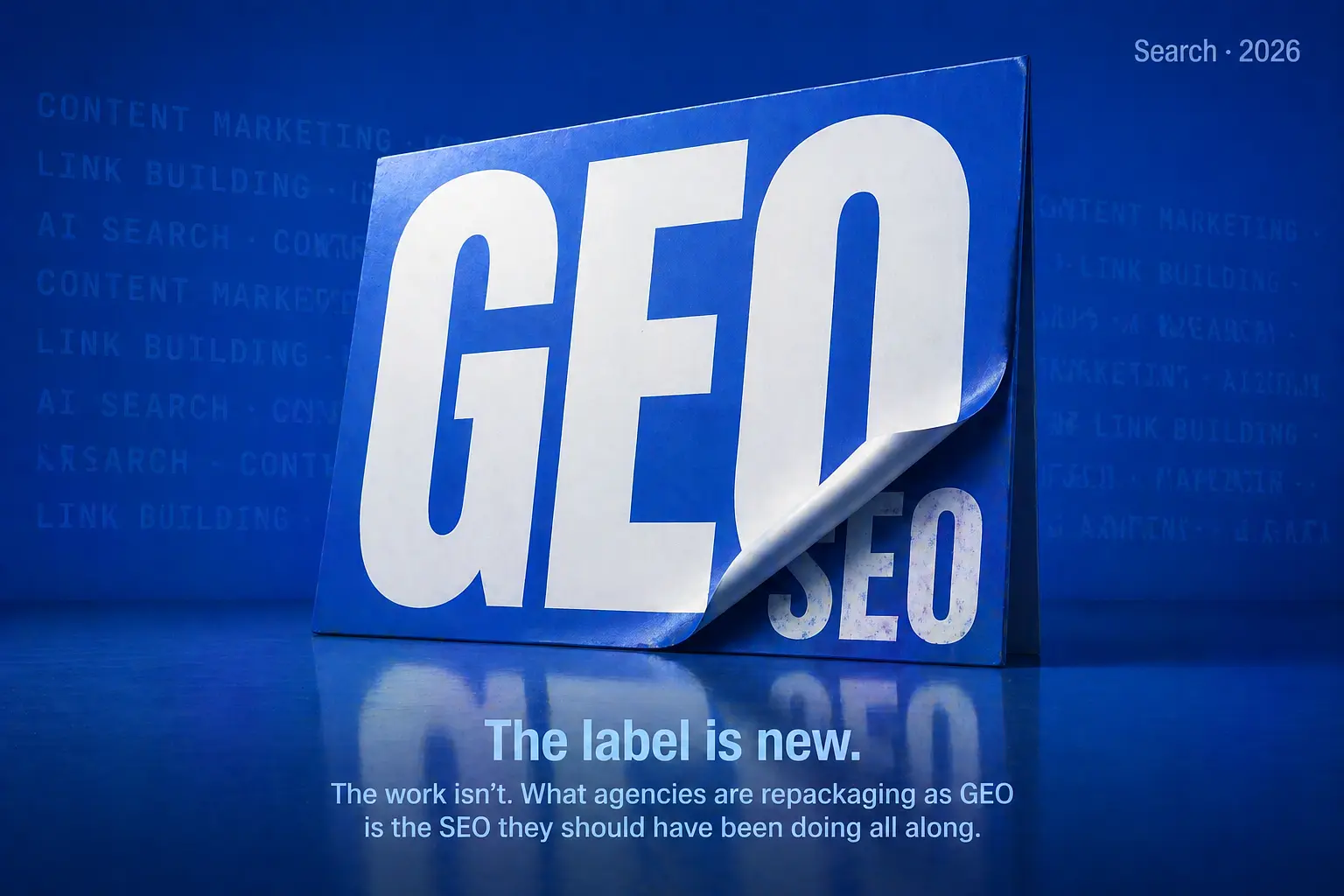
Trend is GEO (Generative Engine Optimization), AKA GEO SEO.
- So Is GEO Actually New?
- You Can’t Skip Regular Search and Jump Straight to AI
- The Numbers Behind the Trend
- The Tools Are Creating the Panic
- Where This Hits Hardest — Ecommerce
- Local SEO and AI Recommendations Don’t Work the Same Way
- What’s Actually Getting Sites Cited by AI
- Agencies Are Rebranding. The Work Hasn’t Changed.
- GEO (Generative Engine Optimization) is the practice of optimizing content to appear inside AI-generated answers — ChatGPT, Gemini, Perplexity, Google AI Overviews.
- Agencies are repackaging their SEO services around it. Tools are building dashboards for it.
- Google Trends interest for “geo seo” hit 100 in March 2026 — the absolute peak.
A few of our ecommerce clients asked us late last year why their competitors were showing up in ChatGPT product recommendations and they weren’t. That question sent us down a path that’s worth documenting — because what GEO actually is, what’s being sold under that name, and what it takes to get cited by AI are three completely different conversations.
So Is GEO Actually New?
Strip away the branding. GEO is: make your content good enough that AI systems trust it and cite it.
The tactics being sold under that label — structured data, clear headings, direct answers early in the content, original research, third-party mentions — this is what competent SEO has looked like for years.
Princeton researchers who coined the term back in 2023 found that adding statistics to content improved AI visibility by up to 40%. That was the single most effective GEO technique in peer-reviewed testing.
It’s also just… writing content properly.
The question isn’t whether GEO is new. It’s whether AI visibility requires a fundamentally different strategy from regular search.
From what we’ve seen across our own sites — no. You don’t need a separate strategy. You need to actually do the work most SEO campaigns skip.
You Can’t Skip Regular Search and Jump Straight to AI
Most GEO pitches leave this part out.
To show up in AI Overviews or get recommended by ChatGPT, your site generally needs to perform well in regular search first. We’ve watched this play out across multiple domains. Sites sitting on page 3 aren’t suddenly getting AI citations. The relationship is direct.
But it’s not a straight line either.
We’ve seen pages holding position 1 for competitive terms that don’t appear in the AI Overview at all. And sites at position 5 or 6 that do. It’s not page-level anymore. AI is evaluating the domain as a whole — its authority, topical depth, and how it shows up across the web.
A single well-optimized page on a thin site doesn’t cut it. The domain needs to carry weight.
The Numbers Behind the Trend
Search “geo seo service” on Google. 36.3 million results.
Agencies are running paid ads on this keyword. Reddit is pushing sponsored placements. There’s a subreddit — r/GenEngineOptimization — sitting at nearly 5,000 members. Not just agencies either. Freelancers, in-house SEOs, small business owners. All trying to crack AI visibility.
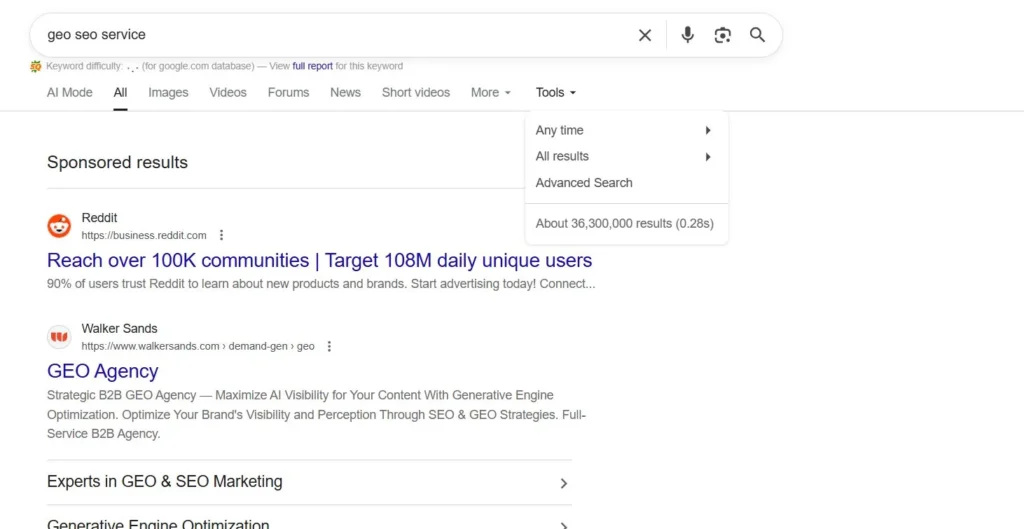
And even think if you earch or check this post over a week you might even see more numbers.
One post on that subreddit stood out. Someone who spent six months doing GEO work shared their biggest realization — AI citations behave nothing like backlinks.
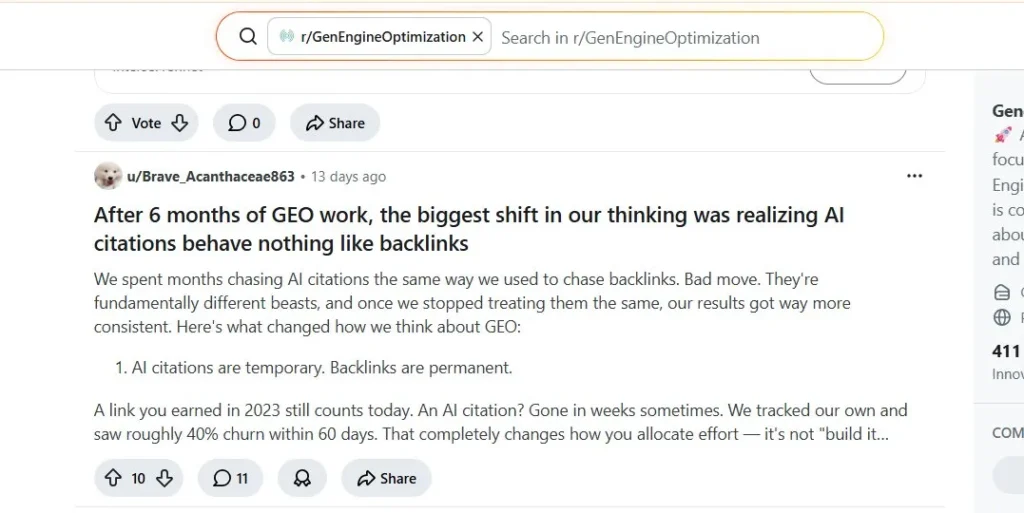
They tracked their own citations. Roughly 40% churned within 60 days.
A backlink you earned in 2023? Still counts. An AI citation from two months ago? Might already be gone.
That changes the value proposition entirely. If the citations an agency earns you disappear in 8 weeks, you’re paying for a treadmill. Not building anything.
The Tools Are Creating the Panic
SEMRush and Ahrefs both rolled out AI visibility tracking recently. You can see how many times your domain gets mentioned across ChatGPT, Gemini, Perplexity, and AI Overviews.
Useful data point. But think about what happens next.
A business owner opens Ahrefs. Their AI visibility score: 0 mentions. Their competitor: 100+ mentions. That gap triggers something — the same reaction Domain Authority scores created years ago. A third-party number that clients started treating as the actual goal instead of what it represents.
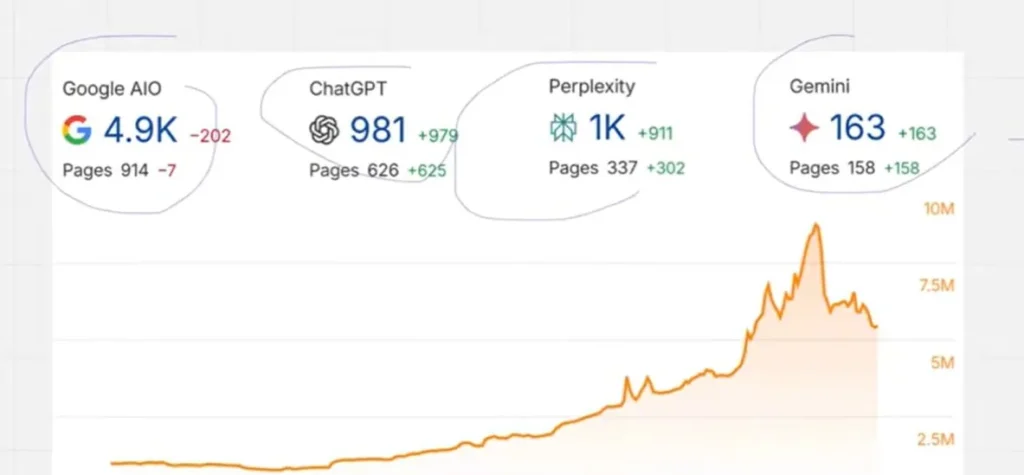
By the way do we really care about Perplexity here? I think NO!
The demand for GEO services didn’t come from business owners deciding they need AI citations. It came from dashboards showing them a number they didn’t have, sitting right next to a competitor who did.
Tool vendors benefit. Agencies benefit. Course creators benefit. Whether the business benefits depends on something else entirely.
Where This Hits Hardest — Ecommerce
If there’s one space where GEO actually deserves attention, it’s ecommerce.
Ask ChatGPT “suggest me the best online store for handmade teapots.” Ask Gemini “I need a reliable site for organic skincare.” The AI doesn’t hand back a list of 10. It names one. Maybe two. Sometimes three.
You’re in that answer or you’re not. No position 7. No “at least I’m on page 1.” Binary.
AI-referred traffic reportedly converts higher than paid social. Makes sense — when someone arrives at your store because ChatGPT recommended it, the trust barrier is already cleared. The AI did the vetting.
For ecommerce, this is a real channel right now. Not theoretical. And the window is wide open because most online stores haven’t thought about it. The ones building strong product pages, stacking genuine reviews, and getting mentioned across trusted sources are going to own these recommendation slots while everyone else is still reading GEO guides.
Local SEO and AI Recommendations Don’t Work the Same Way
Try “best plumber in X City” on ChatGPT. Or “find me an electrician in Manchester.” The whole dynamic shifts.
Local AI recommendations come from a combination of sources – Google My Business, reviews, other sites, mentions on forums. Google reviews count. As do Trustpilot and Yelp recommendations, Facebook recommendations and even the Reddit threads where someone named the specific business. I believe that GEMINI will be benefitting from LOCAL reviews of GMB specifically but not sure how GPT ranks the local searches.
The plumber with 400 reviews on Google and mentioned everywhere gets called. The one with a great site and 12 reviews but no other “mentions”? Doesn’t.
This is where social proof trumps content organisation. You can have flawless schema, every answer to every plumbing question, and the best service pages. But unless it’s backed up by external verification (reviews, mentions, directories, media), AI won’t be confident in recommending your business.
For local businesses, GEO isn’t about content optimization for AI. It’s about building a footprint that AI can verify across independent sources.
What’s Actually Getting Sites Cited by AI
After months of watching this across our own properties and client work, the pattern is consistent.
- Social presence. Not just accounts – activity. Social signals are one factor AI systems use to verify entities. Engagement and visibility on platforms contribute to AI’s assessment of your brand’s legitimacy.
- Backlinks. Still. We know brand mentions is more correlated with AI visibility than just links, but a backlink is a brand mention from a trusted source. The sites getting citations from AI have both.
- Content is commodity now. Everyone produces good content. What matters is the ecology. Who links to you. Who mentions you. Who reviews you. Newspaper articles, directories, third-party reviews – that’s what AI looks to for trust.
You can’t beat an article with third-party trust. AI trusts consensus. Several different sources saying you’re credible? That pattern gets picked up. Only your website claims you’re trusted? Not enough.
This is how backlinks have always worked — just applied through a different system. Brand mentions, co-citations, third-party validation. Same authority model, different delivery layer. If you’ve been working with an seo agency that was already building real authority and earning legitimate coverage, you were doing most of what AI systems now look for before GEO had a name.
Agencies Are Rebranding. The Work Hasn’t Changed.
SEO packages are becoming “GEO packages” overnight. The pitch changes. The deliverables stay the same. The price goes up.
If someone pitches you GEO as a standalone service separate from SEO — ask what exactly they’re doing differently. The agencies getting real AI visibility results are the ones who were already doing strong technical SEO, building authority, earning real coverage, and writing content that answers questions instead of padding word counts.
The label is new. The work isn’t.
And if your organic traffic is flat, your rankings are stuck, and your content isn’t performing — adding GEO on top doesn’t fix that. Fix the foundation. AI visibility follows.