In May 2024, Google changed the way search works. They put AI Overviews before the websites all over the US, and within a few months, website owners began to notice something troubling. Their traffic was going away.
- What Are Google AI Overviews and Why Do They Matter?
- The CTR Collapse: What The Numbers Actually Show
- Seer Interactive Study (June 2024 – September 2025)
- Ahrefs Study (March 2024 vs March 2025)
- Techmagnate Analysis (October 2024 vs May 2025)
- Google’s AI Overviews Often Link Back to… Google
- Zero-Click Searches Are Now The Norm
- Publisher Traffic Losses: The Global Picture
- Which Industries Got Hit Hardest?
- Health and Medical Websites
- News and Media
- Lifestyle, Recipes, and How-To Content
- Who’s Surviving Better
- Specific Site Casualties: The Real Numbers
- What Publishers Are Doing About It
- Future Projections: It’s Getting Worse
- What Website Owners Should Do Now
- The Bottom Line
Slowly. Over time. And Now Not showing up.
By the end of 2025, several separate studies had proven what many people already thought. Around the world, organic search traffic to companies dropped by one-third. For some questions, click-through rates dropped by more than 60%. And there are no signs that the trend will change.
This isn’t guesswork or spreading fear. This information comes from Chartbeat, Seer Interactive, Ahrefs, Similarweb, and many more study groups that keep track of billions of search queries. We’ve put together the most complete list of what’s really happening, the worst-affected businesses, and what you can do about it.
What Are Google AI Overviews and Why Do They Matter?
AI Overviews are Google’s AI-generated summaries that appear at the top of search results. When you search for something informational, Google’s AI pulls information from multiple websites, summarizes it, and displays the answer directly on the results page.
The person gets the answer without having to click on anything.
Google released AI Overviews to a lot of people in May 2024.
Tracking data from Semrush and Ahrefs shows that by late 2025, these summaries were showing up on about 16–21% of all results. That number goes up to 40–90% for areas like health and science. The tool is now used by 1.5 billion people every month in more than 200 countries. This idea is taken even further by Google’s launch of AI Mode in 120 areas.
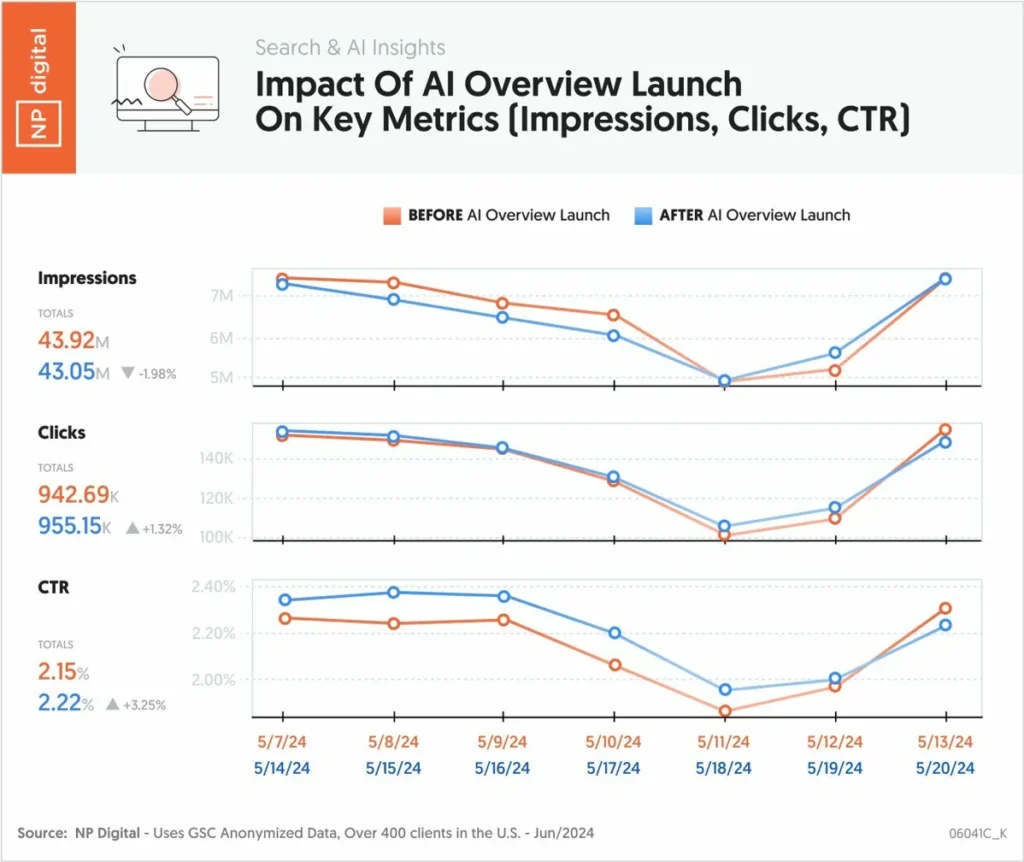
The chart above from NP Digital shows what happened immediately after the AI Overview launch. Notice how clicks and CTR dipped sharply in the weeks following rollout before partially recovering. This pattern repeated across thousands of websites.
The CTR Collapse: What The Numbers Actually Show
Let’s get into the data. Multiple studies have tracked click-through rates before and after AI Overviews, and the findings are consistent across all of them.
Seer Interactive Study (June 2024 – September 2025)
Seer Interactive ran one of the most comprehensive analyses available. They tracked 3,119 informational queries across 42 organizations, covering 25.1 million organic impressions and 1.1 million paid impressions.
Their findings:
- Organic CTR on queries with AI Overviews dropped 61%, falling from 1.76% in June 2024 to just 0.61% by September 2025
- Paid CTR dropped 68%, going from 19.70% down to 6.34%
- Even queries without AI Overviews saw organic CTR decline 41% year-over-year
- Sites cited within AI Overviews saw 35% higher organic CTR and 91% higher paid CTR compared to non-cited sites
That last point matters. Getting cited in AI Overviews provides some protection, but the overall trend is still down for everyone.
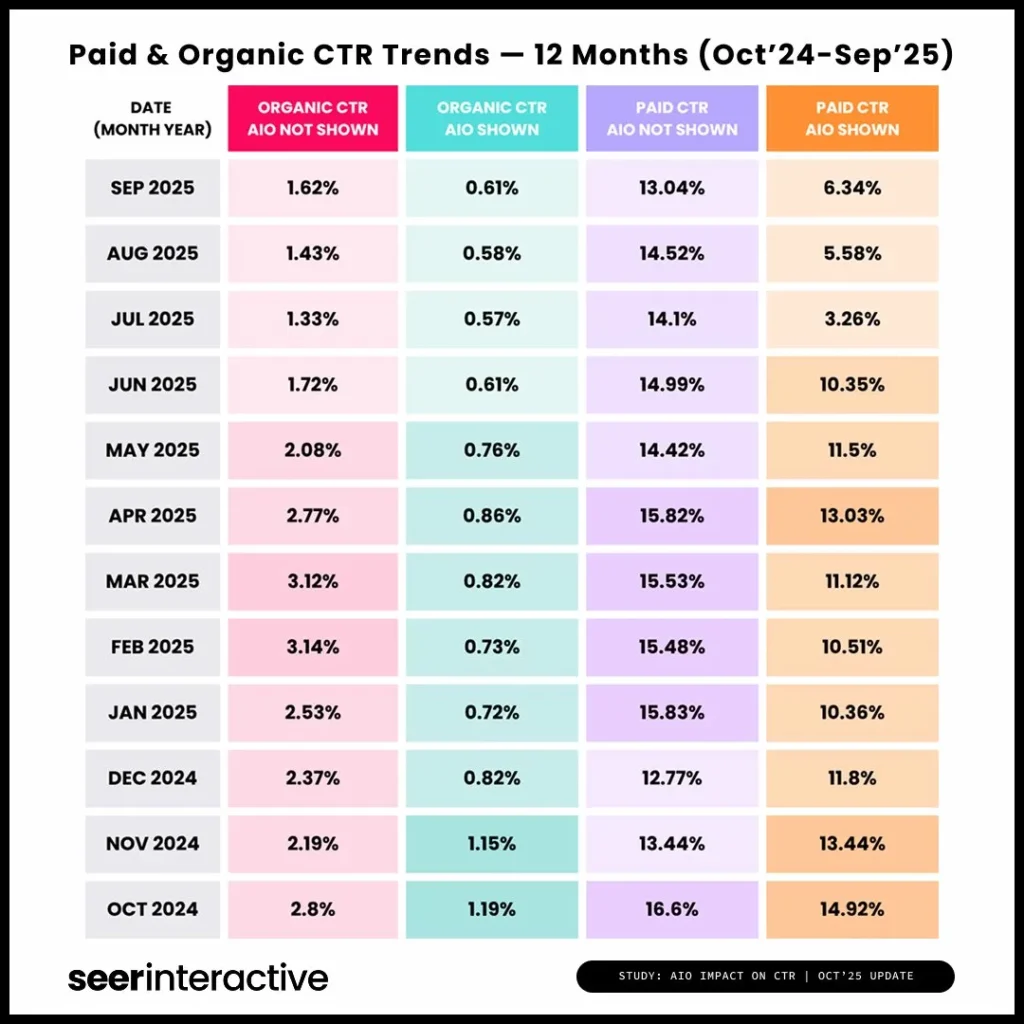
This table breaks down the month-by-month CTR trends from October 2024 through September 2025. The pattern is clear. When AI Overviews appear, CTR craters. The “AIO Shown” columns tell the story.
Ahrefs Study (March 2024 vs March 2025)
Ahrefs compared informational keywords before and after AI Overviews became widespread. They found:
- Position-one CTR dropped 34.5% on queries triggering AI Overviews
- Average CTR went from roughly 7.3% to just 2.6%
- The decline was steeper for informational queries than transactional ones
Techmagnate Analysis (October 2024 vs May 2025)
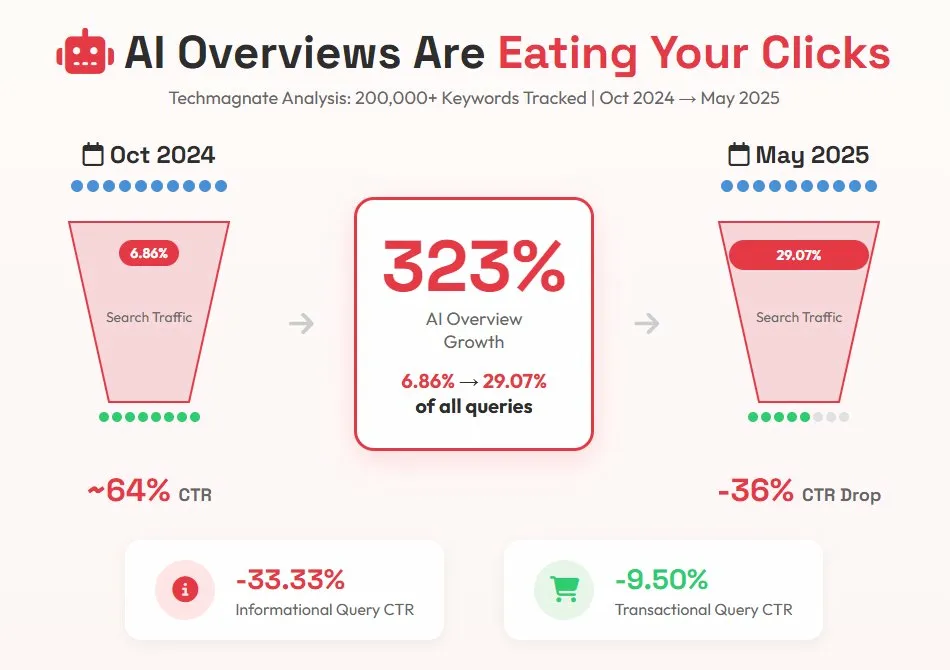
This study tracked over 200,000 keywords across multiple industries and found:
- AI Overview presence jumped from 6.86% to 29.07% of queries, a 323% increase
- Overall CTR across top 10 positions dropped 36%
- Informational queries saw a 33.33% CTR decline
- Transactional queries saw only a 9.50% decline
Google’s AI Overviews Often Link Back to… Google
Here’s something most people don’t realize. Even when AI Overviews include links, nearly half of them don’t actually send users to external websites. They send users to more Google searches.
SE Ranking conducted a study analyzing 141,507 AI Overviews across five U.S. states (California, Texas, Colorado, New York, and Washington D.C.). What they found was eye-opening:
- 43% of AI Overview responses (61,437 instances) included links that directed users to Google’s own search result pages
- Only 57% contained links to actual external websites
- The links essentially just showed websites already ranked on Google, keeping users inside the Google ecosystem
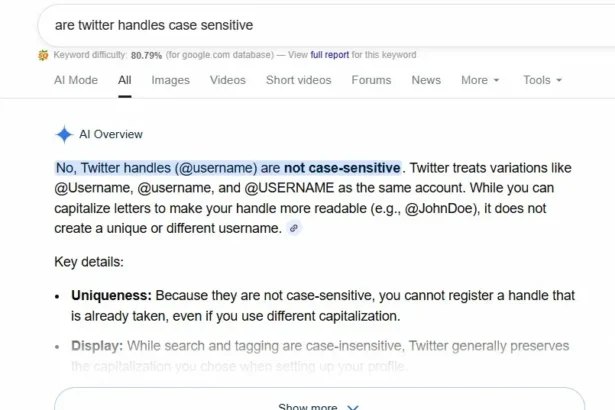
I tested this myself. Searched “what is andalusia known for” and got an AI Overview with bolded phrases like “rich Moorish architecture,” “passionate flamenco dancing,” and “vibrant tapas culture.” Clicked on one of those bolded terms. Where did it take me? Not to a travel blog or Wikipedia. It opened a new Google search.
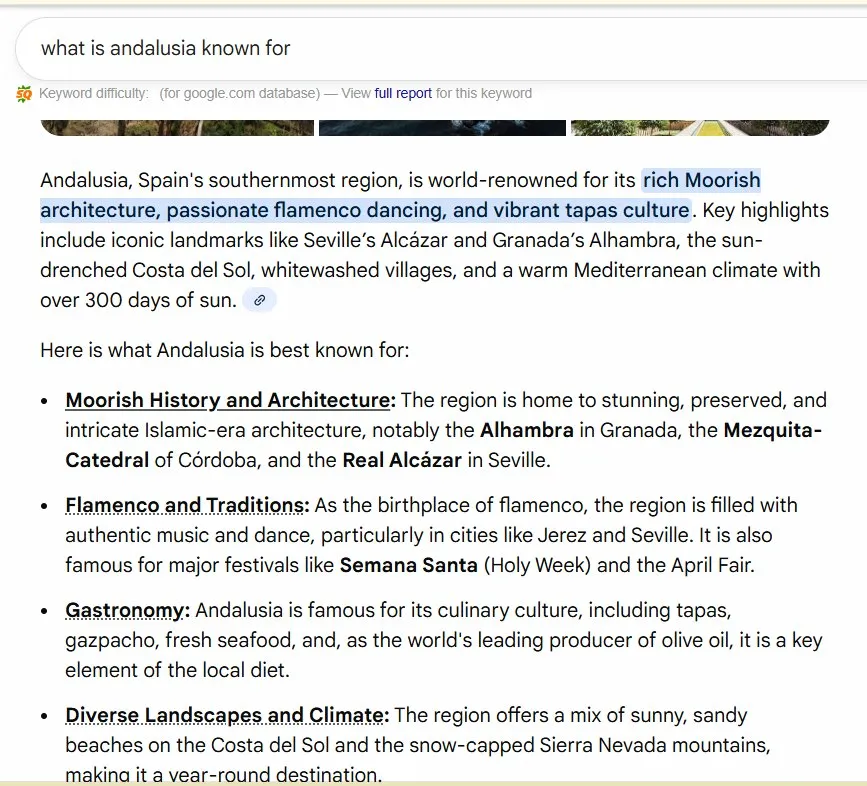
So Google summarizes your content, displays it as their answer, and when users want to learn more, the links often just run another Google search rather than sending traffic to the websites that actually created the information.
How Often Do AI Overviews Actually Appear?
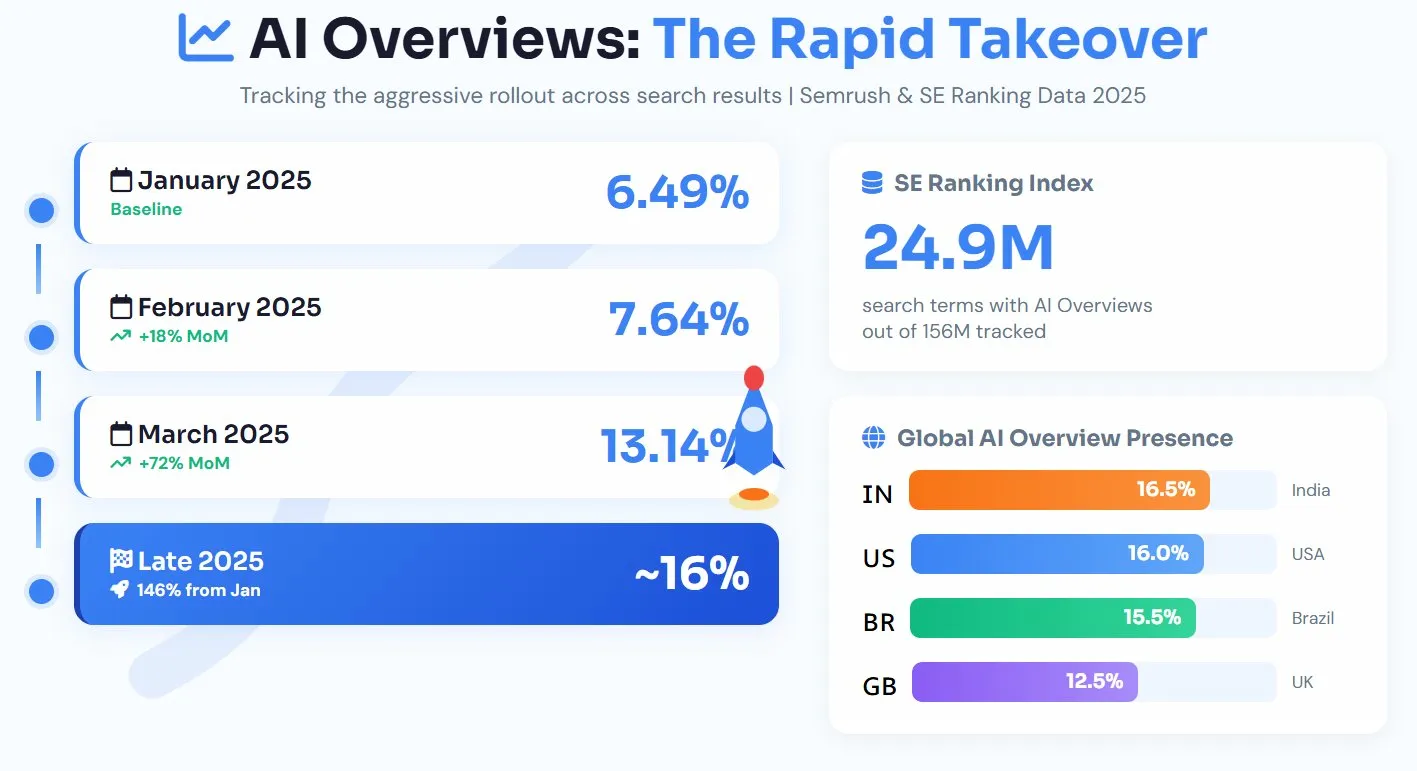
The rollout has been aggressive. According to Semrush tracking data:
- January 2025: AI Overviews appeared on 6.49% of queries
- February 2025: Increased to 7.64% (18% growth month-over-month)
- March 2025: Jumped to 13.14% (72% growth from February)
By late 2025, AI Overviews were showing for roughly 16% of all desktop searches in the US. SE Ranking’s index found them appearing in about 24.9 million out of 156 million total search terms tracked.
The trend is similar globally. India sees AI Overviews on 16.5% of searches, Brazil at 15.5%, and the UK at 12.5%.
Zero-Click Searches Are Now The Norm
Here’s the core problem. Google’s AI summaries answer questions directly on the results page. Users get what they need without clicking through to any website.
This phenomenon is called “zero-click search,” and it’s been growing for years. But AI Overviews accelerated the trend dramatically.
The Data on Zero-Click Growth
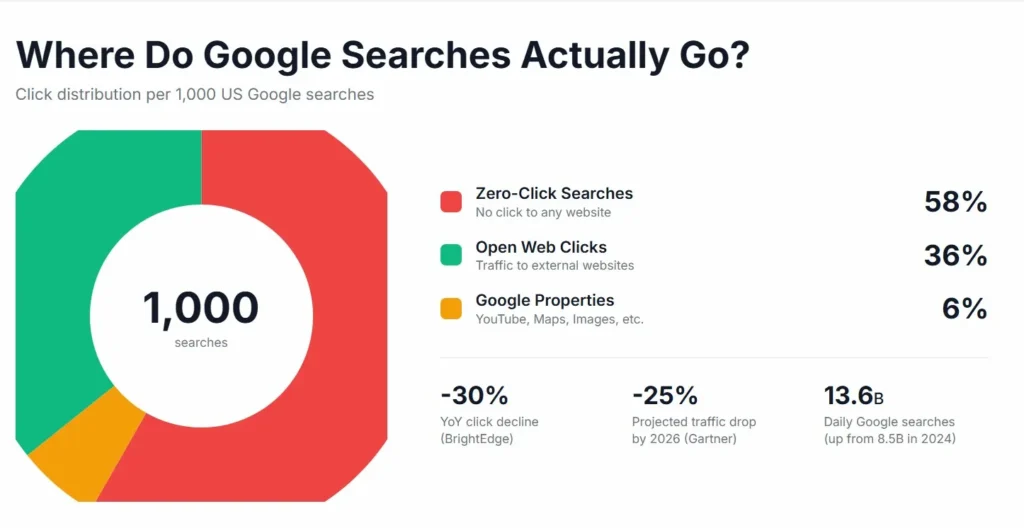
- 58.5% of Google searches in the US now result in zero clicks (SparkToro/Datos 2024 study)
- Zero-click percentage grew from 56% to 69% after AI Overview rollout, a 13 percentage point jump between May 2024 and May 2025 (Similarweb)
- 80% of consumers now rely on zero-click results in at least 40% of their searches (Bain & Company)
- When AI Overviews appear, only 8% of users click on results below, compared to 15% when no AI summary is shown (Pew Research)
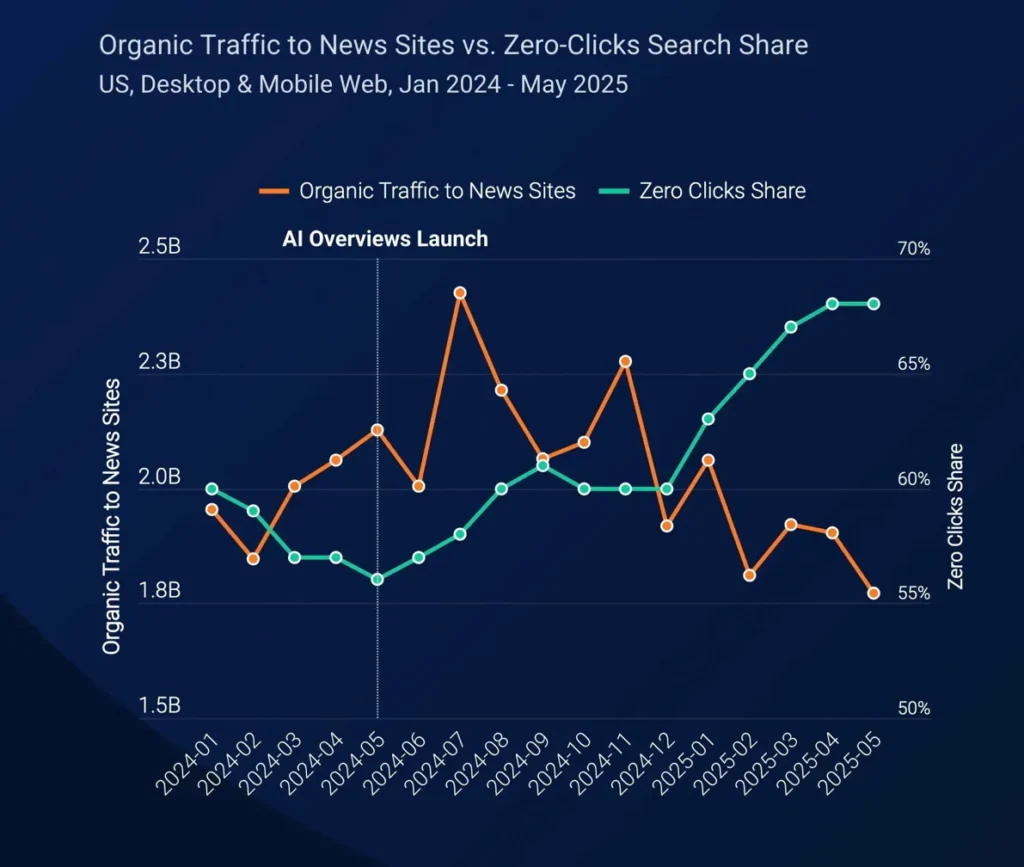
This chart visualizes the relationship between organic traffic and zero-click share. Notice how they move in opposite directions after the AI Overviews launch marker. As zero-click share climbs toward 70%, organic traffic to news sites trends downward.
What This Means Practically
Only 360 out of every 1,000 Google queries in the US get to the open web (SparkToro). The others either stay in Google’s ecosystem or don’t get clicked on at all.
BrightEdge has recorded a 30% drop in clicks from year to year based on billions of Google searches they keep track of. Gartner says that by 2026, traffic from typical searches will drop by 25%.
The math is hard. People are looking for things more than ever. Google handles between 9.1 to 13.6 billion queries every day, which is more than the 8.5 billion it did in 2024. But not as many of those searches lead people to websites.
Publisher Traffic Losses: The Global Picture
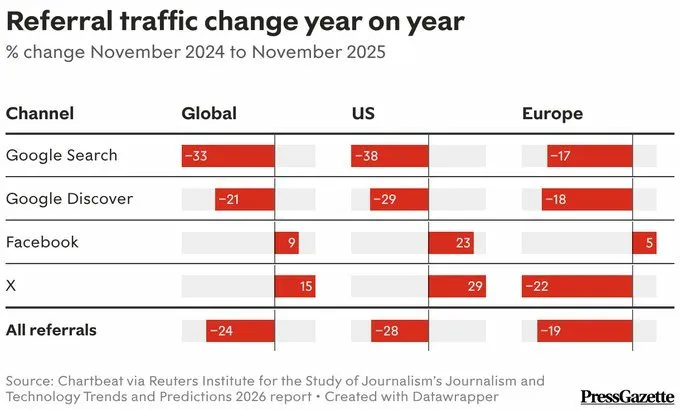
The theoretical CTR declines translate into real traffic losses. Chartbeat aggregated data from over 2,500 publisher websites and the numbers are stark.
Chartbeat Data (November 2024 to November 2025)
- Global Google search traffic to publishers: Down 33% year-over-year
- US-specific: Down 38% year-over-year
- Google Discover referrals: Down 21% year-over-year
- Europe fared slightly better at -17%
The Reuters Institute surveyed media leaders and found they expect search traffic to decline by another 43% over the next three years. Around one-fifth of respondents expect losses exceeding 75%.
Digital Content Next Findings
Digital Content Next represents roughly 40 premium publishers including The New York Times, Condé Nast, and Vox. Their data from 19 member companies covering May and June 2025 showed:
- News brands experienced a 7% median traffic decline
- Non-news content brands saw a steeper 14% decline
- Overall referral traffic drop of 25% linked directly to AI Overviews
The Paradox
Here’s what makes this frustrating. Google search volume is growing. More queries than ever. But that growth isn’t translating into more visits to websites. Google is capturing the value of those searches within its own ecosystem.
Which Industries Got Hit Hardest?
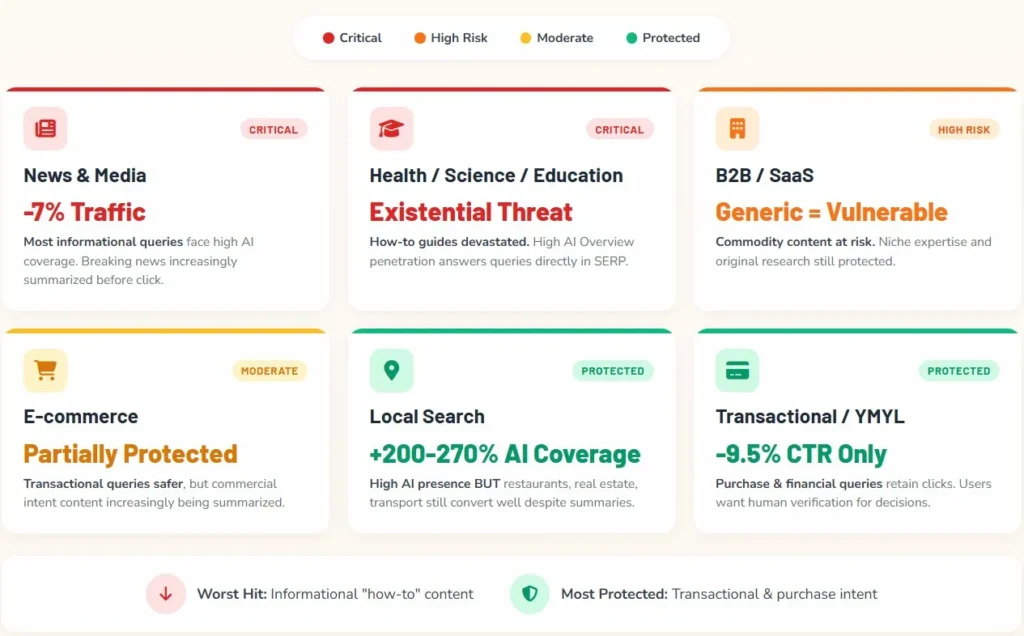
Not every website category suffered equally. The pattern is clear: informational content took the worst beating while transactional and commercial queries held up better.
Health and Medical Websites
Health sites rank among the most vulnerable because AI Overviews trigger on 43-90% of medical keywords. Users asking about symptoms, treatments, or conditions get AI-generated answers directly.
Specific losses:
- WebMD lost approximately 15 million monthly visits in May 2025 alone
- Healthline, Mayo Clinic, Cleveland Clinic all facing 20-35% session losses
- Learning platform Chegg reported 49% decline in non-subscriber traffic between January 2024 and January 2025
- Chegg filed an antitrust lawsuit alleging Google used their content to train AI that now competes directly with them
News and Media
News publishers face acute challenges because their content overwhelmingly serves informational intent.
- 37 of the top 50 US news websites experienced year-over-year traffic declines in May 2025
- By July 2025, only 6 of those 50 showed any growth
- CNN declined from 351 million visits in March to 323 million by July (8% drop in four months)
- Business Insider saw organic search traffic fall 55% between April 2022 and April 2025, leading to 21% staff cuts
- HuffPost lost half of their search referrals over the same period
Lifestyle, Recipes, and How-To Content
This category got crushed. These sites exist to answer questions, and AI Overviews answer those questions first.
- HubSpot lost 70-80% of their traffic
- Forbes saw 50% decline
- The Planet D (travel blog) lost 50% after AI Overview launch, then another 90%, eventually shutting down entirely
- Charleston Crafted (home improvement blog) lost 70% of traffic within two months, with 65% ad revenue decline
- Stereogum (music blog) lost 70% of ad revenue in 2025
Who’s Surviving Better
E-commerce and transactional queries are more protected. When someone wants to buy something, they still need to click through to complete the purchase. AI Overview coverage for transactional queries sits around 1% compared to 27%+ for informational queries.
Local search also maintains stronger click-through, though AI Overview coverage for restaurants, real estate, and transportation has grown 200-270%.
Specific Site Casualties: The Real Numbers
Let’s put names to the damage. These are documented traffic losses from 2025 reporting:
| Website | Traffic/Revenue Loss | Category |
|---|---|---|
| HubSpot | 70-80% traffic decline | Marketing/B2B |
| Forbes | 50% traffic decline | News/Business |
| Business Insider | 40-55% organic search drop | News |
| HuffPost | 40-50% search referral decline | News |
| NBC News | 42% decline | News |
| CNN | 27-38% decline | News |
| The Sun (UK) | 55-59% decline | News |
| Daily Mail (US) | 32-44% decline | News |
| Washington Post | 19-40% decline | News |
| The Planet D | 90%+ (site shut down) | Travel Blog |
| Charleston Crafted | 70% traffic, 65% revenue | Home Improvement Blog |
| Stereogum | 70% ad revenue loss | Music Blog |
| Chegg | 49% non-subscriber traffic | Education |
These aren’t fringe websites. These are established publishers with editorial teams, advertising partnerships, and years of SEO investment. The traffic they built over a decade evaporated in months.
Daily Mail’s DMG Media reported that AI Overviews caused click-through rate drops of up to 89% on affected queries. When nearly 9 out of 10 potential visitors stop coming, no amount of optimization can compensate.
What Publishers Are Doing About It
The industry isn’t taking this lying down. Publishers are shifting strategies and investment.
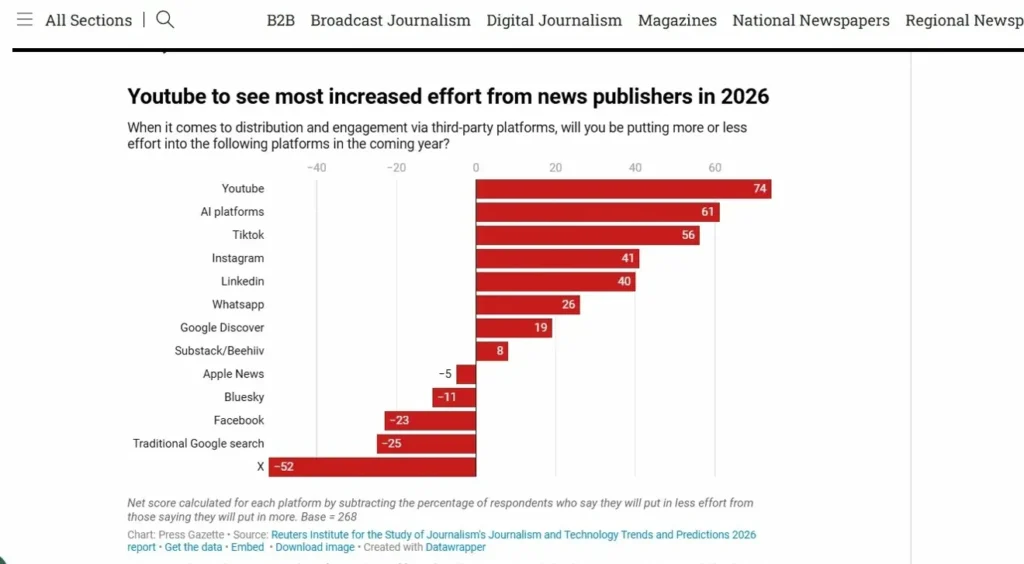
The Reuters Institute survey shows where publishers plan to invest more effort in 2026:
Traditional Google search: -25 (most are pulling back)
- YouTube: +74 net score (highest)
- AI platforms: +61
- TikTok: +56
- Instagram: +41
- LinkedIn: +40
Publishers are diversifying away from Google search dependence (Not Google as they are moving to Youtube). They’re building audiences on platforms where they control the relationship or where content formats don’t translate as easily into AI summaries.
Strategies that are working
Original research and reporting from the field—You can’t just summarize content that needs people, sources, and original information. You have to feel it.
YouTube is still the second biggest search engine, and video content doesn’t turn into text summaries the same way articles do.
Building an audience directly: Email lists, applications, subscriptions, and community platforms let you build relationships that don’t depend on search algorithms.
Being mentioned in AI Overviews—if you can’t beat them, join them. Sites that are mentioned in AI Overviews get 35% more clicks than sites that aren’t mentioned on the same query.
Future Projections: It’s Getting Worse
The data suggests this trend will accelerate, not reverse.
What Studies Predict
- Publishers expect search traffic to decline another 43% over the next three years (Reuters Institute)
- One-fifth expect losses exceeding 75%
- Gartner forecasts 25% decrease in traditional search traffic by 2026
- AI Mode is rolling out across 120 markets, extending AI-first search experiences globally
Google’s Position
Google says that AI Overviews are good for publishers. Sundar Pichai, the CEO, said that material and links in AI Overviews attract more clicks than results that are not in AI Overviews.
This description is questioned by independent studies. The Pew Research Center looked at 68,000 genuine search searches and found that people clicked on results only 8% of the time when AI summaries were included, compared to 15% of the time when they weren’t. That’s a drop of 46.7% in clicks.
Digital Content Next and other publisher associations have publicly pushed back, showing statistics that goes against Google’s statements that traffic is flat or expanding.
What Website Owners Should Do Now
The old playbook doesn’t work anymore. Ranking first on Google used to guarantee traffic. Now you can hold that top position and still watch visitors evaporate because an AI summary answered the question before anyone scrolled down.
Immediate Actions
Audit your content types – Identify which pages serve purely informational queries that AI can easily summarize. These are your highest-risk assets.
Track AI Overview presence – Use SEO tools that show which of your keywords trigger AI Overviews. Most major platforms now include this feature.
Optimize for citations – Structure content so AI systems can extract, attribute, and link to your work. Clear definitions, well-organized facts, and authoritative sourcing increase citation likelihood.
Diversify traffic sources – Any strategy dependent on a single traffic source is fragile. Build email lists, social followings, and direct audience relationships.
Content Strategy Shifts
Create content AI can’t replicate – Original research, interviews, first-person experiences, opinion pieces, and on-the-ground reporting require human presence. AI can summarize existing information but can’t generate new primary sources.
Target transactional intent – Queries where users need to take action (buy, sign up, contact, visit) still drive clicks. Commercial content maintains stronger CTR.
Go deeper, not broader – Surface-level informational content is most vulnerable. Deep expertise, nuanced analysis, and comprehensive guides provide value that quick AI summaries can’t match.
Build brand recognition – Users who know your brand will search for you directly or click your result specifically, even when AI summaries appear. Brand queries bypass the zero-click problem.
The Bottom Line
Google gets more searches than ever before. But those searches don’t bring as many people to websites. AI Overviews sped up a trend that was already happening, and the data from 2025 shows how big the change was.
One-third of all publisher traffic is gone in just one year. CTR is down 61% on searches that show AI summaries. Half or more of the organic search visits to major websites are leaving.
This isn’t a short-term change or an algorithm update that will fix itself. This is a shift in the way search operates on a structural level.
Only the websites that can change will survive. That includes getting traffic from different places, making content that AI can’t readily summarize, forming direct interactions with your audience, and optimizing such that your site is mentioned in AI responses instead of just being ranked lower.
The time of “rank and bank” is over. The following step in search needs a completely different technique.
This analysis was compiled by me for The SEO Spot using data from Seer Interactive, Chartbeat, Ahrefs, Similarweb, Pew Research Center, Reuters Institute, Digital Content Next, BrightEdge, SparkToro, and other independent research sources.