When you hear “local SEO,” you probably picture Google Business listings. Setting up that profile, getting some reviews, making sure your hours are correct. And yeah, that’s still the foundation—can’t ignore it. But here’s the thing nobody’s really addressing: what happens when someone actually wants to click through to a website? What about all the other touchpoints that determine whether you show up at all?
- Understanding AI Overview Search Results
- Forum Content Now Ranks Second Position
- Why Local SEO is More Important Than Ever
- Practical Approach to Optimizing for Local AI Results
- 1. Optimize Your Google Business Profile
- 2. Build and Maintain Local Citations
- 3. Gather and Respond to Reviews
- 4. Produce Locally Relevant Content
- 5. Optimize for Mobile and Voice Search
- YouTube and Facebook: You’re Getting Two Wins
- Measuring and Adapting Over Time
These days, AI overviews sit right at the top of Google’s layout. You search for anything local—plumber, best tacos, divorce lawyer—and there’s this AI-generated summary pulling information from who knows where. Except we do know where. And that’s the problem most local businesses haven’t figured out yet.
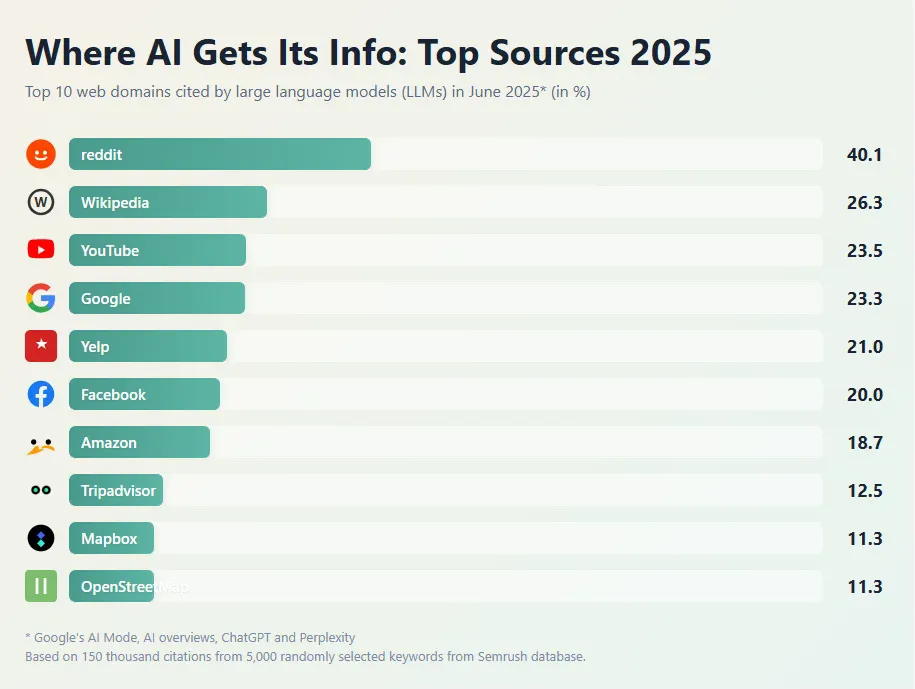
Now you must understand Local SEO isn’t just shaped by your GMB profile anymore. AI overviews are showing up for local queries now, and they’re building those answers from specific sources. Reddit’s feeding 40.1% of the information that large language models cite. Wikipedia sits at 26.3%. YouTube’s at 23.5%, Google itself at 23.3%, Yelp at 21%, Facebook at 20%.
Understanding AI Overview Search Results
Think about what that means for your business. You’ve spent time optimizing your website, maybe paid someone to handle your Google listing. But when ChatGPT or Perplexity or Google’s AI answers someone’s question about the best HVAC company in your city, where’s it looking? Reddit threads in your local subreddit. That’s where real people are asking “who should I call for emergency furnace repair” and getting recommendations from neighbors who’ve actually used those services.
Wikipedia page? Most local businesses think that’s impossible or not worth it. But 26.3% citation rate says otherwise. If your company’s been around for decades, has some history in the community, or operates in a specific niche—getting a Wikipedia presence isn’t as far-fetched as it sounds. And even if you can’t get a full page, being mentioned on your city’s Wikipedia page or in relevant industry articles matters.
Yelp’s always been important for local, sure. But the 21% citation rate tells you something different than just “get reviews.” AI models are scanning those reviews for patterns, pulling quotes, understanding what customers actually say about businesses in your category. Five generic five-star reviews? That’s not doing much. Detailed experiences that mention specific services, problems solved, employee names—that’s what feeds into these systems.
What is most interesting is that AI overviews are not generic. They often include context such as location, search history, and user intent. If someone searches for a service in their city, the AI system is likely to surface a mix of general information and local options. This shift has made local SEO a critical component for businesses that want to be featured in these high-visibility results.
Forum Content Now Ranks Second Position
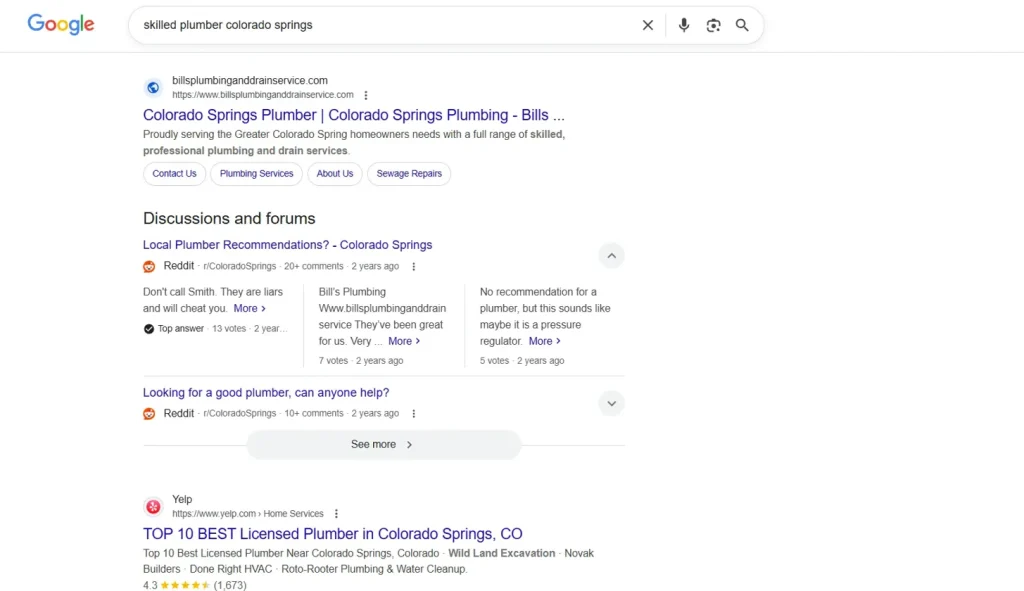
Searched “skilled plumber Colorado springs” recently? The layout’s changed in ways that should make every local business owner pay attention.
First result is still a traditional website—some plumbing company with their SEO dialed in. But right below that? There’s now a dedicated “Discussions and forums” section. Not buried somewhere on page two. Not in some obscure tab. Second position, right after the top result.
What shows up in that section? Reddit threads from r/ColoradoSprings where real people are discussing “Local Plumber Recommendations?” or “Looking for a good plumber, can anyone help?” Those discussions are getting prime real estate in search results now. Individual comments with specific business recommendations—displaying vote counts, how long ago the conversation happened, preview text of what people actually said.
Then you’ve got Yelp results appearing separately from traditional organic rankings. Facebook discussions if they’re relevant. TripAdvisor for certain industries. These aren’t just links—they’re formatted as their own distinct section with special treatment.
Why Local SEO is More Important Than Ever
What does this mean practically? If your business isn’t being mentioned in these conversations, you’re invisible in what’s becoming one of the most valuable parts of the search results. Someone searching for your exact service, in your exact city, and you’re not appearing because nobody’s talking about you on Reddit or reviewing you on Yelp or discussing you in Facebook groups.
Traditional SEO used to mean ranking your website. Now it also means being present in spaces where conversations happen. Can’t game that with backlinks or keyword density. Has to be earned through actually being worth talking about.
As per research done across North America by Stephan Gauthier founder of Clickspire SEO an Ottawa based seo firm, many of the local businesses are now being surfaced in AI results because search engines prioritize expertise and authority signals. Partnering with or other regional specialists can help a business establish itself as a trusted source by building structured data, earning quality backlinks, and creating locally relevant content. This strategy improves the chances of being chosen as a cited expert within AI-generated summaries, not just listed as another search result.
This is particularly important because AI overviews often favour trusted sources that offer detailed, verifiable information. A business that appears within these results gains significant credibility and visibility compared to competitors who are absent.
Practical Approach to Optimizing for Local AI Results
Businesses can take specific, actionable steps to improve their chances of being included in AI overview results. Here’s a practical plan you can follow:
1. Optimize Your Google Business Profile
Ensure your Google Business Profile (GBP) is complete and accurate. This includes business hours, service areas, website link, description, categories, and images. Add regular updates, such as posts or offers to keep your profile active. Google and other AI systems use this data to verify that your business is current and trustworthy.
2. Build and Maintain Local Citations
Local citations are mentions of your business on directories, maps, and review sites. Ensure that your are consistent across all listings. Inconsistent data can confuse search engines and lower your ranking in AI results. Tools like Moz Local or BrightLocal can help track and manage citations efficiently.
Name, Address, and Phone number (NAP) consistency, across every directory still matters. Sounds boring compared to chasing AI citations, but Google’s local algorithm still uses this as a trust signal. If your business information is different on Yelp versus your website versus some random directory you forgot about three years ago, that creates confusion for both search engines and potential customers.
The directories worth focusing on depend on your industry. General ones like Yelp, Yellow Pages, and Bing Places cover everyone. But then there’s industry-specific ones—Avvo for lawyers, Healthgrades for doctors, Houzz for contractors. Those niche directories often carry more weight because they’re where people in your specific market actually look.
Don’t just set and forget these either. Update them when anything changes. New phone number, expanded service area, different hours—those updates need to propagate everywhere. Takes time but prevents the “I tried calling and the number was disconnected” reviews that tank your credibility.
3. Gather and Respond to Reviews
User-generated content, such as reviews, signals trustworthiness to AI algorithms. Encourage happy customers to leave reviews and take the time to reply to them. Responses should be professional and timely, as they show engagement and customer service commitment — both of which AI systems consider when assessing credibility.
Getting reviews means asking, but timing matters. Right after you’ve solved someone’s problem, when they’re happy with your work, that’s when you request feedback. Not three weeks later when they’ve moved on mentally.
Responding to reviews—especially negative ones—shows you’re paying attention. Generic “Thanks for your review!” responses are worse than nothing. Reference something specific they mentioned. If they complained about wait time, explain what you’ve changed to improve that. If they loved your technician, mention that person by name and pass along the compliment.
4. Produce Locally Relevant Content
Content here doesn’t mean churning out blog posts nobody reads. “5 Tips for Maintaining Your HVAC System” written by some freelancer who’s never been to your city—that’s not moving the needle.
Create content that speaks directly to your local audience. video guides that reference neighbourhoods, city events, and community trends help establish your business as an authority in your area. Include schema markup to make your content machine-readable so that AI systems can easily extract key information.
Local content means showing your city. Behind-the-scenes of working in specific neighborhoods people recognize. Before/after photos of jobs where the background clearly shows “yeah, that’s Colorado Springs.” Videos explaining problems that are unique to your region’s climate, architecture, regulations. Memes about local quirks that only residents would get.
YouTube Shorts work particularly well for this because they’re quick, they show up in search results, and they feed into those AI overview sources we talked about earlier. Thirty-second clip of a common problem you see in older houses in your area. Fifteen-second time-lapse of a job completed. Forty-second explanation of why everyone in your city needs to worry about a specific issue each winter.
The authenticity matters more than production quality. People can tell when content’s generic versus when it’s made by someone who actually works in their community. Phone camera footage with natural lighting beats a perfectly lit studio setup that could be anywhere in the country.
Cultural references to local events, local landmarks, local inside jokes—those make people recognize (not only people but these AI/LLMs as well) you’re actually part of the community versus some national chain with no connection to the area. That recognition translates to trust, which translates to conversions when they need your service.
5. Optimize for Mobile and Voice Search
Rough estimate: “over 70% of total searches are on mobile devices” so majority of internet traffic happens on mobile now. That’s not news. But here’s what people miss: commercial conversions for local searches aren’t happening on laptops.
Click-to-call buttons need to be obvious and actually work. Forms need to be easy to fill out on a small screen without zooming and scrolling horizontally. Maps and directions need to load instantly. Hours need to display prominently because people are checking whether you’re open right now, this second, not planning a visit for next week.
Google’s mobile-first indexing means your mobile site is what gets ranked anyway. Desktop version doesn’t matter if your mobile experience is trash. Check your site on your actual phone, on multiple browsers, with different connection speeds. The slow-loading hero image that looks impressive on desktop? Kill it if it’s adding three seconds to mobile load time.
Since many local searches are conducted on mobile devices so they can be connected to voice assistants and voice search, make sure your website loads quickly, is mobile-friendly, and uses natural language targeting. Voice searches often take the form of questions, so include FAQ sections that answer common queries clearly.
YouTube and Facebook: You’re Getting Two Wins
YouTube content and Facebook presence aren’t just social media plays anymore. They’re showing up in search results and feeding AI systems. That’s a double benefit you can’t ignore.
Your Facebook business page with regular posts, photos from jobs, customer interactions—it’s building credibility with both Facebook’s algorithm and the AI models scanning for local business information. Active presence there means you’re in the 20% of sources that AI overviews draw from. Same with Facebook Groups. Local community groups where people ask for service recommendations? Being a known, helpful member there pays off twice.
YouTube’s even more powerful because of how people search now. Someone types “how to fix leaking faucet” and your local plumbing company’s tutorial video shows up. Even if they don’t hire you right then, they’ve seen your face, heard your voice, know you exist. When they do need a plumber, guess who they remember? Plus, that video’s feeding into the 23.5% of AI citations. Google’s AI overview might pull from your explanation and mention your company specifically.
The content doesn’t need to be professionally produced either. Phone videos showing before/after of jobs you’ve completed, quick tips specific to your region (like “why Colorado’s dry climate affects your plumbing differently”), or even just explaining common problems you see locally—all of that works. Shorts perform particularly well because they’re easy to consume and YouTube’s pushing them hard in search results now.
Measuring and Adapting Over Time
Local SEO is not a one-time project. Track your visibility in local search results and monitor how often your business appears in AI overviews. Use analytics tools to see which content drives engagement and adjust your strategy based on performance. The search landscape is evolving quickly, and businesses that adapt will stay ahead of competitors.