My colleague published an article on TheSEOSpot back in May 2023 answering a simple question: are Twitter handles case sensitive? Straightforward stuff. He wrote it, published it, and Google indexed it. The meta description reads: “No, Twitter handles are not case-sensitive. ‘@JohnDoe’ and ‘@johndoe’ are considered the same handle by Twitter.”
- What Google’s AI Overview Actually Did to Our Content
- The Data Confirms What We’re All Experiencing
- It’s Not Just Google — GPT and Grok Are Doing the Same Thing
- The Core Problem Nobody Wants to Say Out Loud
- What a Fair Solution Would Actually Look Like
- This Isn’t Just About Big Publishers
- Where This Leaves Bloggers and Small Publishers
- FAQ
What Google’s AI Overview Actually Did to Our Content
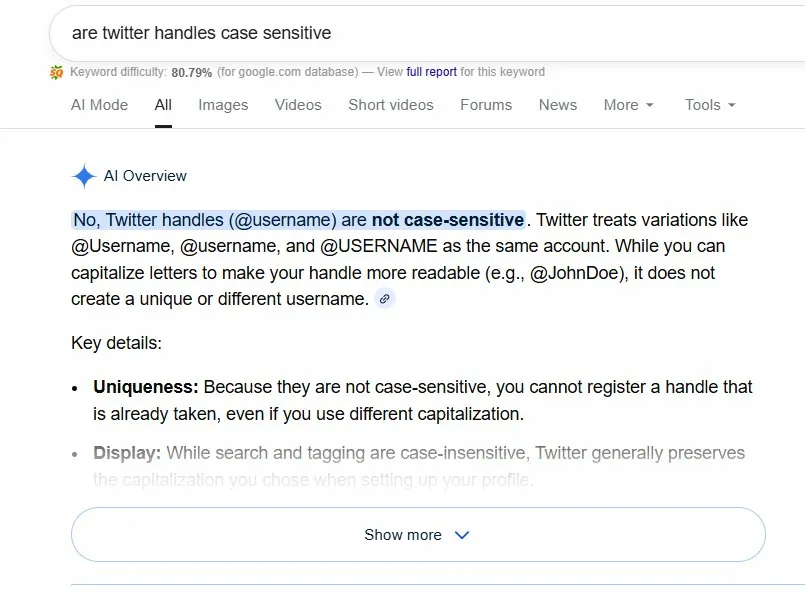
Fast forward to 2026. Google’s AI Overview now sits at the top of that exact search result, answering the question almost word for word. Our original content — the thing Google clearly trained on and pulled from — is sitting somewhere around position 9 or 10 on the page. Below the fold. Below the AI Overview. Below everything that matters.
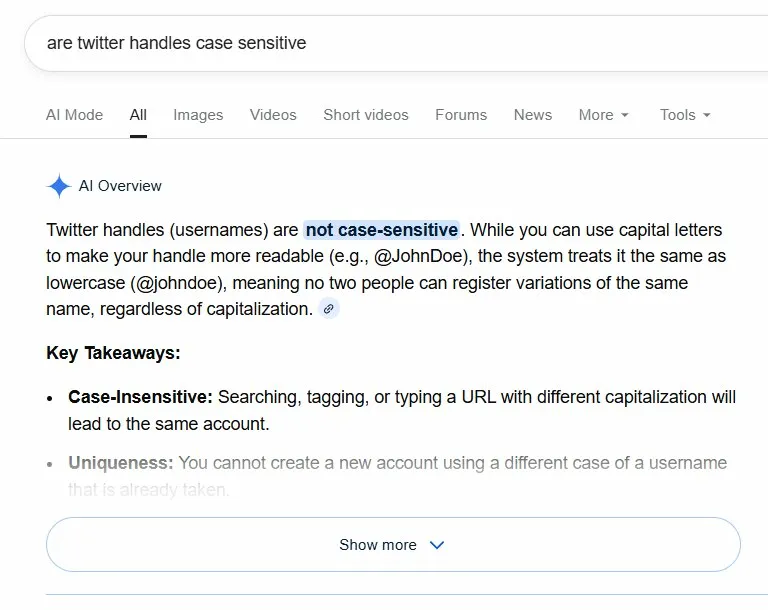
Look at the AI Overview response. It says Twitter handles are not case sensitive, that @Username and @username are treated identically, that capitalization is just cosmetic. Key details about uniqueness and display behavior. All of it structured with bullet points and delivered with confidence at the top of the page.
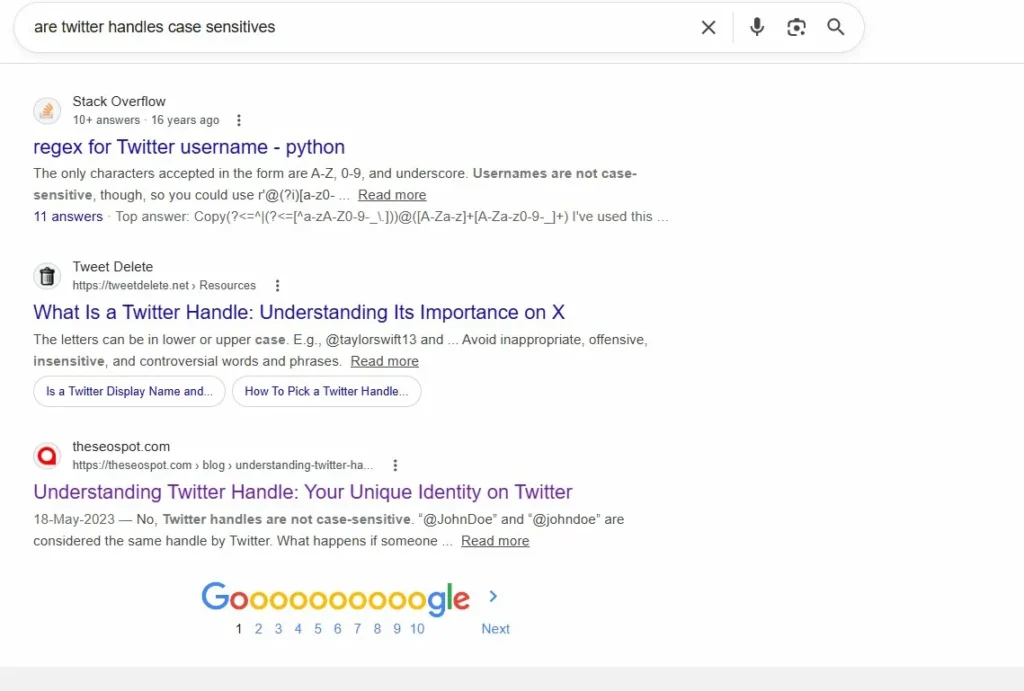
Now look at our original meta description from 2023 that Google crawled and learned from. The overlap isn’t subtle. Google didn’t just happen to know this information floating around in its training data — it indexed our page, read our content, used our explanation to inform its AI-generated answer, and then pushed our actual page so far down the results that almost nobody will ever see it.
Nobody scrolls that far down. And that’s exactly the problem.
And this isn’t a one-off. Every publisher, every blogger, every small website owner creating informational content is watching this happen to their traffic in real time.
The Data Confirms What We’re All Experiencing
When Google first rolled out AI Overviews to US users in May 2024, people hoped it would be limited. A test. Something that might affect a small slice of searches. That hope didn’t age well.
Semrush tracked over 10 million keywords throughout 2025 and found AI Overviews went from appearing in roughly 6.5% of searches in January to peaking around 25% by July. They pulled back to about 16% by November, but the damage was already baked in. Some estimates from late 2025 put the number closer to 50-60% of US searches showing some form of AI summary, depending on who you ask and how they measure it.
The traffic impact is not theoretical. Pew Research Center — not some SEO blog with an agenda — tracked 68,000 real search queries and found that when AI summaries appeared, users clicked on results just 8% of the time. Without the summaries, that number was 15%. That’s a 47% drop in the likelihood of anyone clicking through to an actual website.
Chartbeat data tracking over 2,500 news sites globally showed Google search referrals declining by 33% from November 2024 to November 2025. In the US specifically, the drop was 38%. Seer Interactive’s study across 42 organizations found organic CTR dropped 61% on queries where AI Overviews appeared. Some publishers reported numbers even worse. DMG Media, which runs MailOnline and Metro, saw click-through rates fall by close to 90% for certain searches. Chegg, the learning platform, reported a 49% decline in non-subscriber traffic and ended up filing an antitrust lawsuit.
Business Insider lost 55% of its organic search traffic between April 2022 and April 2025. HuffPost’s search referrals got cut in half over the same period. These aren’t small niche sites. These are major publications with massive editorial teams, and they’re still getting crushed.
It’s Not Just Google — GPT and Grok Are Doing the Same Thing
Here’s where it gets worse. At least Google’s AI Overview has the decency to show a few source links somewhere in the response — even if basically nobody clicks them (only 1% of searches with AI summaries result in someone clicking a link within the overview, according to Pew).
ChatGPT doesn’t even bother with that courtesy for most queries.
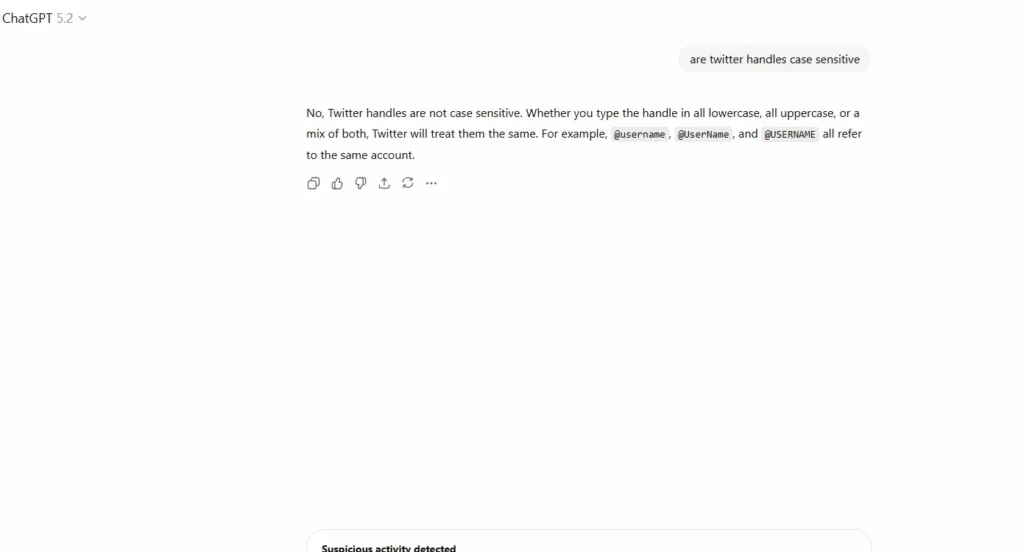
I asked ChatGPT the exact same question. Got a clean, confident answer: handles aren’t case sensitive, @username and @UserName and @USERNAME all point to the same account. Correct information. Our information, arguably — or at least information that sites like ours spent time writing, structuring, and publishing so it could be discovered through search. ChatGPT offers nothing in return. No link. No citation. No “this comes from…” nothing. Just the answer, served up like it was born knowing it.
Grok’s fake attempts to cite sources, but the user experience makes actually visiting those sources almost impossible.
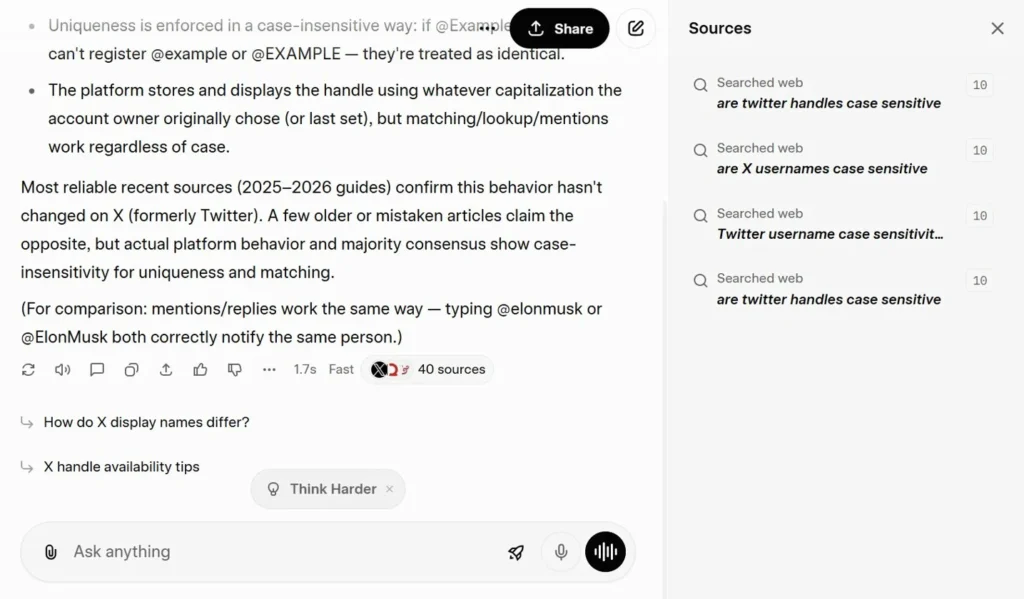
Grok’s approach is fascinating in how it technically gives credit while practically ensuring nobody follows through on it. You get the answer upfront. Sources are tucked behind a “Sources” button on the side. Click that, and you see a panel with search queries Grok ran — not even direct links to the cited pages. You’d need to click through at least two or three more times before you’d land on any publisher’s website. That’s not a citation. That’s a fig leaf.
Also? Grok pulls from X posts, web content, whatever it can scrape — and the sourcing is even less transparent. Reports from 2025 confirmed xAI was ignoring robots.txt directives entirely, crawling sites that explicitly told bots to stay out.
The Core Problem Nobody Wants to Say Out Loud
Google trained on our content. Our meta description. Our article body. Our structured explanation. By our I am not representing my own website or a one blog post but over all publishers from the internet. theGoogle built a product feature that answers the question so completely at the top of the page that there’s zero reason for anyone to scroll down and visit the source.
That’s the transaction publishers didn’t agree to. You write it. Google indexes it. Google learns from it. Google serves its own version of it. You get pushed to page irrelevance.
The data around zero-click searches tells the story cold. About 58% of Google searches in the US now end without a single click to any website. When AI Overviews are present, that jumps to 43% zero-click rate according to some tracking — and in Google’s newer AI Mode, 93% of sessions end without anyone leaving Google’s ecosystem at all. Seventy-five percent of AI Mode sessions never result in an external visit. Users spend an average of 49 seconds inside AI Mode, get their answer, and leave. The publisher who created that answer? Never even knew someone was looking.
Reuters Institute’s 2026 report surveyed 280 media leaders across 51 countries and found that news publishers expect their search traffic to drop 43% over the next three years because of AI summaries and chatbots. A fifth of those surveyed expect losses exceeding 75%. That’s not pessimism — that’s executives at major media companies looking at their analytics and projecting forward based on real trends.
What a Fair Solution Would Actually Look Like
I’m not a UX designer at Google. I don’t run product at OpenAI. But the unfairness of the current system is hard to miss, and a few things seem obvious.
For Google’s AI Overviews specifically — if you’re going to serve a synthesized answer at the top of the page that was built from a specific publisher’s content, why not embed a visible, clickable preview of that source right there? Not a tiny text link buried at the bottom of the overview. An actual embedded preview — maybe a half-page glimpse of the source article, or a card that shows the publisher’s page with a clear “Read the full answer at [source]” prompt. The technology exists. Google already does rich previews for shopping results, recipe cards, and knowledge panels. Why does publisher content not get the same treatment?
When someone scrolls through the AI Overview and wants to keep reading, the original source should be the immediate next thing they see. Not ten other results. Not ads. The source. The site Google pulled from.
For ChatGPT — the complete absence of citation for factual queries is hard to justify. Even a simple “Source: theseospot.com” underneath the answer would acknowledge that the information originated somewhere. GPT knows where it learned things, or at least where its training data came from. Showing that isn’t technically difficult. It’s a product choice.
For Perplexity and Grok — making citations accessible in one click instead of three or four would at least give publishers a fighting chance at getting some traffic from their own content being used.
The UK’s Competition and Markets Authority is actually trying to do something about this. In January 2026, they proposed rules that would let publishers opt out of AI Overviews without losing their regular search rankings. Currently, the only way to prevent Google from using your content in AI summaries is the NOSNIPPET tag — which also kills your regular search snippets and tanks your visibility. You’re basically choosing between being plagiarized with credit or being invisible. Some choice.
This Isn’t Just About Big Publishers
We’re not the New York Times. TheSEOSpot is not a media conglomerate with licensing lawyers on retainer. We’re a blog that wrote a genuinely useful article about whether Twitter handles are case sensitive. That article served real people for years. It ranked. It brought visitors. It did what content is supposed to do.
And now an AI summary does the same job, using our work as its foundation, while our original page sits on the ninth or tenth position collecting dust.
Multiply that by every small publisher, every independent blogger, every niche site that spent time creating something useful for a specific audience. The aggregate effect is enormous. Chartbeat’s data covering 2,500+ sites shows the decline is happening across the board — not just to publishers who were already struggling.
The 33% decline in global publisher search traffic during 2025 represents millions of lost visits, millions in lost ad revenue, and for smaller sites, potentially the difference between staying online and shutting down. AdExchanger reported in January 2026 that some smaller publishers have already been forced to close, with more expected to follow throughout the year.
And while traffic from AI platforms is technically growing — ChatGPT sent 1.2 billion outgoing referrals to publisher sites between September and November 2025, which sounds impressive — that represents about 1% of total publisher traffic. One percent. All AI platforms combined.
Where This Leaves Bloggers and Small Publishers
I don’t have a neat answer. The honest take is that writing purely informational content — the “what is” and “how to” articles that Google can easily summarize — is becoming a losing bet. The data makes that clear. About 99.2% of keywords triggering AI Overviews have informational intent. That’s the category of content getting hit hardest.
What seems to survive better: content with genuine first-person experience, original data that AI can’t synthesize from existing sources, analysis that requires human judgment, and anything where the reader needs to interact with the source to get full value. AI can tell someone whether Twitter handles are case sensitive. It can’t show them a tool, walk them through a unique process, or give them a personalized recommendation based on their specific situation.
We’re also seeing that brands cited within AI Overviews actually get a boost — 35% higher organic CTR according to Seer Interactive. So the game isn’t entirely over. But it has fundamentally changed. The old promise of “create great content and Google will send you traffic” is broken. Google will take your great content, answer the user’s question with it, and send the user on their way. Whether you get anything from that exchange is increasingly up to chance.
That’s not a partnership. That’s extraction. And the data says it’s only getting worse.
FAQ
How much traffic have publishers lost because of Google AI Overviews?
Chartbeat data shows global publisher Google search traffic dropped 33% from November 2024 to November 2025, with US publishers seeing a 38% decline. Individual sites have reported losses ranging from 20% to 89% depending on the type of content. CTR drops of 47-61% when AI Overviews appear are documented by Pew Research and Seer Interactive.
What percentage of Google searches show AI Overviews?
Semrush data from late 2025 shows AI Overviews appearing in roughly 16% of queries after peaking near 25% mid-year. Other studies put the number higher, with some claiming up to 50-60% of US searches include some form of AI-generated summary, depending on the query type and measurement methodology.
Can publishers opt out of Google AI Overviews?
Currently, the only option is using the NOSNIPPET meta tag, which also removes your regular search snippets and severely hurts your organic visibility. The UK’s CMA proposed new rules in January 2026 that would allow publishers to opt out of AI features while keeping their normal search listings intact, but these haven’t been finalized yet.
Does ChatGPT send traffic to publisher websites?
Technically yes, but the numbers are marginal. ChatGPT sent 1.2 billion outgoing referrals between September and November 2025, which sounds large but represents roughly 1% of total publisher referral traffic when combined with all AI platforms. ChatGPT often provides direct answers without any visible citation or link to the source.
Are smaller blogs affected more than major publishers?
Independent sites creating informational content appear to be among the hardest hit. Ahrefs data shows some independent sites losing up to 65% of top-page traffic for “how to” and “what is” queries where AI Overviews now answer the question directly. Meanwhile, Reuters Institute reports that a fifth of media leaders expect traffic losses exceeding 75% over the next three years.