The main characteristics of an LP include:
- Stop buying into the content length myth
- Why your brain decides to hire someone in 3 seconds
- Why Do You Need SEO for Landing Pages?
- SEO-First Landing Pages
- Conversion-First SEO Pages
- Advanced Strategy: The Funnel Keyword Approach
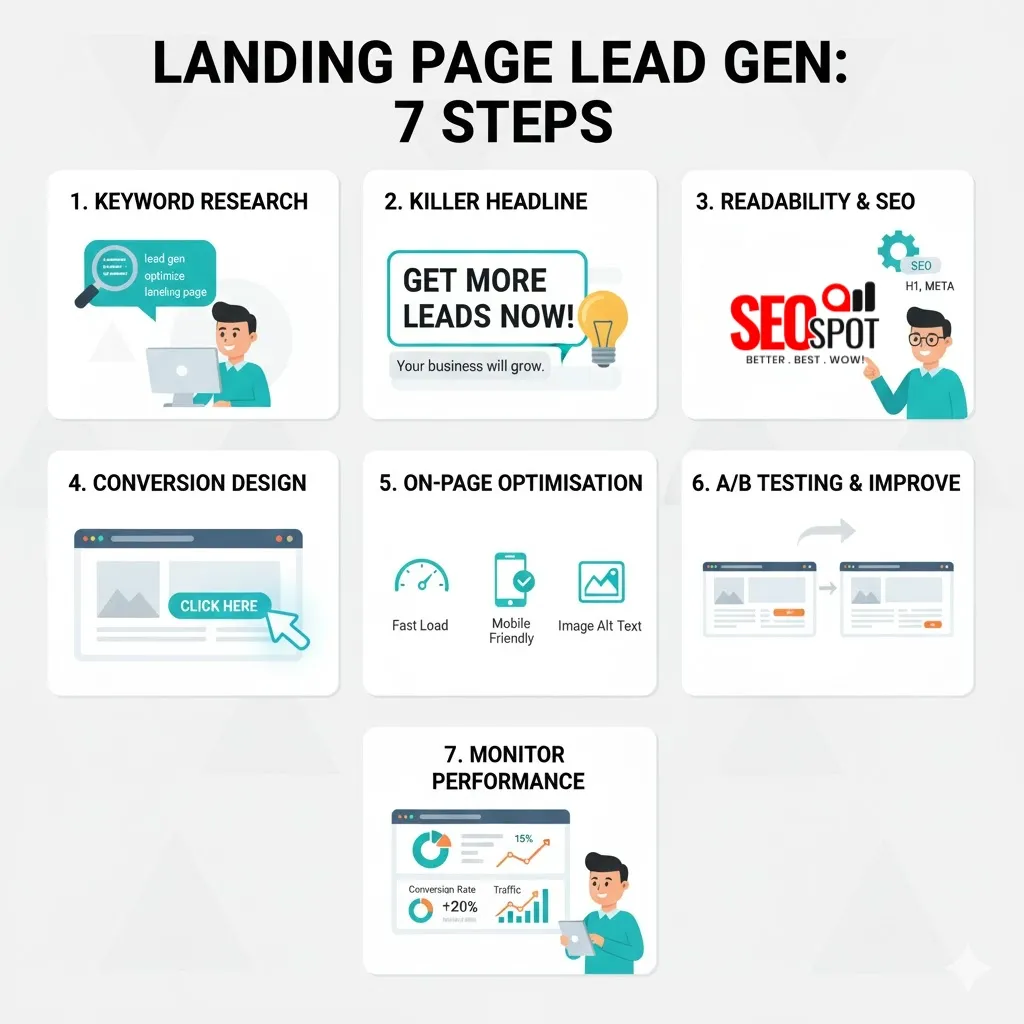
- How to Optimise a Landing Page for Lead Generation: 7 Steps
- 1. Conduct Keyword Research
- 2. Create a Killer Headline and Subhead
- 3. Optimise for Maximum Readability and SEO
- 4. Implementing Conversion-Focused Landing Page Design
- 5. Leverage On-Page Optimisation Techniques
- 6. Run A/B Testing and Improve
- 7. Engage in Ongoing Performance Monitoring
- Conclusion
- Conversion-oriented.
- Focus on one specific call to action (CTA).
- User-friendly and readable content that features a clear CTA.
Most marketers are stuck in 2020 thinking about landing pages – treating SEO and conversions as separate battles. But in 2025, the winners are using psychological triggers and advanced SEO tactics that make their pages rank AND convert simultaneously.
So, how do you do this?
In this article, we’ll define the key concepts, tell you about the importance of building an SEO landing page, and share the specific steps you should take to secure conversions.
Stop buying into the content length myth
Everyone’s been fed this garbage that SEO pages need 2,000+ words while landing pages should be short and punchy. That’s complete nonsense, and it’s why most landing pages either rank terribly or convert poorly.
Here’s what actually happens: you build a beautiful, conversion-focused landing page with clear headlines, strong calls-to-action, and zero fluff. It converts great but sits on page 47 of Google because there’s nothing for search engines to work with. Or you create a massive SEO article stuffed with keywords that ranks well but reads like a Wikipedia entry – nobody’s calling you after reading that mess.
The real answer? Your landing page needs enough content to satisfy search intent AND enough persuasion to get people to take action. Sometimes that’s 800 words, sometimes it’s 2,500. Depends what people are actually looking for when they find you.
Take “hire graphic designer” searches. Someone typing that isn’t looking for a 3,000-word essay about design theory. They want to see work samples, understand your process, know your prices, and figure out if they can trust you. Give them exactly that, but do it in a way that covers all the related topics Google expects to see.
Why your brain decides to hire someone in 3 seconds
Your landing page isn’t just fighting for search rankings – it’s fighting for attention spans that barely last long enough to load the page. People make snap judgments about whether they trust you before they’ve even read a single word.
This stuff directly impacts your SEO now because Google tracks how long people stay on your page, whether they bounce back to search results, and if they take any actions. Get the psychology wrong, and your search rankings tank along with your conversions.
Let’s say someone searches “hire graphic designer” and lands on your page. Their brain is instantly scanning for proof that you’re legit. They want to see work that looks better than what they could do themselves, evidence that other people have hired you and been happy, and some way to start a conversation without jumping through hoops.
Your portfolio needs to be front and center – not buried under paragraphs explaining your design philosophy. Show 6-8 pieces of your best work right at the top. Make it obvious what each project was for and maybe drop a quick line about the results it got.
Social proof comes next. Not testimonials that sound like your mom wrote them, but real feedback from actual clients. Screenshots of text messages, LinkedIn recommendations, even just “Currently working with 3 clients, next availability in 2 weeks” creates scarcity without being pushy.
The contact method matters more than you think. A phone number signals that you’re a real business. Live chat or quick contact forms work for people who hate phone calls. Email addresses look professional but feel slow. Give people options, because someone ready to hire you right now shouldn’t have to wait for you to check your email tomorrow.
Here’s what kills most graphic design landing pages: walls of text about your process, education, or passion for design. Nobody cares until they’ve already decided you might be worth talking to. Lead with results, back it up with proof, make it easy to reach you. Everything else is just noise that makes people hit the back button.
Why Do You Need SEO for Landing Pages?
Since LPs serve as final destinations for people who interact with your marketing campaign, it might not be so clear why bother about landing page optimisation. Nevertheless, doing so can give you a massive competitive edge.
By creating SEO-friendly LPs, you ensure that they are being found organically in addition to driving leads who see your ads. This means greater exposure for your campaigns, without additional investment in paid advertising.
Furthermore, since landing pages are conversion-oriented, they typically use high-intent keywords that people look up when they are in the middle or end of the funnel. This means that optimising these pages can let you convert high-potential organic traffic into solid leads.
The Two Types of SEO Landing Pages
Stop guessing. Start converting. Master both approaches and dominate search results while turning visitors into customers.
SEO-First Landing Pages
Rank first, convert second
- 2,000+ words of comprehensive content
- Multiple keyword targets in one page
- Educational focus with soft sell approach
- Internal linking to other resources
- FAQ sections and related topics
- Longer user sessions and lower bounce rates
Conversion-First SEO Pages
Convert first, rank second
- Focused messaging around one core offer
- Clear value proposition above the fold
- Strong calls-to-action throughout
- Social proof and testimonials
- Minimal navigation to reduce distractions
- Mobile-optimized for quick decisions
Advanced Strategy: The Funnel Keyword Approach
The Bridge Strategy
Use your SEO-focused landing page to target top-funnel keywords and capture early-stage visitors. Then guide them through internal links and retargeting to your conversion-focused pages where they’re ready to buy.
The Bottom Line
Stop treating SEO and conversion optimization as separate strategies. The best landing pages do both – they rank high AND convert well. Choose your approach based on search intent, not outdated best practices.
How to Optimise a Landing Page for Lead Generation: 7 Steps
1. Conduct Keyword Research
Before you start building your SEO optimised landing page, you need to start with some preparation and target relevant, high-intent keywords that you will use on your page. To do this, you need to perform in-depth keyword research using tools like Google Keyword Planner or similar. Research words and phrases that relate to your business and the purpose of the particular page to find relevant and high-traffic queries. Also, keep an eye on the competition for each term- when it’s low, you have a higher likelihood of ranking for it.
Most importantly, target long-tail, intent-driven keywords for maximum conversions. For example, if your LP is created to sell sports shoes, you want to go beyond the generalised “sports shoes” keyword and also target more specific queries like “buy sports shoes in [your area],” etc.
2. Create a Killer Headline and Subhead
A headline is the very first thing visitors will see on your page, and a sub-headline is a short paragraph of supporting copy that reinforces the power of the headline and encourages people to take action instantly or continue reading.
Both these elements have to be very snappy and clear. According to experts, the perfect length of these two elements shouldn’t exceed 10-15% of the total word count. A headline should make a statement that perfectly aligns with the reason why a user clicked on your ad in the first place. A sub-headline should provide extra details on what users will get after performing an action.
Your primary keyword should be naturally integrated into the headline, and you can use either a primary or a secondary keyword in the following statement.
3. Optimise for Maximum Readability and SEO
Unlike product pages, blog articles, and other content on your site, LPs are meant to be concise and without unnecessary fluff. They need to convey the most important information. Yet, they shouldn’t tire or overwhelm visitors. Thus, brevity and readability are must-haves. On average, the recommended word count for an LP is about 500-1,000 words.
In order to fit all the crucial information into this word count, you need to organise several blocks with distinct subheadings, each covering something important like features, benefits, pricing, customer reviews, etc. Under these subheadings, you need to provide short and straight-to-the-point text blocks.
If you are not sure how to structure your LPs correctly, it can be helpful to watch your competitors. You can run an all-around content audit of your direct competitors to see how they organise their landing pages for success.
4. Implementing Conversion-Focused Landing Page Design
The traditional web design that may work for other website pages, unfortunately, doesn’t make the cut for LPs. It has to be much more focused, clean, and persuasive.
The typical anatomy consists of the following elements:
- Hero media (image, video, etc.) that instantly captures attention.
- A brief headline that matches the user’s initial intent.
- Supporting copy that makes a statement “for” your offer (aka persuades the user to take the action).
- Subheadings with supporting copy that communicate different important details of your offer, for example, clarify your unique selling points, features, benefits, etc.
- Social proof in the form of user feedback, awards, etc.
- Reinforcing statement that leaves users with no doubts about taking the target action.
Follow this structure in your design to create LPs that convert. And, most importantly, strategically incorporate clickable CTA buttons after each section to let visitors take action quickly and easily.
5. Leverage On-Page Optimisation Techniques
Implementing on-page SEO best practices on your LP should help you improve your page’s visibility in SERPs and drive organic traffic. The main steps you should take include:
- Integrate target keywords naturally into headings and subheadings.
- Spread your primary and secondary keywords through the body content strategically, without compromising the quality or value.
- Craft descriptive, clear, and well-optimised meta titles and descriptions. And don’t forget to keep them short for maximum visibility for mobile users.
- Optimise the media files, enable caching, and use other tricks to maintain a fast loading speed.
- Make sure that your LP looks and works great for different screen sizes.
Improving landing page performance for higher traffic and conversions requires a holistic approach. Thus, after you handle on-page SEO, it will be wise to go beyond. By saying this, we mean engaging in guest blogging and fostering relationships with reporters, influencers, and other brands to receive high-quality backlinks for your LPs. Backlinks will serve as additional votes of trust and will further improve your rankings in SERPs.
6. Run A/B Testing and Improve
A/B testing for landing pages is like the holy grail that lets you see the flaws and find a version of your page that can bring the best results. If you want to create LPs that rank high and convert, there is no way you can skip this step.
Launch a few versions of your LP simultaneously and leverage reliable software to track the performance. At the end of the test period, compare the outcomes to find the top-performing version for your marketing campaign.
Apart from the possibility of enhancing conversion, what this will do for you is a chance to detect issues and improve UX for long-term success.
7. Engage in Ongoing Performance Monitoring
Lastly, after you handle all the stages of landing page optimisation, focus on growth and continuous improvement. Leverage analytical tools that you trust, such as Google Analytics and similar, and collect real-time insights into your SEO, conversions, and other outcomes.
Leverage data-based insights to strategically improve your campaigns over time and get the best ROI you can!
Conclusion
A landing page, on its own, is typically meant for marketing purposes with the sole goal of converting traffic from ads into qualified leads. However, while so many businesses focus on creating them only with their campaigns in mind, you can add some SEO to this equation and get even greater results.
As you now know, an SEO landing page can bring you double the benefit. Thanks to a high position in SERPs, it can let you capture and convert high-intent organic traffic. So don’t hesitate to use this to your benefit!