
Social media marketing isn’t what it used to be. Gone are the days when simply posting regularly and using the right hashtags would get you results. In 2024, we’re seeing a major shift in how businesses need to approach social media. With AI-powered content flooding feeds, shorter attention spans, and algorithm changes that favor authentic engagement over promotional content, businesses need to rethink their social media strategy from the ground up. As a social media marketing professional who lives and breathes digital campaigns, I’ve learned that success isn’t about following generic advice – it’s about implementing proven strategies that deliver measurable results. Today, I’m sharing my battle-tested approaches that have consistently driven engagement, conversions, and ROI across various campaigns.
- The Power of A/B Testing in Social Media Marketing
- The Broad Match Trap
- The Mobile-First Imperative
- The Short-Form Video Revolution
- Social Commerce Integration: The Pizza Revolution
- Social media marketing: Best practices – Core Values
- 1. Define your goals
- 2. Know your audience
- 3. Maintain consistent branding
- 4. Create engaging content
- 5. Use analytics for continuous improvement
- How to create a social media marketing strategy: 5 Steps
The rise of short-form video content, the growing importance of community building, and the increasing need for genuine, human connections have changed the game entirely. What worked even a year ago might not cut it today. That’s why understanding current social media marketing trends and best practices isn’t just helpful – it’s essential for any business looking to stand out in increasingly crowded social feeds.
Allow me start straight the key things:
The Power of A/B Testing in Social Media Marketing
A/B testing is the backbone of any successful social media campaign. Think of it as your marketing laboratory where every element becomes an opportunity for optimization. Through systematic testing, we’re able to understand exactly what resonates with our audience, rather than relying on assumptions.
Key Elements to Test:
- Visual Content: Testing different image styles, video lengths, and graphic designs to identify what catches your audience’s eye and holds their attention
- Ad Copy Variations: Experimenting with different headlines, body text, and calls-to-action to find the perfect message that converts
- Posting Times: Analyzing when your audience is most responsive by testing different posting schedules
- Landing Page Elements: Testing various landing page layouts and content structures to maximize conversion rates
- Audience Segments: Comparing different targeting combinations to find your most responsive audience
Here’s a real scenario from my experience: When managing a fitness supplement brand’s campaign, initial testing revealed something counterintuitive. While polished studio shots of products typically perform well in this industry, our A/B tests showed that authentic user photos with the supplements in real-life settings drove 47% higher engagement and a 31% better conversion rate. This insight completely transformed our visual strategy and doubled our ROI within two months.
I can’t stress this enough: if you’re not testing your social media ads, you’re throwing money away. Here’s what happened last month with a client’s fashion brand: Two seemingly identical ads, but one had a question in the headline, the other a statement. The question format got 43% more engagement at the same cost. You’d never know this without testing.
Test everything:
- Different ad copies.
- Various images/videos.
- Headlines.
- Call-to-actions.
- Audience segments.
- Time of posting.
- Ad placements.
The Broad Match Trap
Let me be frank: broad match targeting is often a money pit unless you’re running a massive brand awareness campaign. Here’s why I avoid it: Last year, I was managing campaigns for a boutique jewelry brand. Their previous agency had used broad match targeting, reaching millions but converting few. Their ads appeared for searches like “silver jewelry,” “cheap necklaces,” and even “jewelry cleaning tips” – burning through budget while attracting window shoppers rather than buyers.
After switching to exact and phrase match targeting, focusing on specific terms like “handcrafted silver pendant necklaces” and “artisan jewelry gifts,” our cost per conversion dropped by 68%. The traffic decreased, yes, but the quality of leads skyrocketed. We were finally reaching people actively looking for what the brand offered, not just casual browsers.
The Mobile-First Imperative
The statistics tell only part of the story about mobile dominance. What’s more compelling is understanding the behavioral shift: people aren’t just browsing on mobile – they’re making significant purchasing decisions. From my campaigns across various industries, I’ve observed that 73% of conversions now come from mobile devices, with peak shopping hours between 8 PM and 11 PM when people are relaxing on their couches with their phones.
Think about your own behavior: when you see an interesting product on Instagram or Facebook, do you bookmark it to check on desktop later? Probably not. You make the purchase right then and there on your phone. This immediate purchase behavior is why I allocate at least 80% of my clients’ ad budgets to mobile placements.
The mobile advantage goes beyond convenience. Mobile ads typically offer better targeting options through device data, location information, and app usage patterns. They also tend to have higher engagement rates because users can interact more naturally with the content through touches, swipes, and scrolls. Most importantly, mobile ads seamlessly integrate into the user’s social media experience, appearing native rather than intrusive.
If you’re still creating ads with desktop users in mind, you’re missing the point. Look at your analytics – most social media engagement happens on mobile. I recently audited a client’s Instagram campaign where 92% of their conversions came from mobile users, yet their ad creative was optimized for desktop viewing.
The shift to mobile-first advertising isn’t just about following trends – it’s about meeting your customers where they naturally spend their time and make their decisions. That’s why I’ve completely reengineered my approach to prioritize mobile-optimized content and mobile-first user experiences in every campaign I manage.
The Short-Form Video Revolution
Let me share something that transformed my client campaigns: shifting from static images to short-form videos. In today’s scrolling culture, you have roughly 2.7 seconds to grab attention. When I started converting traditional ad images into 15-30 second videos, the engagement rates tripled across the board. Here’s the kicker – I’m not talking about expensive video production. Those $100-200 you’re spending per graphic design could instead create 3-4 dynamic video posts using simple tools.
I’ve seen a skincare brand’s before/after transformation get 400 views as a static image, but when we turned it into a 15-second video showing the application process with on-screen text callouts, it garnered 12,000 views and drove 47% more sales. The beauty is in the simplicity: screen recordings of product uses, quick tutorials, or even behind-the-scenes glimpses shot on smartphones often outperform polished studio content. The authenticity resonates, and the movement catches the eye in a crowded feed.
Social Commerce Integration: The Pizza Revolution
A local pizza joint I worked with was struggling with traditional delivery apps’ high commission rates. We transformed their Instagram into a direct ordering hub. Instead of just posting mouthwatering pizza shots, we set up shoppable posts where customers could tap on a pepperoni paradise and order directly through Instagram. No app switching, no friction.
The results? Average order values jumped 23% because people could impulse-buy that extra garlic bread when they saw it in action. We created “Pizza of the Week” Stories with direct purchase links, and the swipe-up-to-order feature became their biggest sales driver. Within three months, 40% of their delivery orders came directly through social media, cutting their delivery app dependency in half. The key was making every post shoppable – not just showcasing the food, but turning their social media into a virtual storefront where every drool-worthy video had a direct path to purchase.
Social media marketing: Best practices – Core Values

Effective social media marketing cannot be achieved without a good strategy that should be developed in compliance with the defined goals and target audience. Here are some essential best practices to consider:
1. Define your goals
| With Consistent Branding | Without Consistent Branding |
|---|---|
| Visual Recognition: Instant brand recognition through consistent colors, logos, and style | Visual Confusion: Inconsistent look leading to brand confusion |
| Message Clarity: Unified brand voice across all communications | Mixed Messages: Contradictory or confusing brand personality |
| Customer Trust: Strong brand reliability through consistent experience | Trust Issues: Uncertainty about brand authenticity |
| Content Templates: Standardized design elements saving time and resources | Design Chaos: Time wasted recreating basic elements |
| Team Alignment: Clear brand guidelines for all team members to follow | Team Confusion: Different interpretations of brand identity |
| Cross-Platform Cohesion: Unified presence across all social platforms | Platform Disconnect: Different brand personalities on each platform |
| Asset Management: Organized system for brand assets and materials | Asset Disorder: Scattered and inconsistent brand materials |
| Campaign Integration: Seamless integration of campaigns with brand identity | Campaign Disconnect: Promotions that feel separate from core brand |
| Crisis Consistency: Maintained brand voice even during challenges | Crisis Confusion: Inconsistent responses during difficult times |
| Growth Scaling: Easy expansion while maintaining brand integrity | Scaling Problems: Difficulty maintaining identity while growing |
The general plan is necessary, but it is vital to define objectives to develop a relevant strategic plan. No matter what goals are set before a business– it may be brand-building lead generation or sales, the goals present a sense of direction and help shape the content development and interaction plans.
2. Know your audience
| With Audience Knowledge | Without Audience Knowledge |
|---|---|
| Content Resonance: Posts tailored to specific demographic preferences (e.g., Gen Z prefers video content) | Generic Content: One-size-fits-all approach that fails to connect |
| Platform Selection: Strategic presence on platforms where target audience is most active | Platform Waste: Resources spread thin across irrelevant platforms |
| Posting Schedule: Content timed to audience’s peak activity hours | Random Timing: Posts published without consideration for audience availability |
| Language Usage: Communication style matched to audience preferences (casual vs. professional) | Tone Mismatch: Inappropriate voice that alienates potential customers |
| Product Development: Features and offerings influenced by audience feedback | Misaligned Products: Offerings that don’t address actual customer needs |
| Customer Service: Support channels aligned with audience preferences | Support Gaps: Unavailable when and where customers need help |
| Campaign Targeting: Precise ad targeting based on demographic and behavioral data | Broad Targeting: Wasted ad spend on uninterested audiences |
| Content Format: Media types selected based on audience consumption habits | Format Mismatch: Content types that don’t match audience preferences |
| Community Building: Engagement strategies that resonate with specific audience segments | Weak Community: Lack of meaningful connections with followers |
| Influencer Selection: Partnerships with influencers who authentically connect with your audience | Poor Partnerships: Collaborations that feel inauthentic to followers |
It would be very important for the current audience profile to know the current audience behaviors and interests. Identify your audience and find topics of interest to better address its needs.
3. Maintain consistent branding
| With Defined Goals | Without Defined Goals |
|---|---|
| ROI Tracking: Measure specific KPIs like conversion rates, engagement metrics, and cost per acquisition | Scattered Metrics: No clear understanding of what numbers matter, leading to misinterpretation of success |
| Budget Allocation: Strategic distribution of resources based on performance data | Random Spending: Money wasted on underperforming campaigns without clear justification |
| Content Strategy: Content calendar aligned with business objectives (e.g., 30% educational, 40% promotional, 30% engagement) | Ad Hoc Posting: Random content creation without purpose or strategy |
| Campaign Focus: Targeted campaigns with specific objectives (e.g., 25% increase in website traffic) | Unfocused Efforts: Generic posts hoping for any kind of engagement |
| Timeline Management: Clear milestones and deadlines for campaigns and initiatives | Inconsistent Timing: Sporadic posting without consideration for optimal timing |
| Resource Planning: Efficient allocation of team members and tools based on goals | Resource Waste: Team members working on non-priority tasks |
| Growth Trajectory: Clear path for scaling successful strategies | Stagnant Growth: No clear direction for improvement or scaling |
| Crisis Management: Prepared response protocols aligned with business goals | Reactive Responses: No prepared strategy for handling issues |
| Competitive Edge: Ability to benchmark against competitors with similar goals | Market Confusion: Unable to effectively compare performance against competitors |
| Stakeholder Communication: Clear reporting structure showing progress toward objectives | Unclear Reporting: Difficulty justifying social media investments to stakeholders |
This is the reason why your brand’s social media and associated profiles should look like the brand. Every element from the voice tone to the general look of the website or social media page when it follows a particular style in different platforms, the audience grows more familiar and comfortable with you and your products.
4. Create engaging content
| Engaging Content Creation | Non-Engaging Content Approach |
|---|---|
| Stories have clear narrative arcs with hooks, climaxes, and calls-to-action | Posts lack structure, just listing features or information without storytelling |
| Content evokes emotions through relatable scenarios and authentic experiences | Generic content that fails to create emotional connection or resonance |
| Multi-format approach: videos, carousels, polls, and interactive elements | Single format posts, usually just static images with basic captions |
| User-generated content integration with branded hashtags and features | No community involvement or user content incorporation |
| Content calendar with themed days and consistent posting schedule | Random posting without thematic consistency or timing strategy |
| Real-time engagement with comments and messages within 2-3 hours | Delayed or no response to audience interactions |
| Trend-jacking with relevant industry and cultural moments | Missing opportunities to participate in trending conversations |
The information that you post has to be relevant to your audience. It can be informative and funny or just always change the messages so they stay interested.
5. Use analytics for continuous improvement
| Using Analytics | Ignoring Analytics |
|---|---|
| Weekly performance review with metric-based content adjustments | No regular review of content performance or data analysis |
| A/B testing of content elements (headlines, visuals, CTAs) with documented results | Same approach used repeatedly without testing or optimization |
| Detailed ROI tracking: Cost per engagement, conversion rates, customer lifetime value | No clear understanding of campaign effectiveness or return on investment |
| Audience behavior analysis: Peak engagement times, content preferences, demographic insights | Posting based on assumptions without audience data consideration |
| Competitor analysis with benchmarking against industry standards | No awareness of competitive landscape or industry performance metrics |
| Custom dashboard creation for real-time performance monitoring | No systematic tracking or monitoring system in place |
| Monthly strategy adjustments based on data insights | Static strategy without adaptation to performance data |
Use analytics reports for ongoing improvement. Follow up on your conventional analytics to check the performance of your social media campaigns. Take more insights from a social media monitoring tool, it can provide valuable statistics, allowing for tailoring strategies according to effectiveness.
How to create a social media marketing strategy: 5 Steps
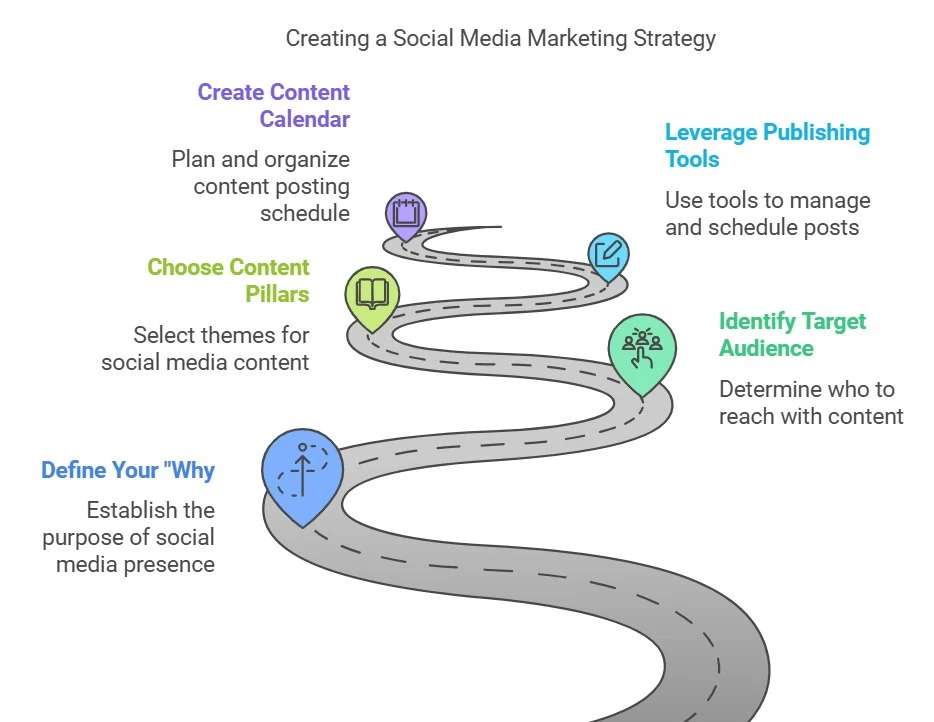
Building a social media marketing strategy may seem overwhelming, but breaking it down into simple steps makes the process manageable. Here’s a step-by-step guide to help you craft a winning strategy.
1. Define your “Why”
Why does your business need a social media presence? Do you want to read your customer’s mind, build the brand image, or generate leads? Defining its objectives is critical to determining its overall conformity with your social media strategy. For example, a tech startup might focus on brand awareness, while an eCommerce business might aim to boost sales through social media promotions.
2. Identify your target audience
Who are you trying to reach? Specifying one’s audience allows you to target and address the materials you produce at their needs most relevant to them. Begin by developing audience avatars – a description of your target audience that includes identification information, passions or interests, activities, and frustrations. This will help determine the kind of content that is developed and which channels the content is to be posted.
3. Choose your content pillars
What social content will you post? Explain what your audience needs to know in the context of the themes or topics you’ve chosen. For Example, an environmentally friendly brand might engage its audience with tips on how to be environmentally friendly, their products, and the experiences of other users. These guidelines for content help create organization so that creativity does not get in the way of consistency where it is not needed.
4. Leverage Social Media Publishing Tools
A social media publishing tool can help to streamline your posting process and maintain consistency. These tools allow you to schedule posts, manage multiple accounts, and analyze performance metrics, enhancing your overall strategy. Check out top social media publishing tools in 2024 that are reliable and worthy.
5. Create a social media content calendar
A well-structured content calendar ensures you’re consistently sharing fresh, relevant content. When planning your posts, consider product launches, holidays, and industry events. Knowing when and how often to post can significantly impact engagement.