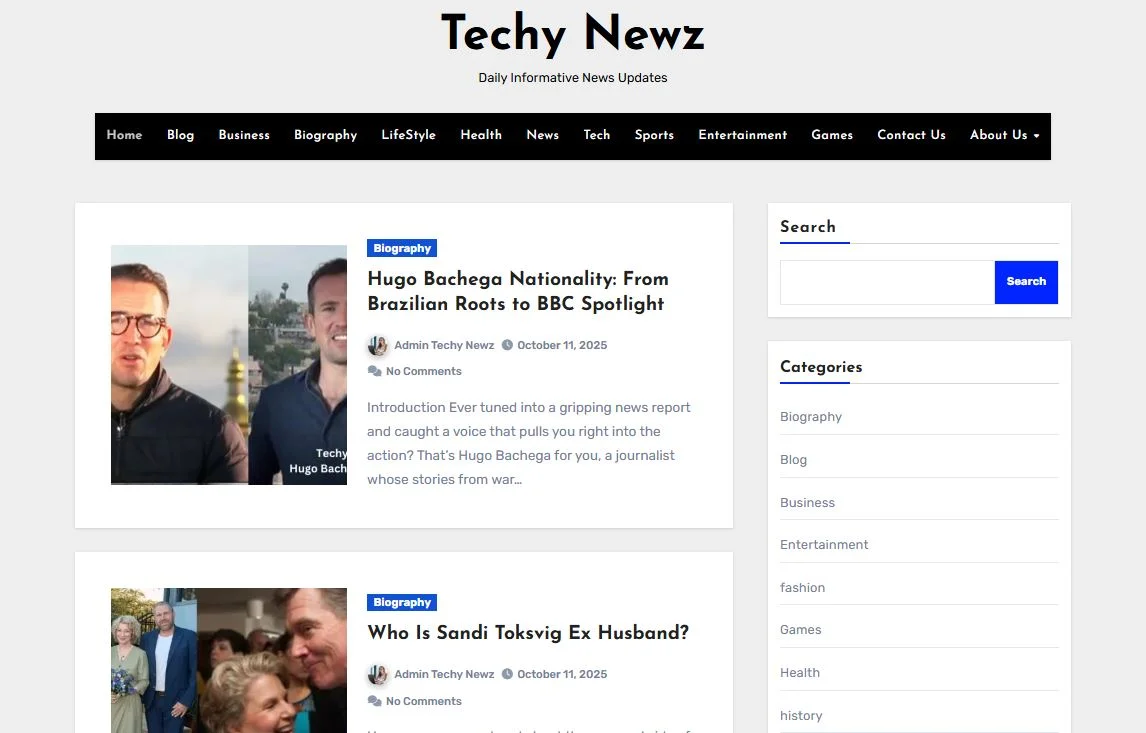
Found this one while browsing through tech news sites for a different project. TechyNewz.com. Generic name, kind of forgettable, but something about their backlink profile caught my eye.
- The Numbers Tell Two Different Stories
- The “Dangerous” Backlink Profile Explained
- What They’re Actually Doing Right
- The Mobile-Friendly Failure That’s Costing Them Traffic
- The Link Building Strategy (If You Can Call It That)
- What Google’s Algorithm Sees vs What’s Actually Happening
- The Content Strategy That’s Actually Working
- The Robots.txt and Sitemap Situation (At Least This Works)
- What TechyNewz Should Do (If They Want to Grow Instead of Stagnate)
- Fix the Mobile Issue Immediately
- Clean Up the Dangerous Link Profile
- Pick 2-3 Categories and Dominate Them
- Compress Those Components Already
- Target Questions Instead of Keywords
- The Trajectory: Where This Is Probably Headed
- What Other Small News Sites Can Learn
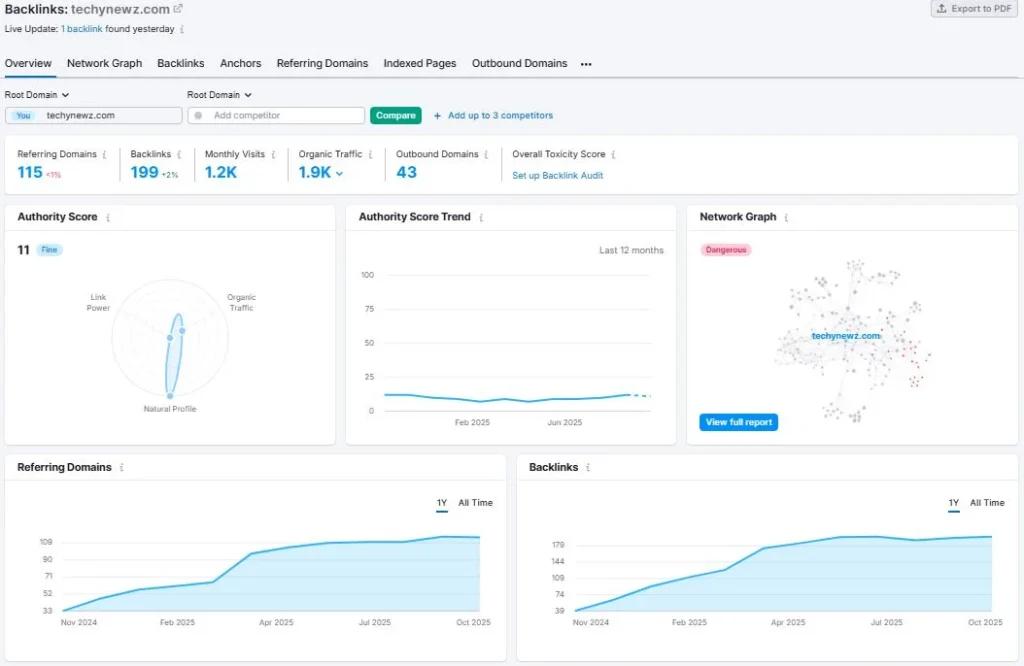
199 backlinks from 115 referring domains. Authority Score of 11. Not terrible numbers for a small news site. Pretty standard, actually.
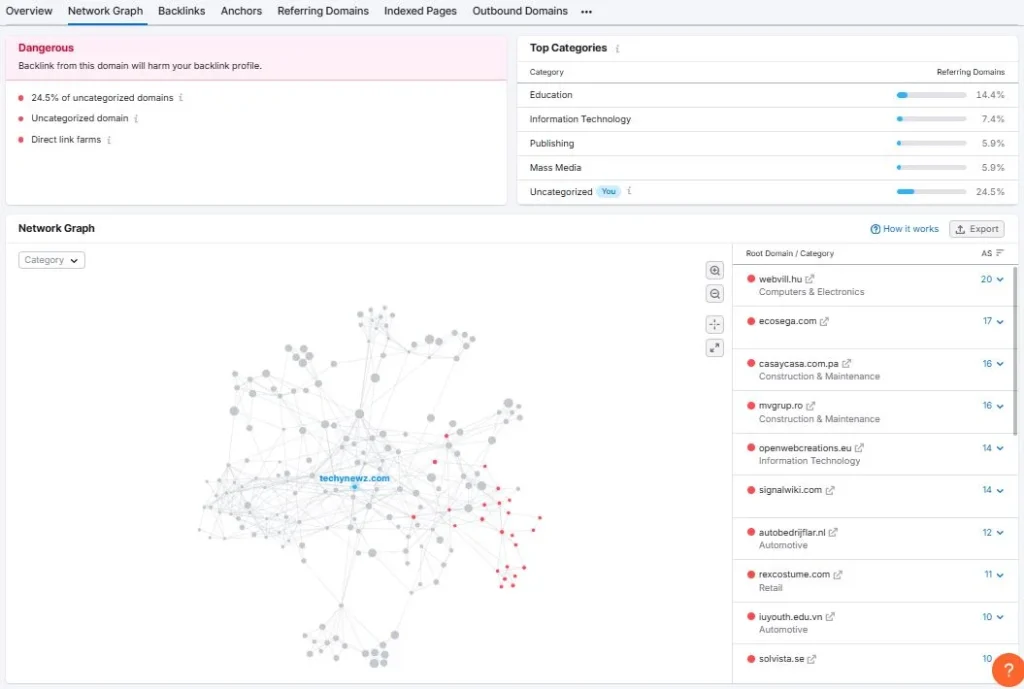
Then I saw the network graph tag: “Dangerous.”
Not “Suspicious” like we sometimes see. Not “Needs review.” Full-on “Dangerous – Backlink from this domain will harm your backlink profile.”
But here’s what’s weird—they’re still getting traffic. 1.9K monthly organic visitors. 305 keywords ranking. The site hasn’t been nuked by Google. Yet.
So I dug deeper. What I found is basically a case study in how to do just enough right to stay afloat while simultaneously building the exact link profile that could sink everything overnight. This is what happens when SEO exists in the grey area between legitimate tactics and stuff that’ll get you penalized.
Let me show you what they’re doing, what’s working and where this is probably heading.
The Numbers Tell Two Different Stories
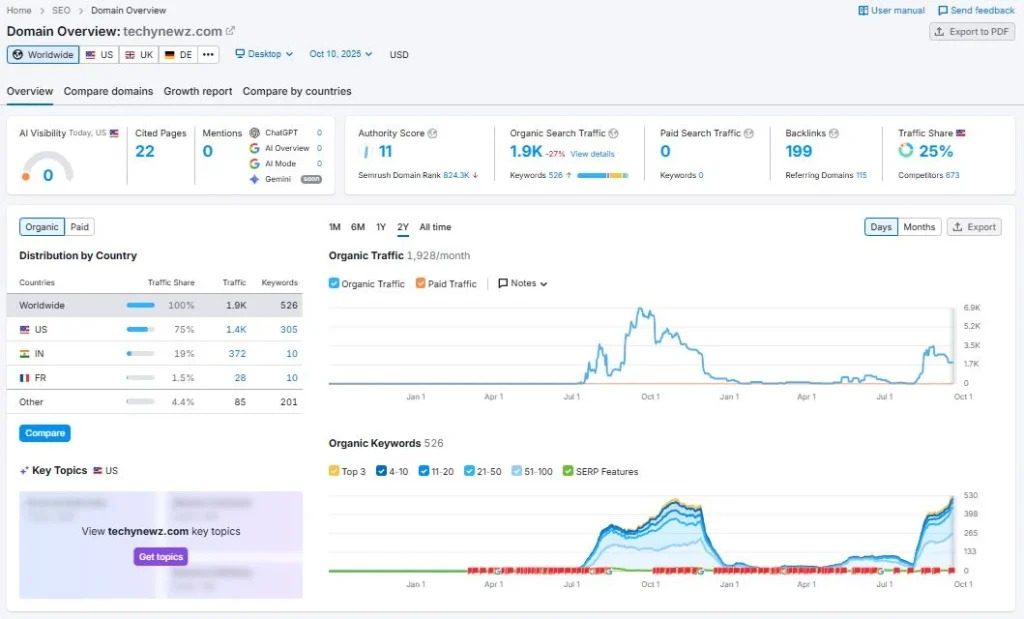
Looking at the Semrush overview, things seem… okay?
The “looks fine” metrics:
- Authority Score: 11
- Organic Traffic: 1.9K monthly (-27% but still existing)
- Keywords: 526 total
- Backlinks: 199
- Referring Domains: 115
For a news blog? That’s survivable. Not crushing it, but functional.
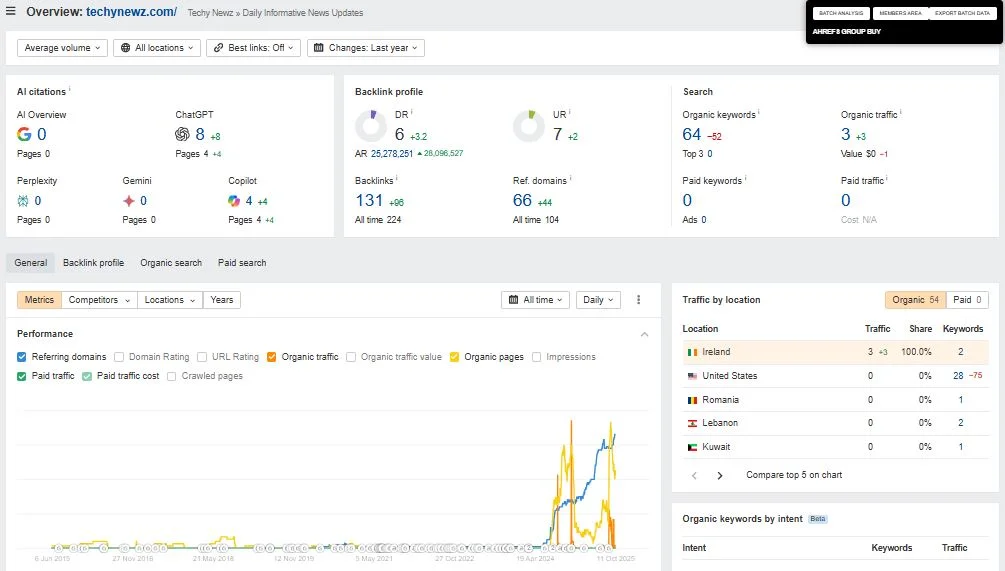
Ahrefs tells a slightly different story:
- Domain Rating: 6
- URL Rating: 7
- Backlinks: 131 (their count)
- Referring Domains: 66
- Organic Keywords: 64
- Organic Traffic: 3
Wait. Three? Ahrefs estimates 3 monthly visitors?
Tool discrepancies are normal, but Semrush saying 1.9K while Ahrefs says 3 is a massive gap. When estimates differ that dramatically, usually means:
- Traffic’s highly volatile (spikes then crashes).
- Keywords ranking are super low-volume.
- One tool’s data is way off.
- Or traffic’s coming from sources that don’t look organic.
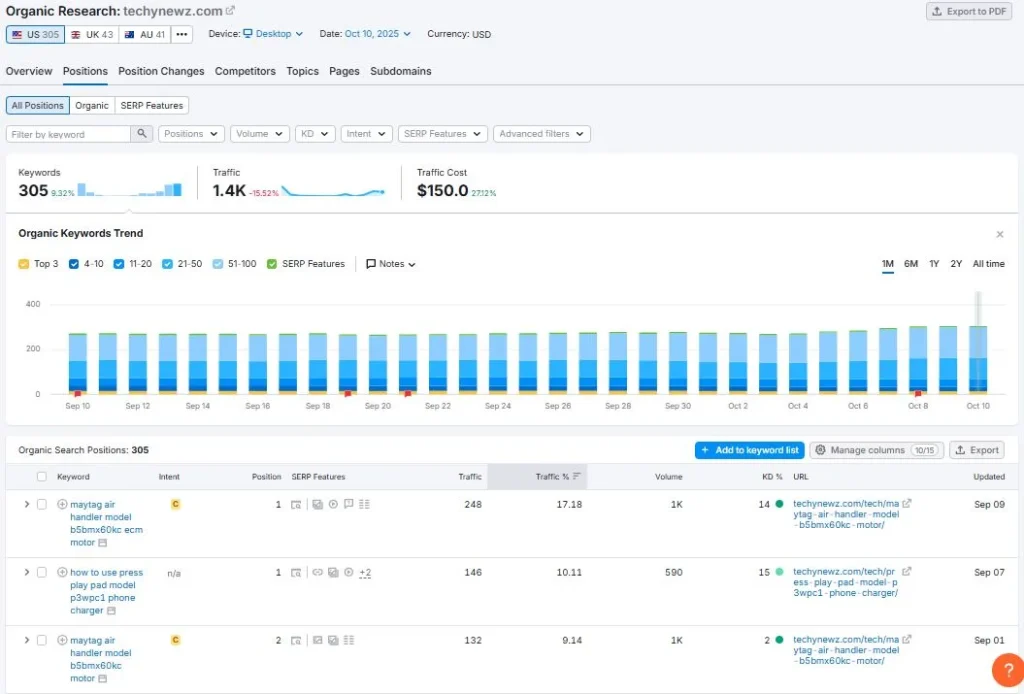
The organic research view shows 305 keywords and 1.4K traffic. So Semrush is at least internally consistent around the 1.4K-1.9K range.
Traffic by country:
- United States: 75% (1.4K visitors)
- India: 18% (372 visitors)
- France: 1.5% (28 visitors)
- Other: 4.4% (85 visitors)
That India traffic percentage jumped out. 18% is high for a site with an English-language, US-focused domain name. Either they’re deliberately targeting Indian audiences or they’re getting traffic from sources that over-index on Indian visitors (link exchanges, certain directories, etc.).
The Keyword Performance Reality
Their #1 keyword? “maytag air handler model b58mv60kc ecm motor” – Position 1, 248 traffic, 1K volume.
That’s… incredibly specific. And looking at the other top keywords:
- “how to use press play pad model p3wpc1 phone charger” – Position 1, 146 traffic.
- “maytag air handler model b58mv60kc motor” – Position 2, 132 traffic.
These aren’t news keywords. These are product support queries. Someone’s searching for tech manuals, product specifications, troubleshooting guides.
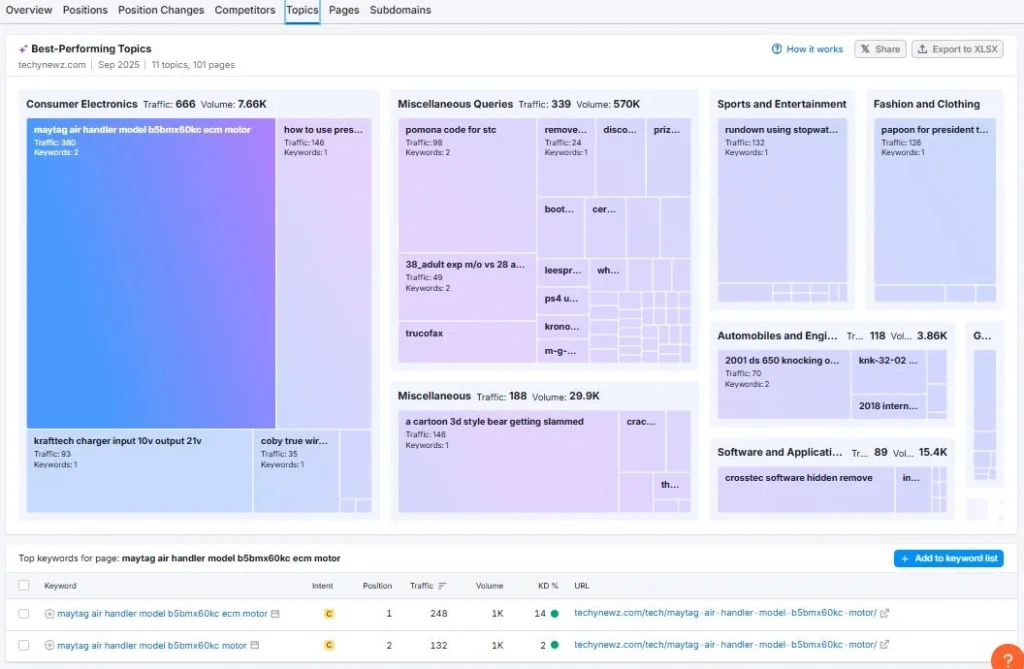
The topics breakdown shows what they’re actually covering:
- Consumer Electronics (Traffic: 666, Volume: 7.66K) – Biggest cluster.
- Miscellaneous Queries (Traffic: 339, Volume: 570K).
- Sports and Entertainment (smaller section).
- Fashion and Clothing (smaller section).
- Automobiles and Engineering (smaller section).
- Software and Applications (Traffic: 89, Volume: 15.4K).
They’re all over the place. News sites usually have topical focus—tech news, sports news, political news. TechyNewz covers consumer electronics, fashion, sports, software, automobiles, random queries.
That’s not a content strategy. That’s throwing stuff at the wall to see what ranks.
The “Dangerous” Backlink Profile Explained
Here’s where things get interesting. The network graph doesn’t just flag this as suspicious—it says “Dangerous.”
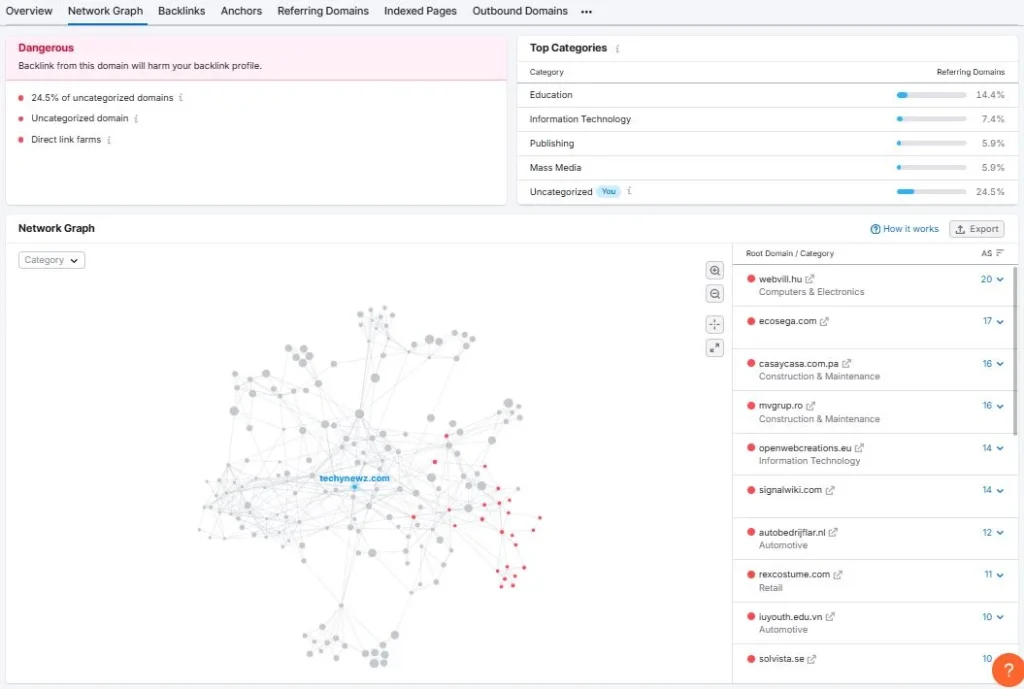
That warning appears when the tool’s algorithm detects patterns that actively harm your profile, not just low-quality links you should avoid building more of.
What triggers “Dangerous” classifications:
- Links from known spam networks.
- PBN connections that Google’s identified.
- Domains flagged for manipulation.
- Link schemes that have pattern-matched to penalties.
The network graph shows scattered, disconnected nodes with several red-flagged domains. Those red dots? Those are sites the algorithm identified as toxic.
Top Categories of referring domains:
- Education: 14.4%
- Information Technology: 7.4%
- Publishing: 5.9%
- Mass Media: 5.9%
- Uncategorized: 24.5%
One quarter of referring domains are uncategorized. That’s a problem. Legitimate sites have clear categories. Uncategorized usually means:
- New/unestablished domains.
- Domains that don’t fit standard categories (often spam).
- Sites with unclear or constantly changing content.
- PBN sites built to look like multiple types of sites.
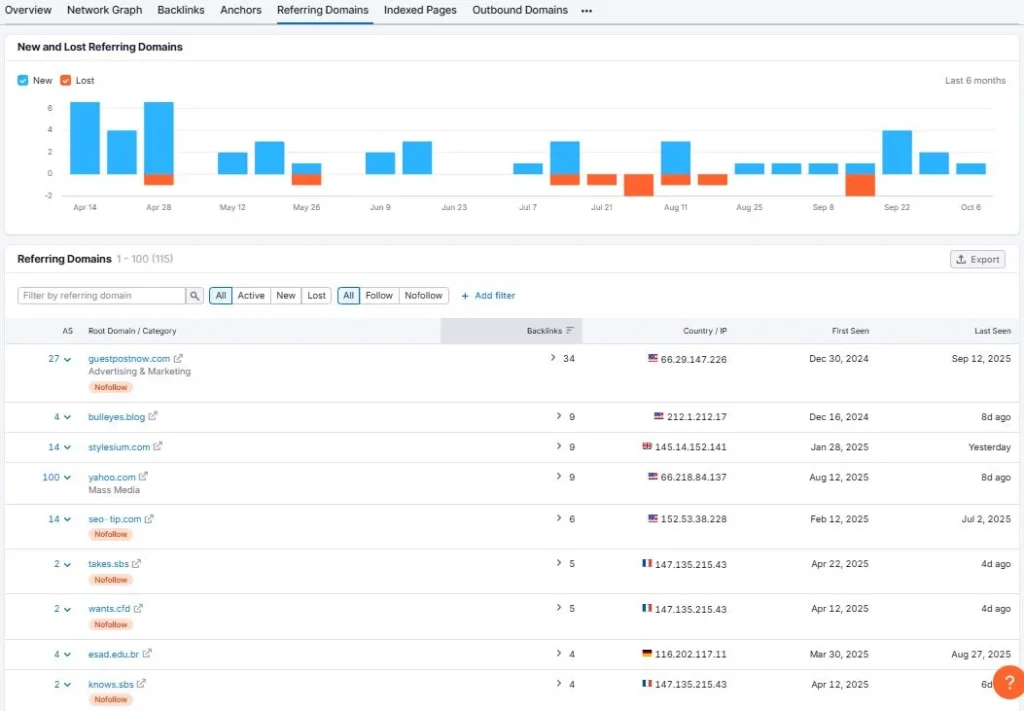
Looking at the actual referring domains:
Top sources by backlink count:
- guestpostnow.com (AS 27) – 34 backlinks, Nofollow.
- Advertising & Marketing category.
- This is literally a guest post marketplace.
- bulleyes.blog (AS 4) – 9 backlinks.
- Low authority.
- stylesium.com (AS 14) – 9 backlinks.
- Decent authority but questionable relevance.
- yahoo.com (AS 100) – 9 backlinks.
- Mass Media (legitimate source).
- seo-tip.com (AS 14) – 6 backlinks, Nofollow.
- SEO tool/service site.
So the link profile is a mix: one legitimate high-authority link from Yahoo, several from guest post marketplaces and SEO services and a bunch from low-authority blogs.
The Guest Post Marketplace Problem
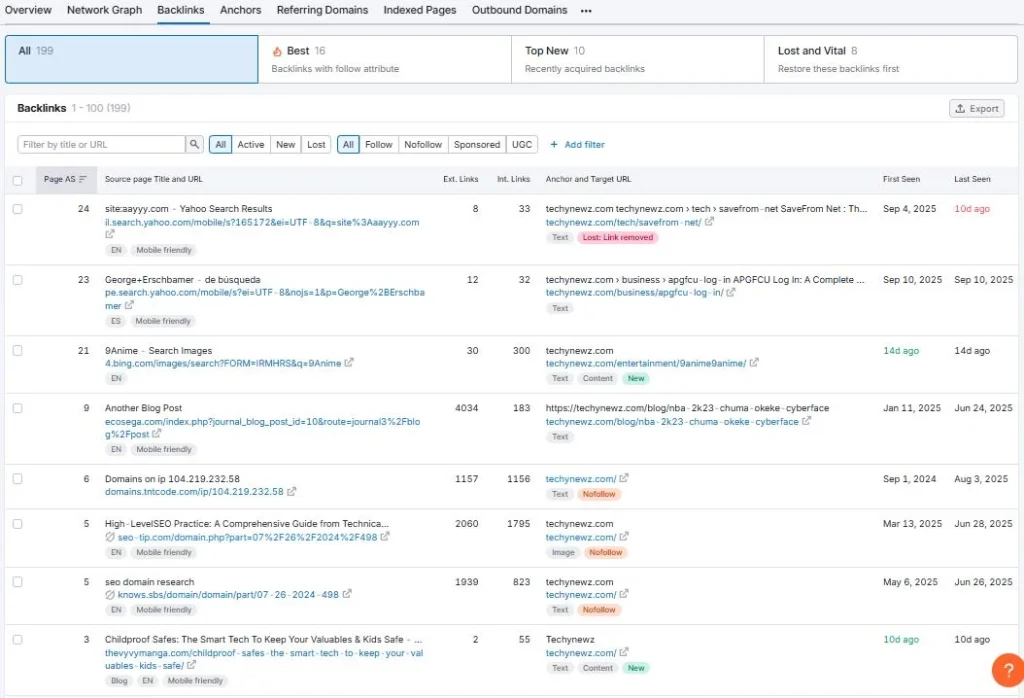
Scrolling through the backlinks, I see patterns:
- Links from site.aayyy.com (Yahoo Search Results redirect) – 8 external links, 33 internal.
- Links from pa.yahoo.com (mobile search results).
- Links from 4.bing.com (image search).
Those aren’t backlinks. Those are search engine result pages where TechyNewz appeared. Tools sometimes count SERPs as backlinks, but they’re not editorial links. They’re just… Google and Bing indexing the site.
The real backlinks show a different story:
Sample backlink anchors from Image 1:
- “techynewz.com” (33 referring domains, 27 dofollow).
- “https://techynewz.com/blog/nba-2k23-chuma-okeke-cyberface” (5 domains, 12 dofollow).
- “Logistis” (3 domains, 3 dofollow).
- “Conduit Tech Lead PM candidate” (2 domains, 1 dofollow).
- “visit techynewz.com for latest info” (2 domains, 0 dofollow).
- “tanyatsuruxoxo” (1 domain, 1 dofollow).
- “http://techynewz.com” (1 domain, 0 dofollow).
- “Londe Washington” (1 domain, 1 dofollow).
- Various article titles and promotional anchors.
Most anchors are branded (site name) or article-specific. That’s normal for news sites. But then you get random anchors like “Logistis,” “tanyatsuruxoxo,” and “Londe Washington” that have nothing to do with tech news.
Those are signatures of link exchanges or directory submissions where you don’t control the anchor text. Someone’s out there building links with whatever anchor the platform allows or assigns.
What They’re Actually Doing Right
Despite the dangerous backlink profile, TechyNewz has some things working in their favor.
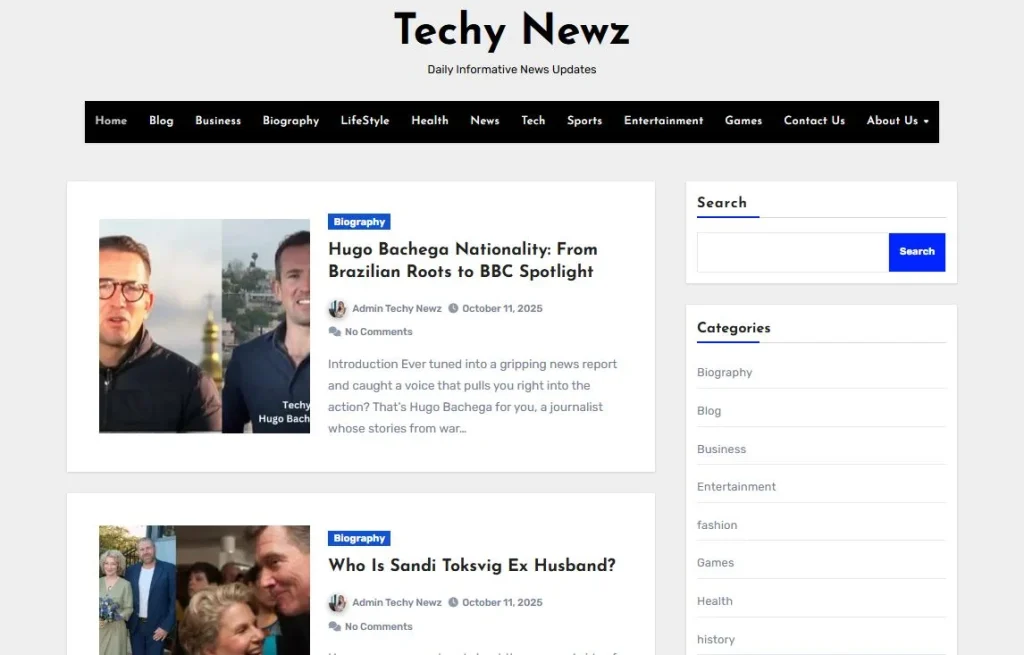
They have a real site. Not a placeholder. Not a thin affiliate site. Actual published articles with:
- Multiple content categories (Blog, Business, Biography, LifeStyle, Health, News, Tech, Sports, Entertainment, Games).
- Regular publishing (based on recent dates in backlink acquisition).
- Structured navigation.
- Search functionality.
- Professional design (not amazing, but functional).
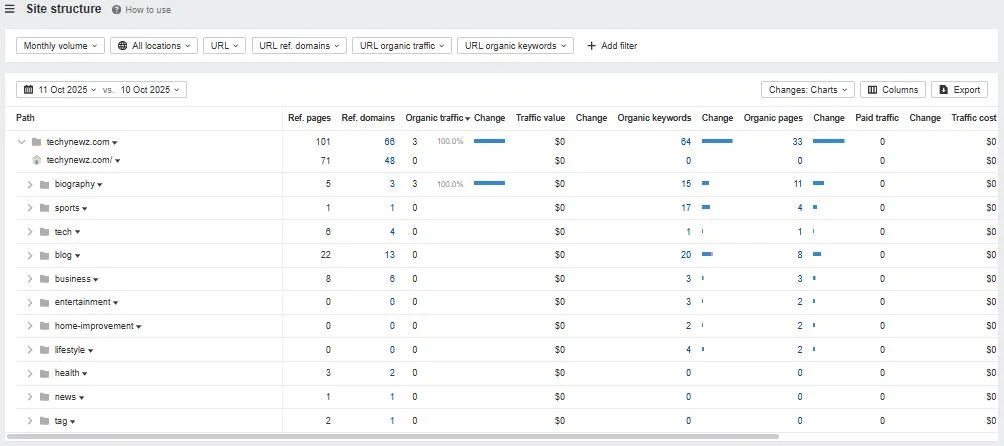
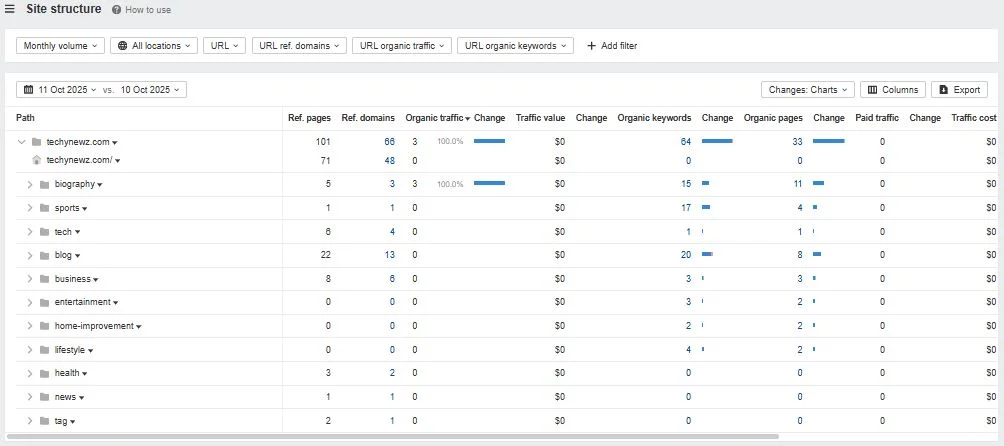
The site structure breaks down like this:
Main sections with actual content:
- /techynewz.com/ (root) – 101 referring pages, 68 domains.
- /techynewz.com/ subdirectory – 71 pages, 48 domains.
- /biography/ – 5 pages, 3 domains, 100% traffic increase.
- /sports/ – 1 page, 1 domain.
- /tech/ – 8 pages, 4 domains.
- /blog/ – 22 pages, 13 domains.
- /business/ – 8 pages, 6 domains.
- /entertainment/ – 0 pages, 0 domains.
- /home-improvement/ – 0 pages, 0 domains.
- /lifestyle/ – 0 pages, 0 domains.
- /health/ – 3 pages, 2 domains.
- /news/ – 1 page, 1 domain.
- /faq/ – 2 pages, 1 domain.
So they’ve got categories set up, but only blog, biography, tech, business and health are actually getting any link or traffic traction. The rest exist but aren’t performing.
The Content Topics That Work
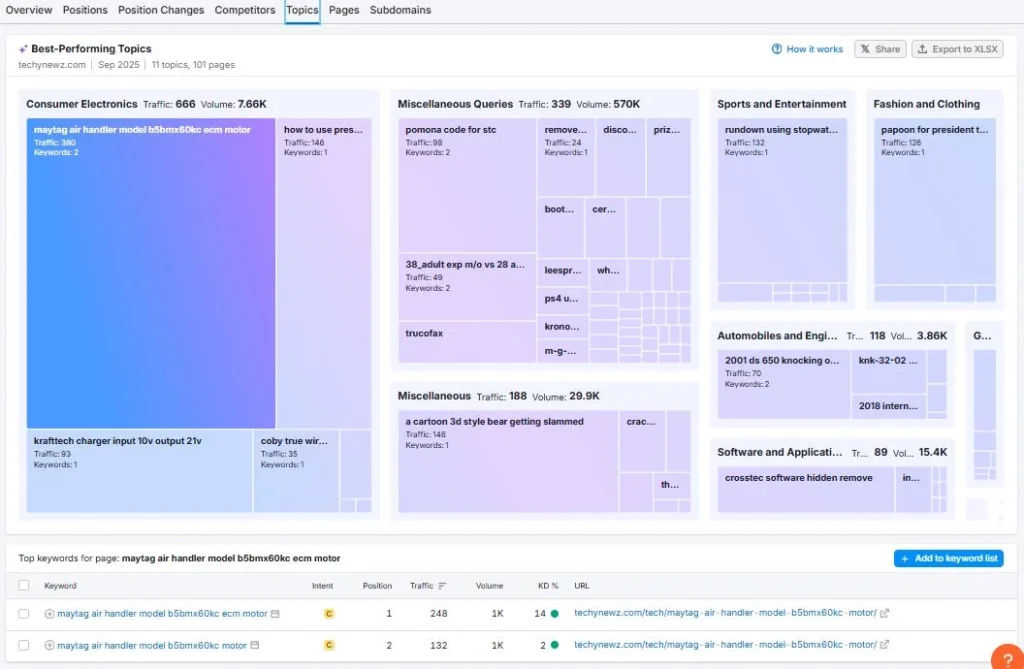
Their consumer electronics content is crushing it. “maytag air handler model b58mv60kc ecm motor” getting 380 monthly visits is their biggest winner.
Why? Because nobody else is targeting hyper-specific product model numbers. When someone searches that exact phrase, TechyNewz ranks #1 because they’re one of the few sites that wrote content specifically about it.
Same with “krafttech charger input 10v output 21v” (93 traffic) and other ultra-specific tech product queries.
That’s actually smart long-tail SEO. Target questions and queries so specific that competition is zero, even if search volume is tiny. Rank for 100 of these, you’ve got thousands of monthly visitors from queries nobody else bothered competing for.
Their other performing topics:
- Miscellaneous queries (188 traffic).
- Sports and Entertainment content.
- Software and Applications (89 traffic).
The miscellaneous category having 188 traffic but 29.9K volume suggests they’re ranking poorly for high-volume terms in that cluster. Positions 20-50, getting scraps of traffic from big-volume keywords.
Technical Performance That Doesn’t Suck
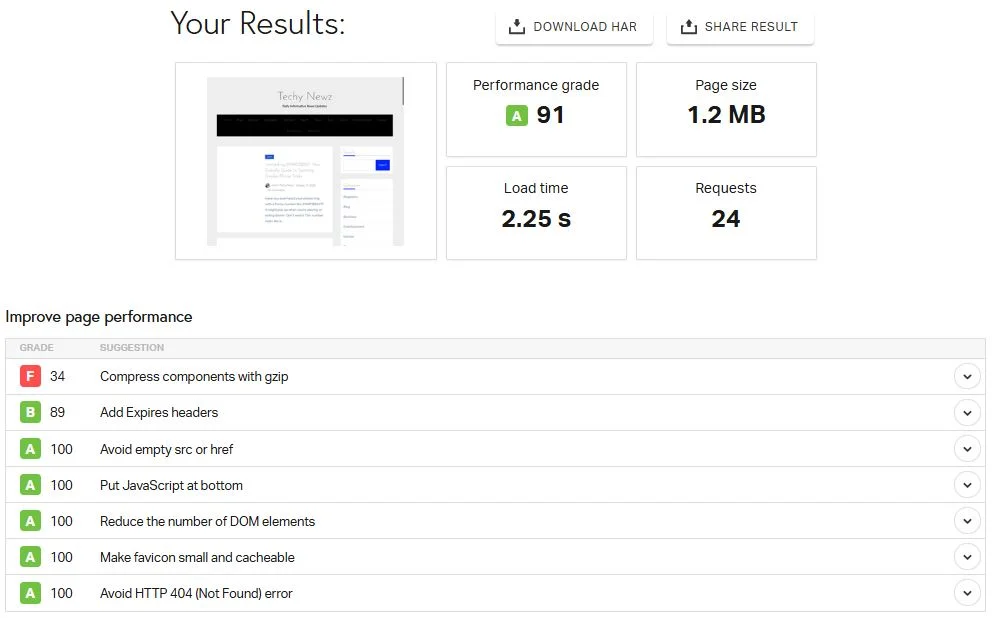
Unlike Rocket Ocean’s disaster, TechyNewz has solid technical fundamentals:
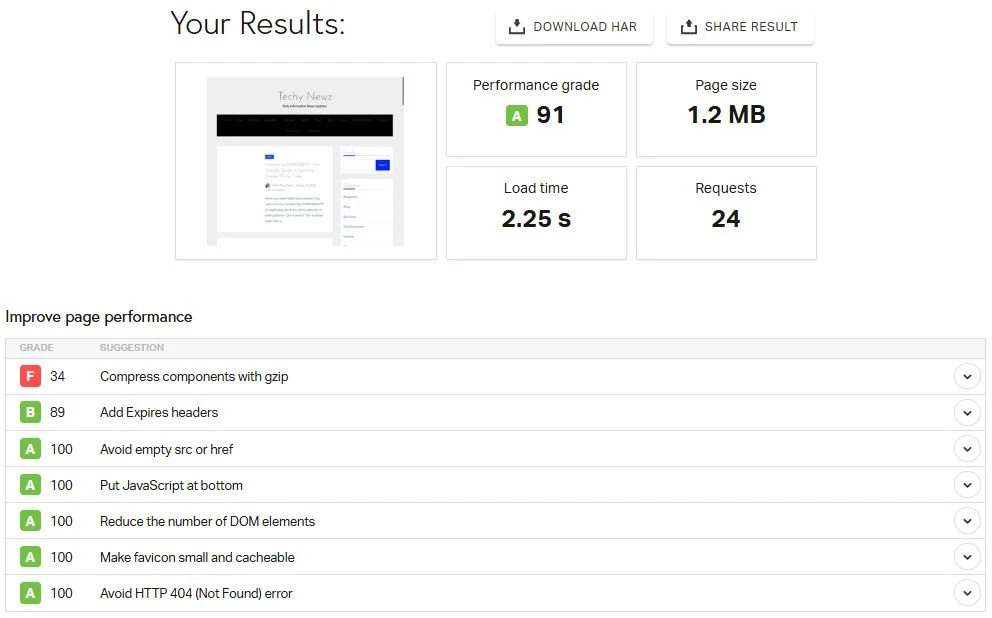
Performance metrics:
- Grade: A (91/100)
- Page Size: 1.2 MB
- Load Time: 2.25 seconds
- Requests: 24
That’s actually good. Under 2MB, under 3 seconds, under 30 requests. Those are respectable numbers.
What they’re doing right:
- Avoid empty src or href (100).
- Put JavaScript at bottom (100).
- Reduce DOM elements (100).
- Make favicon small and cacheable (100).
- Avoid HTTP 404 errors (100).
What needs improvement:
- Compress components with gzip (Grade F, 34 points).
- Add Expires headers (Grade B, 89 points).
Compression failure is their biggest issue. Gzip compression can reduce file sizes by 70%+, which would bring that 1.2MB down significantly and speed up load times.
But overall? Their technical SEO is fine. The site loads, works properly, has proper structure.
The Mobile-Friendly Failure That’s Costing Them Traffic
Here’s the killer. The thing that’s probably holding them back more than anything else.
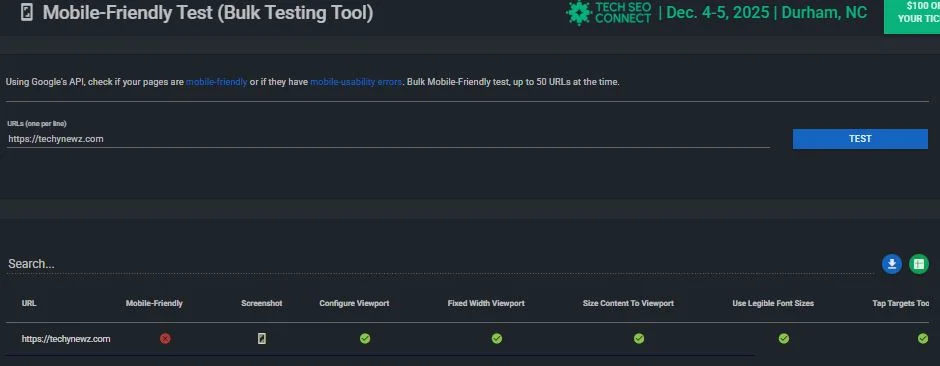
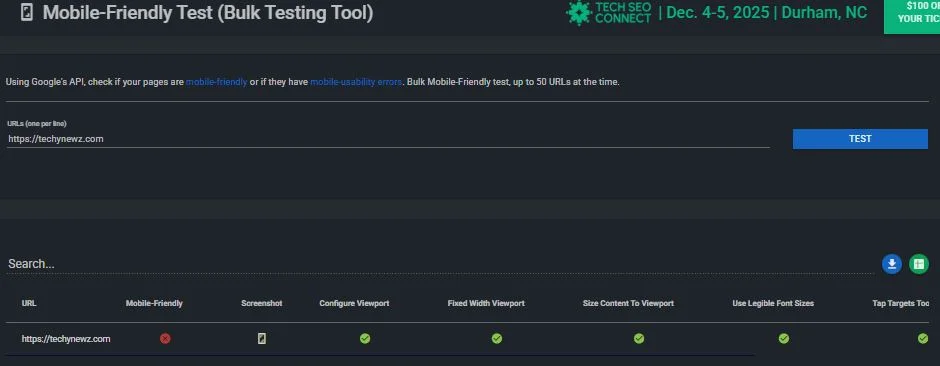
Failed mobile-friendly test. Red X next to “Mobile-Friendly.”
Every other check passes—screenshot works, viewport configured, fixed width viewport good, content sized properly, legible fonts, tap targets not too close. But the overall mobile-friendly result? Fail.
Google’s been mobile-first indexing since 2019. That means the mobile version of your site is what Google primarily uses for ranking and indexing. If mobile fails, you’re essentially invisible to a huge portion of search traffic.
Look at their traffic trend in Image 8. That spike in July 2024, then the crash? That’s classic mobile-first indexing penalty behavior. Something breaks on mobile, Google notices, rankings drop, traffic tanks.
They recovered somewhat—sitting around 1.9K now versus the peak of maybe 6-7K based on the graph. But they never got back to where they were.
What Mobile Failure Actually Costs
Let me break down the math here.
US search traffic splits roughly:
- 60% mobile
- 35% desktop
- 5% tablet
If your site doesn’t work on mobile, you’re potentially losing 60% of your addressable audience before you even start.
But it’s worse than that. Because Google uses mobile-first indexing, your desktop rankings suffer too when mobile fails. It’s not “you only lose mobile traffic.” It’s “your entire domain authority takes a hit because Google can’t properly evaluate your mobile experience.”
What TechyNewz is probably losing:
Current traffic: 1.9K monthly. Potential traffic if mobile worked: Probably 4-5K based on their keyword rankings.
They’re ranking for 305 keywords. Many of those are positions 11-20 (page 2), which get almost zero clicks. If mobile worked properly and their domain authority improved, those page 2 rankings could shift to page 1.
Page 1 positions get exponentially more traffic:
- Position 1: ~30% CTR
- Position 5: ~5% CTR
- Position 10: ~2% CTR
- Position 11-20: ~0.5% CTR
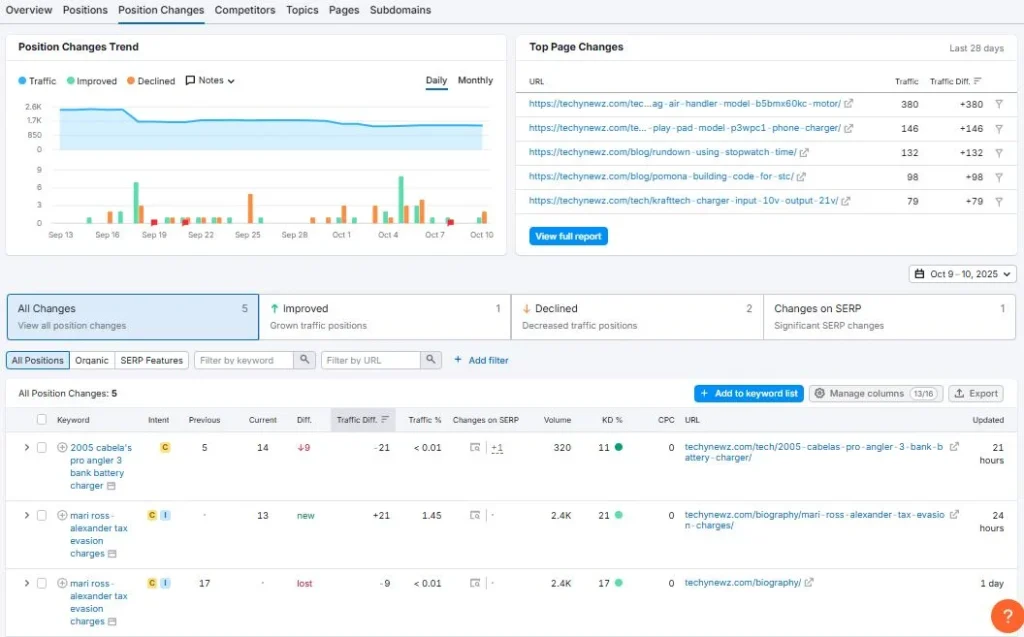
The position changes graph shows volatility. Lots of small improvements (green bars) and declines (red bars) bouncing around. That instability often indicates technical issues causing ranking fluctuations.
Their top page changes show:
- maytag air handler page: 380 traffic (+380 recent gain).
- press play pad model page: 146 traffic (+146 gain).
- rundown using stopwatch timer: 132 traffic (+132 gain).
- pomona building code: 98 traffic (+98 gain).
- krafttech charger: 79 traffic (+79 gain).
So they’re gaining traffic on specific pages. Individual wins. But overall domain traffic is down 27% and volatile.
That’s the signature of technical problems dragging down an otherwise functional site.
The Link Building Strategy (If You Can Call It That)
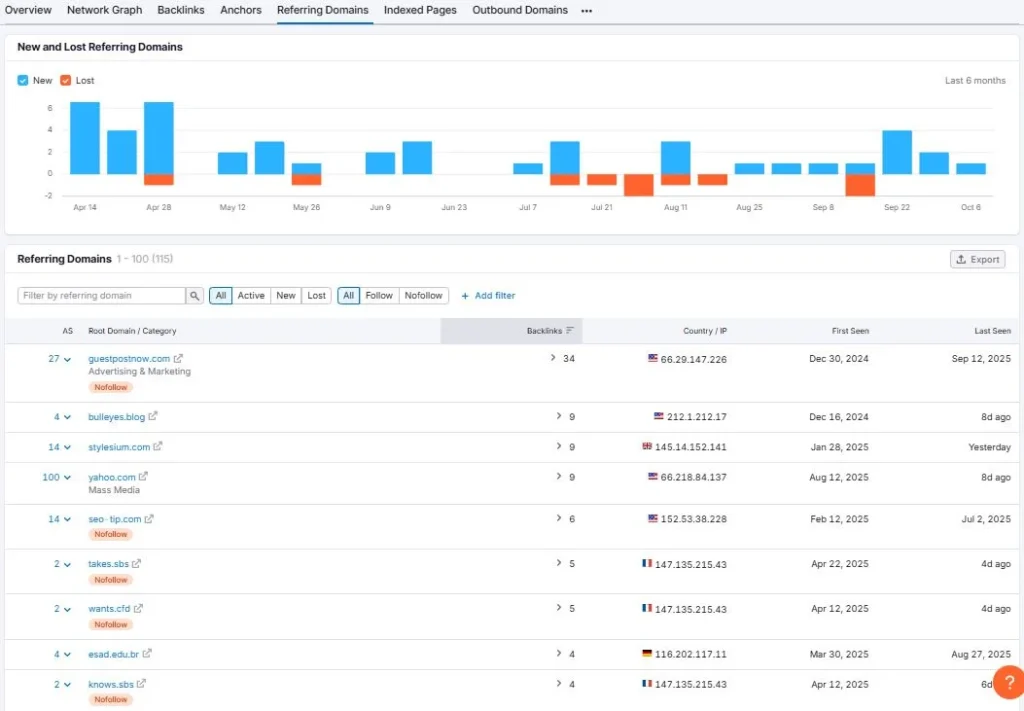
The referring domains graph shows their link acquisition pattern. Steady gains most weeks—2-4 new domains, occasional spikes of 6 domains.
Some weeks show losses (red bars). Domains that previously linked stopped linking. That happens naturally as sites die, remove pages or change content. But consistent losses while you’re actively building? That’s churn.
Link velocity breakdown:
- April-May 2025: Heavy acquisition (4-6 new domains weekly).
- June-August: Moderate activity (2-3 new weekly).
- September: Uptick again (4-5 new weekly).
- October: Slowing down (1-2 new weekly).
They’re clearly running active link building campaigns. Not random editorial links appearing naturally. Someone’s out there pitching, guest posting or buying placements.
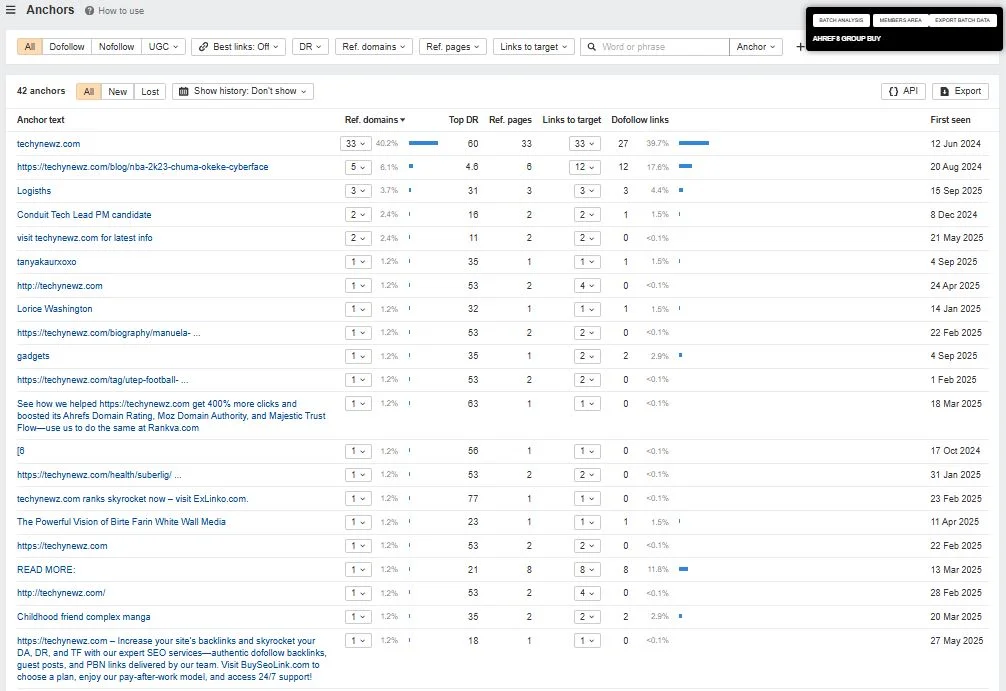
The anchor distribution from earlier shows what kind of links they’re building:
Branded anchors (normal):
- “techynewz.com” – 33 referring domains.
- “https://techynewz.com/[various URLs]” – 5-12 domains each.
- “visit techynewz.com for latest info” – 2 domains.
Random anchors (questionable):
- “tanyatsuruxoxo” – 1 domain.
- “Londe Washington” – 1 domain.
- “gadgets” – 1 domain.
- “Logistis” – 3 domains.
- “Conduit Tech Lead PM candidate” – 2 domains.
Those random anchors? They’re what happens when you:
- Submit to directories that auto-generate anchors.
- Do link exchanges with other sites.
- Use guest post services that insert random contextual anchors.
- Get listed on profile pages with username-based anchors.
None of those are terrible on their own. But accumulated together? Pattern looks manipulative.
The Guest Post Marketplace Footprint
Remember guestpostnow.com being their #1 referring domain with 34 backlinks?
That’s a paid guest post marketplace. You pay, you get a guest post placement, you get a link. The site explicitly exists to sell links.
Google’s stance on paid links is clear: they violate Webmaster Guidelines. If they’re followed links intended to pass PageRank, they’re supposed to be nofollow or sponsored.
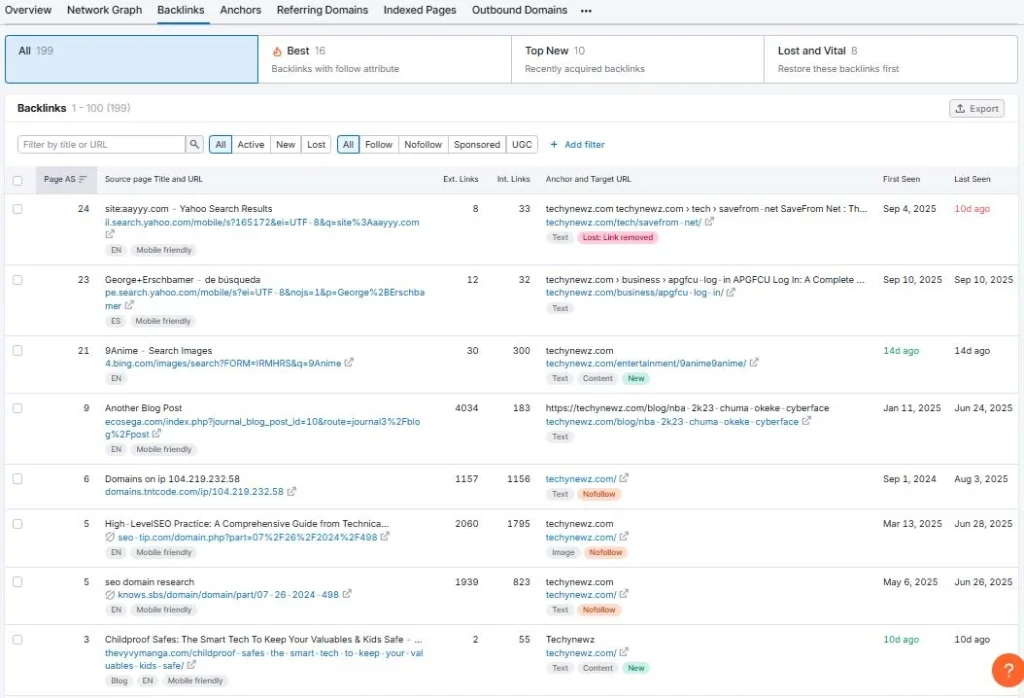
Good news: those 34 links are marked nofollow. So TechyNewz (or whoever’s building their links) at least had the sense to nofollow paid placements.
But here’s the thing—if you’re buying guest posts, you’re probably buying followed links elsewhere too. The nofollow ones are just the visible tip.
Other questionable sources in their profile:
- seo-tip.com (6 backlinks, nofollow) – SEO service.
- Multiple low-authority blogs (AS 4-14).
- Random unrelated sites (construction blogs, automotive sites for a tech news site?).
The pattern suggests someone’s running a budget link building campaign. Not high-quality editorial outreach. More like “buy placements wherever cheap, mix in some legitimate sources, hope Google doesn’t notice the sketchy ones.”
It’s working. Sort of. They’re not penalized yet. But that “Dangerous” network graph tag says the algorithm sees patterns it doesn’t like.
What Google’s Algorithm Sees vs What’s Actually Happening
Let me connect the dots between what the data shows and what’s probably happening behind the scenes.
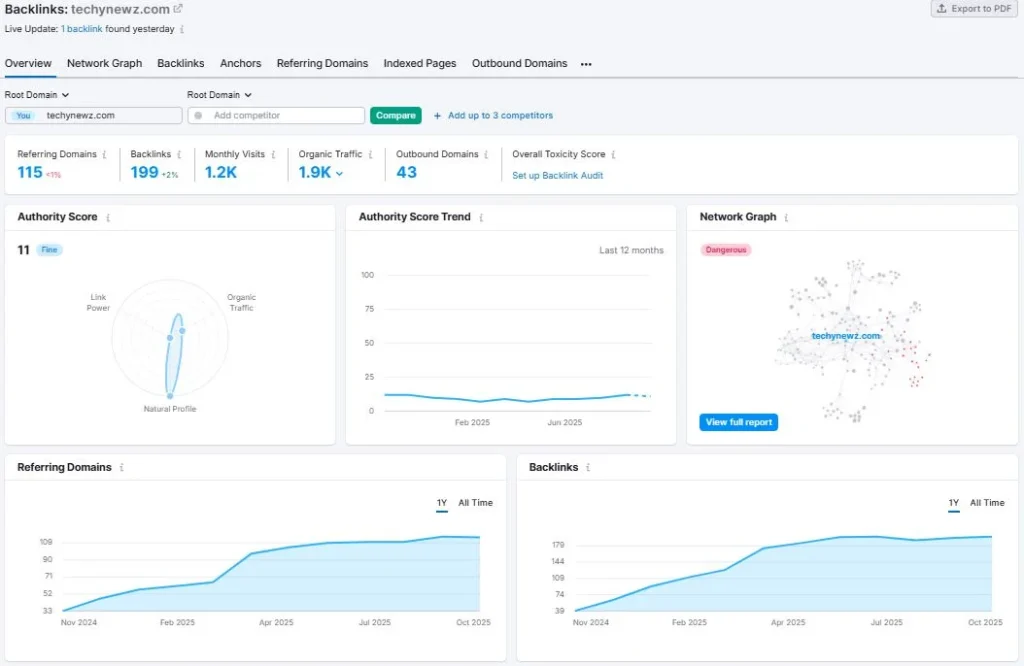
Authority Score has been flat at 11 for the entire observation period. Not growing despite active link building. That’s significant.
When you build legitimate links, Authority Score should climb gradually. You add 50 referring domains over 6 months, AS should increase from 11 to maybe 15-20.
TechyNewz added dozens of domains. Authority stayed flat.
What that tells us:
Google’s algorithm is seeing the new links but not rewarding them. They’re being discounted, filtered out or flagged as manipulative.
The links exist (tools count them). They’re technically followed in many cases (passing signals). But Google’s not crediting them toward domain authority.
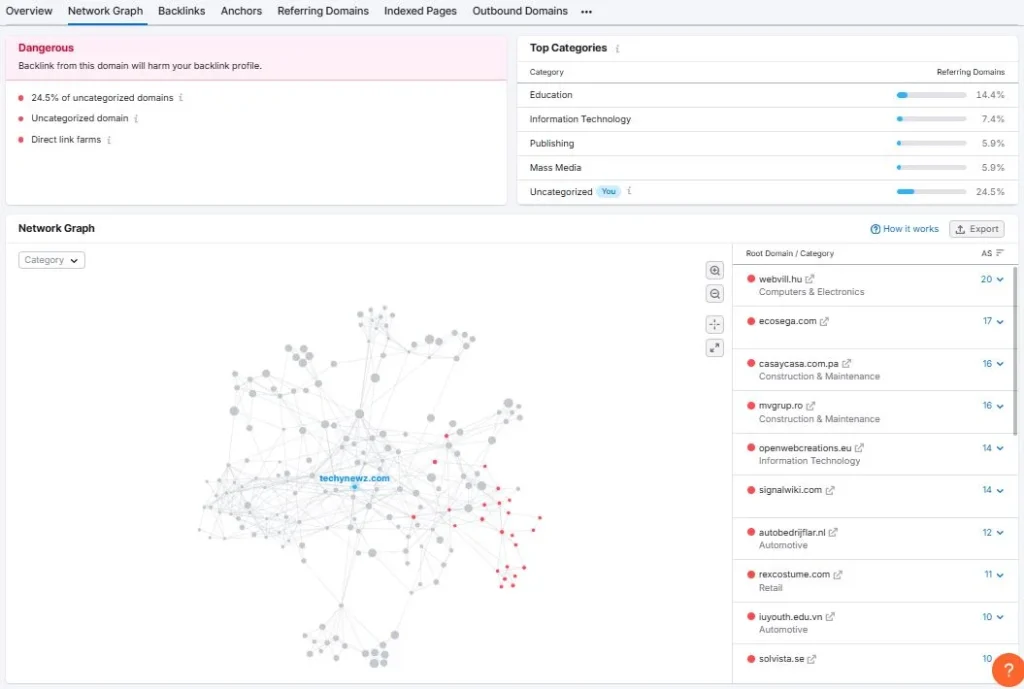
The network analysis explains why. Links are coming from:
- Known guest post marketplaces.
- Low-quality directories.
- Sites with no topical relevance.
- Domains that link to hundreds of other sites indiscriminately.
- Patterns matching PBN or link scheme fingerprints.
Red flags Google’s algorithm likely detected:
- Link velocity doesn’t match content velocity: They’re publishing articles regularly but acquiring backlinks way faster than content typically earns links organically.
- Topical mismatch: Tech news site getting links from construction blogs, automotive sites, fashion blogs, random unrelated niches.
- Anchor text patterns: Mix of branded + random anchors typical of directory submissions and link exchanges.
- Referring domain quality: Many domains with AS below 15, uncategorized or flagged as spam.
- Co-occurrence patterns: Sites linking to TechyNewz probably link to dozens of other sites in the same campaign/network.
Google doesn’t need to manually review. The algorithm pattern-matches these signals against billions of known link schemes and flags the domain.
Why They Haven’t Been Penalized Yet
Good question. With a “Dangerous” backlink profile and clear manipulation signals, why is TechyNewz still ranking?
Possible reasons:
- They’re small enough to not matter: Under 2K monthly traffic. Google’s manual review team focuses on bigger fish. Algorithmic filters might not be aggressive enough yet to fully penalize small sites.
- They have legitimate content: Unlike pure spam sites, TechyNewz publishes real articles. The content itself isn’t spammy. That buys goodwill with the algorithm.
- Mixed signals: Some legitimate links (Yahoo, decent blogs) mixed with sketchy ones. Algorithm might be uncertain, so it’s just discounting suspicious links rather than penalizing the whole domain.
- They’re in the warning phase: That “Dangerous” tag from the tool might be predictive. Google sees the pattern, hasn’t acted yet, but will if it continues.
- Luck and timing: They might be between algorithm updates. When the next core update rolls out, sites flagged with these patterns often take hits.
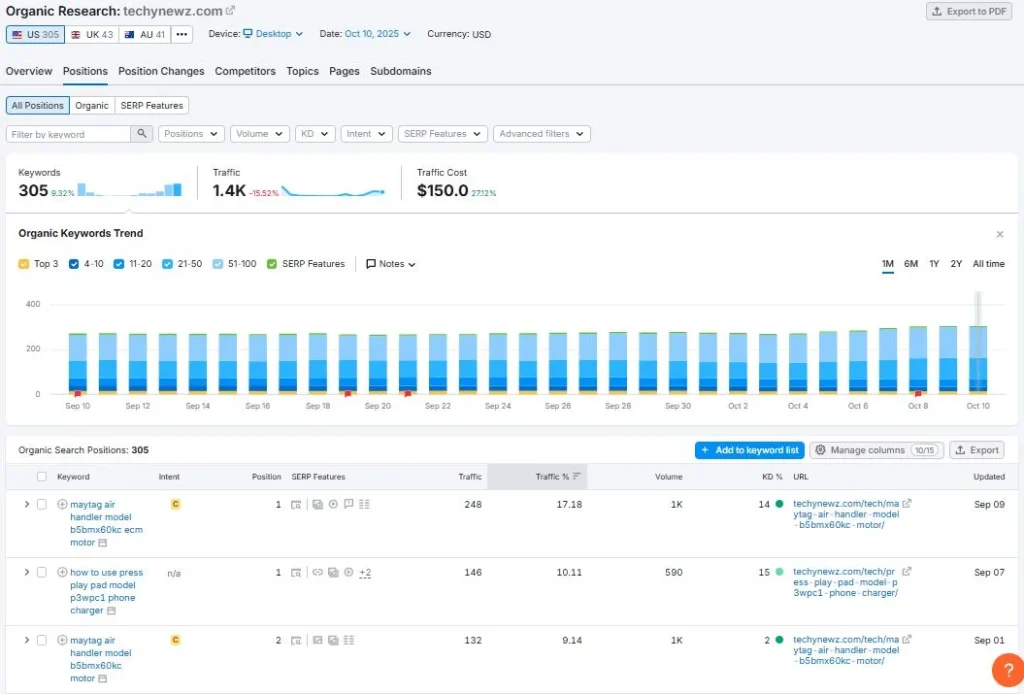
Actually, they might be getting penalized already. That 27% traffic drop? Could be algorithmic filtering kicking in. Not a full manual penalty (which would be 80-90% traffic loss), but the algorithm starting to discount their links and demote rankings.
The Content Strategy That’s Actually Working
Despite all the link profile issues, some of their content approach is solid.
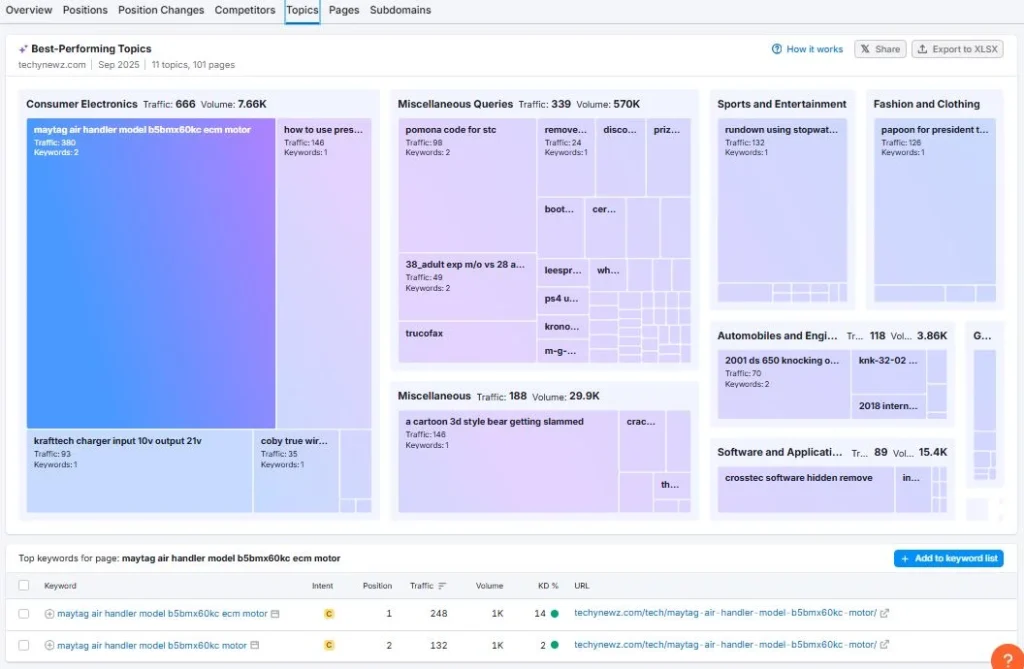
The Consumer Electronics category is their winner. 666 traffic from 7.66K volume keywords.
They’re targeting ultra-specific product queries that bigger sites ignore:
- Specific model numbers.
- Product troubleshooting guides.
- “How to use [specific product]” queries.
- Technical specifications for obscure items.
Why this works:
Big tech sites like CNET, TechCrunch, Wired—they cover news, reviews, trends. They don’t write articles about “maytag air handler model b58mv60kc ecm motor” because:
- Volume’s too low (1K monthly searches).
- Too specific/niche.
- Not scalable content.
- Doesn’t fit their editorial focus.
TechyNewz fills that gap. Someone googles that exact model number, TechyNewz has a page specifically about it, boom—position 1.
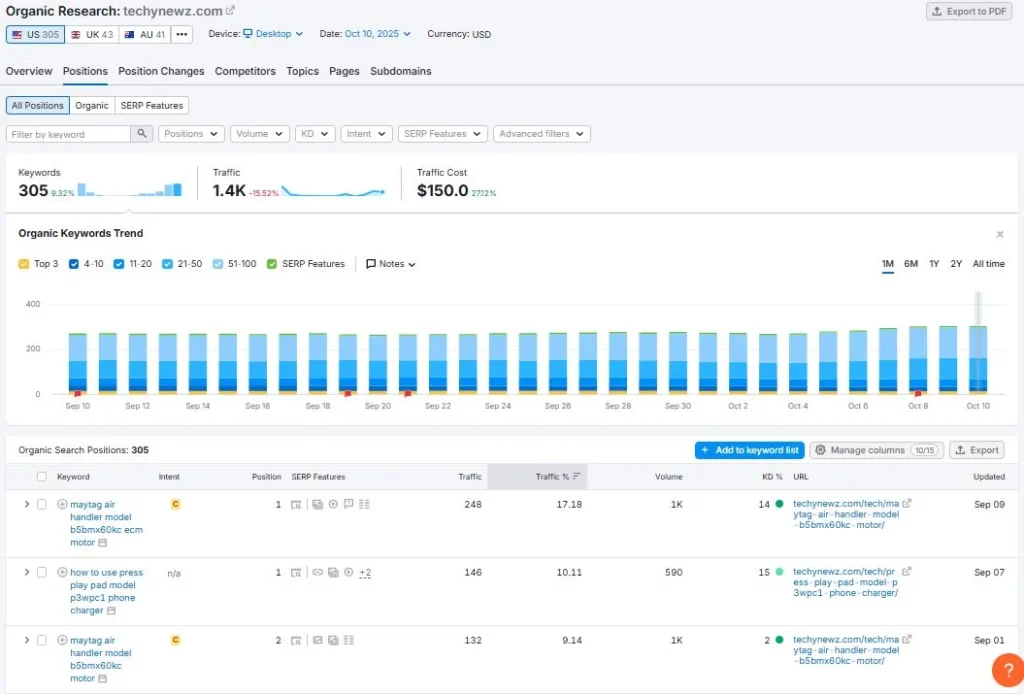
Their top 5 keywords are all like this:
- maytag air handler model – Position 1, 248 traffic.
- how to use press play pad model – Position 1, 146 traffic.
- maytag air handler model (variation) – Position 2, 132 traffic.
- pomona code for slc – Position varies, 98 traffic.
- krafttech charger specs – Position varies, 93 traffic.
These aren’t news articles. They’re reference content. Buyers guides. Product support documentation.
The smart play here:
They’re basically creating the content that should exist in product manuals but often doesn’t. When manufacturers have terrible documentation, someone searches for help, finds TechyNewz’s article explaining it.
That’s valuable. Genuinely useful content that serves searcher intent.
Where the Strategy Falls Apart
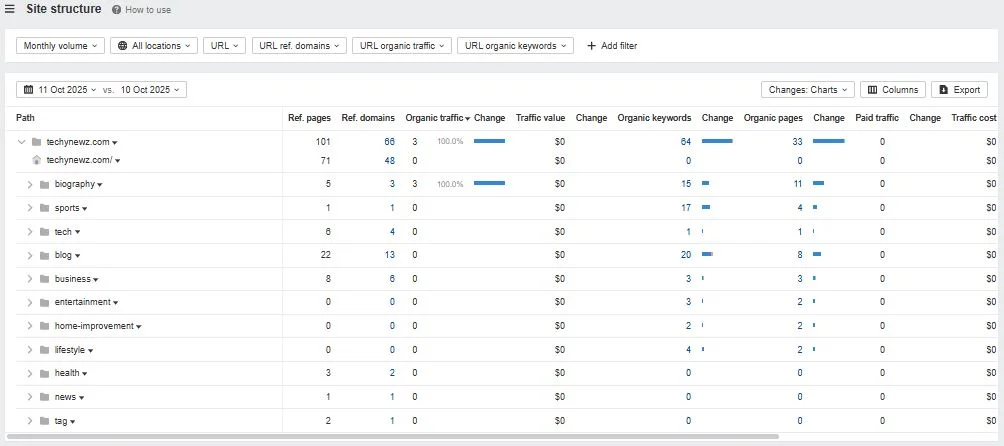
Problem is, they’re not focused. Look at all those categories:
- Biography
- Sports
- Tech
- Blog
- Business
- Entertainment
- Home Improvement
- Lifestyle
- Health
- News
- FAQ
That’s 11 different content categories. For a small site with maybe a few dozen to a few hundred articles? Way too scattered.
Better approach: Pick 2-3 categories, dominate them. Build topical authority in specific niches rather than spreading thin across everything.
Right now they rank well for consumer electronics queries. If they doubled down on that—more product guides, more model-specific content, more troubleshooting—they could build real authority in that niche.
Instead, they’re also publishing about sports, biographies, fashion, business news. None of those categories are performing well because they’re afterthoughts, not focus areas.
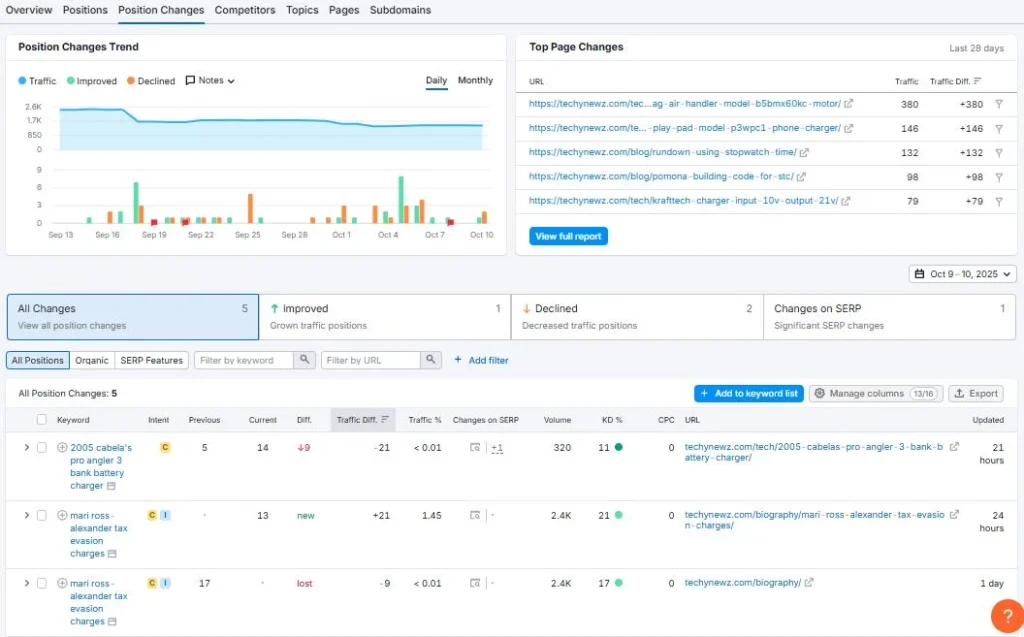
The position changes reflect this scattered approach. Lots of keywords moving 1-3 positions up or down. No major wins. No breaking into top 3 for competitive terms.
They’re stuck in positions 5-20 for most keywords because the domain doesn’t have strong topical authority in any one area. Google sees them as generalists rather than experts.
The Robots.txt and Sitemap Situation (At Least This Works)
One thing they got right—their robots.txt and sitemap setup actually functions.
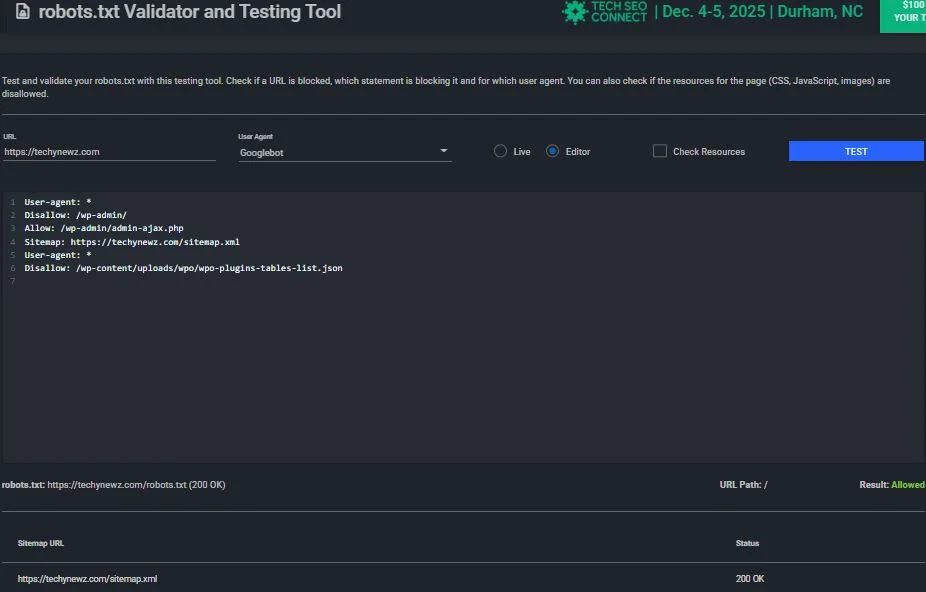
The robots.txt file returns 200 OK. Properly formatted. Declares one sitemap at https://techynewz.com/sitemap.xml and that sitemap actually exists (200 OK status).
Compare this to Rocket Oceans where all five sitemaps returned 404 errors. TechyNewz at least has their technical infrastructure working.
What their robots.txt allows:
- User-agent: * (all bots can crawl).
- Disallow: /wp-admin/ (blocks admin directory, standard WordPress practice).
- Allow: /wp-admin/admin-ajax.php (allows necessary WordPress functions).
- Sitemap declaration present and working
This is basic but correct. They’re not blocking Googlebot accidentally. They’re not hiding their sitemap. The technical crawling foundation works.
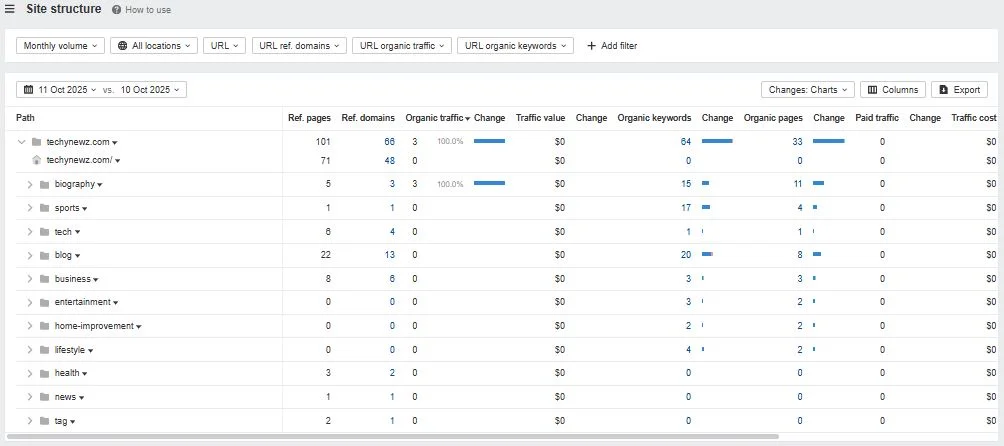
The site structure shows clean URL organization:
- Main sections have logical paths (/blog/, /tech/, /biography/).
- No weird parameters or session IDs.
- Readable URLs that make sense.
For a WordPress site, this is what you want. Clean permalinks, organized sections, proper sitemap feeding Google all the URLs.
So why aren’t they ranking better if technical SEO is mostly fine? Because technical SEO is table stakes. It doesn’t make you rank—it just removes barriers. You still need content quality and legitimate authority signals to actually rank well.
What TechyNewz Should Do (If They Want to Grow Instead of Stagnate)
Been analyzing SEO disasters and mediocre sites for years. Here’s what TechyNewz needs to do to break out of this 1.9K traffic plateau.
Fix the Mobile Issue Immediately
This isn’t negotiable. Mobile failure kills everything else.
Priority 1: Figure out why mobile fails
- Hire a developer to debug the mobile rendering.
- Check for JavaScript errors on mobile.
- Test viewport meta tags.
- Verify touch elements aren’t overlapping.
- Make sure content fits mobile screens properly.
Whatever’s broken, fix it. This is probably costing them 50%+ of potential traffic.
Clean Up the Dangerous Link Profile
You can’t un-build links easily, but you can stop making it worse and potentially use Google’s disavow tool for the worst offenders.
What they should do:
- Stop buying guest posts from marketplaces: Those guestpostnow links are nofollow anyway—not helping. Just burning budget.
- Audit and disavow toxic domains: Use Moz, Ahrefs or Semrush to identify the worst offenders Add them to a disavow file and submit to Google Won’t help immediately but prevents future damage
- Build legitimate links through:
- Creating genuinely useful product guides people want to reference.
- Getting mentioned in relevant tech forums and communities.
- Building relationships with other tech bloggers for natural mentions.
- Creating shareable resources (comparison charts, databases, tools).
What legitimate link building looks like for a tech news site:
- Write the definitive guide to a product category.
- Create a comparison database people reference.
- Get quoted in industry publications.
- Contribute expert commentary to larger sites.
- Build tools that solve problems (link magnets).
None of that is fast. All of it actually works.
Pick 2-3 Categories and Dominate Them
Stop spreading thin. They’re already winning with Consumer Electronics content. Double down.
Recommended focus:
- Consumer Electronics (already working)
- More product model guides
- Troubleshooting content
- Comparison reviews
- Specification databases
- Software and Applications (performing okay at 89 traffic)
- How-to guides
- Software reviews
- Tutorial content
- Feature comparisons
- Tech News (if they want to be a news site)
- Daily updates on tech industry
- Product launch coverage
- Company news and analysis
Pick those three. Kill or deprioritize everything else—Biography, Sports, Fashion, Entertainment, Health, Lifestyle.
Every article outside your focus areas dilutes topical authority. Google looks at your domain and sees “generalist site that covers everything” instead of “tech authority.”
Compress Those Components Already
They’re getting an F (34 points) on compression. That’s leaving performance on the table.
Quick fix:
Enable gzip or brotli compression on the server. For WordPress:
- Install a caching plugin (WP Rocket, W3 Total Cache)
- Enable compression in settings
- Test with GTmetrix again
This could reduce page size from 1.2MB to maybe 400-600KB. Load time drops from 2.25s to under 1.5s. Better user experience, better Core Web Vitals, slight ranking boost.
Takes maybe an hour to implement. No excuse not to do it.
Target Questions Instead of Keywords
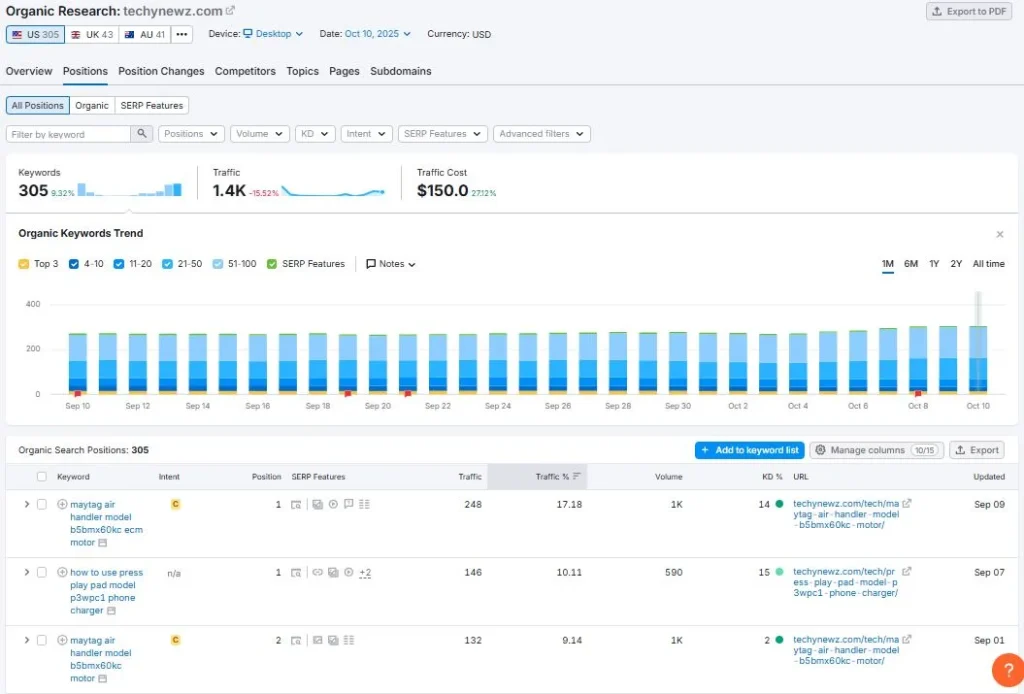
Their best-performing content answers specific questions:
- “how to use press play pad model p3wpc1 phone charger”.
- Various “how to” product queries.
That’s the content model to scale.
Question-based content strategy:
- Find product-related questions people ask (forums, Reddit, Quora, Google autocomplete).
- Write comprehensive answers.
- Target the exact question as the keyword.
- Rank position 1 because nobody else wrote about it.
- Repeat 100 times.
You won’t get huge traffic per article. But 100 articles averaging 50-100 visits each = 5,000-10,000 monthly traffic.
That’s more sustainable than chasing high-volume competitive keywords they’ll never rank for.
The Trajectory: Where This Is Probably Headed
Let me be real about what’s likely to happen here.
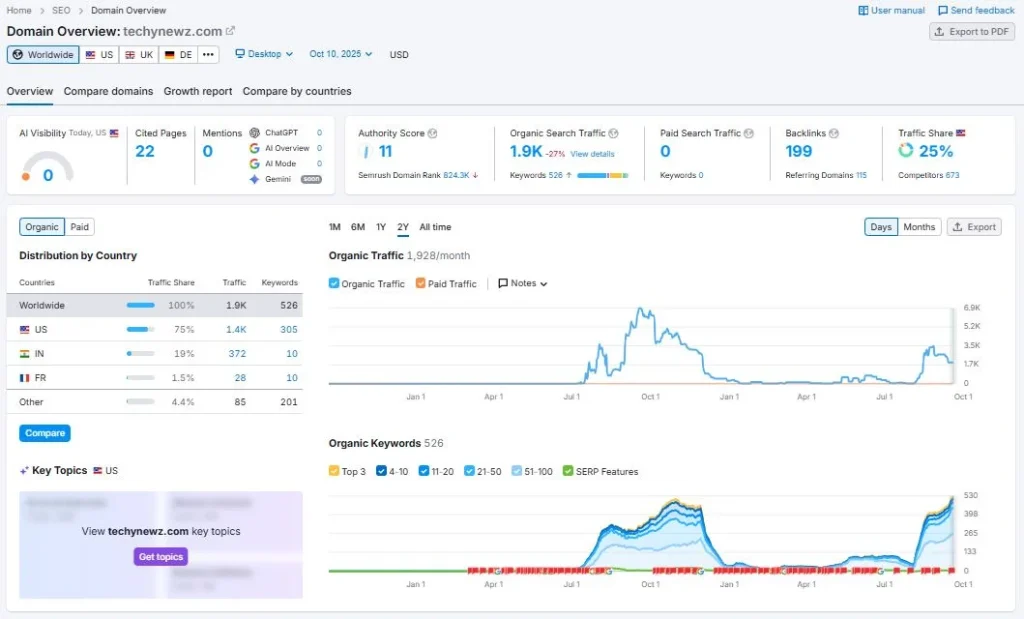
That traffic pattern—spike, crash, slow recovery, ongoing volatility—doesn’t usually resolve upward unless major changes happen.
Scenario 1: They Continue Current Approach
- Keep building questionable links
- Don’t fix mobile
- Stay scattered across categories
- Traffic stays flat or slowly declines
- Eventually hit by algorithm update
- Drop to under 500 monthly visitors
Scenario 2: They Clean Up Their Act
- Fix mobile rendering
- Stop buying links
- Focus on 2-3 categories
- Build through legitimate content
- Slow growth to 5-10K monthly over 12-18 months
- Sustainable long-term
Scenario 3: They Get Aggressive (Wrong Direction)
- Double down on paid links
- Keep spreading across topics
- Chase quick wins
- Manual penalty from Google
- Traffic drops 80-90%
- Takes years to recover if ever
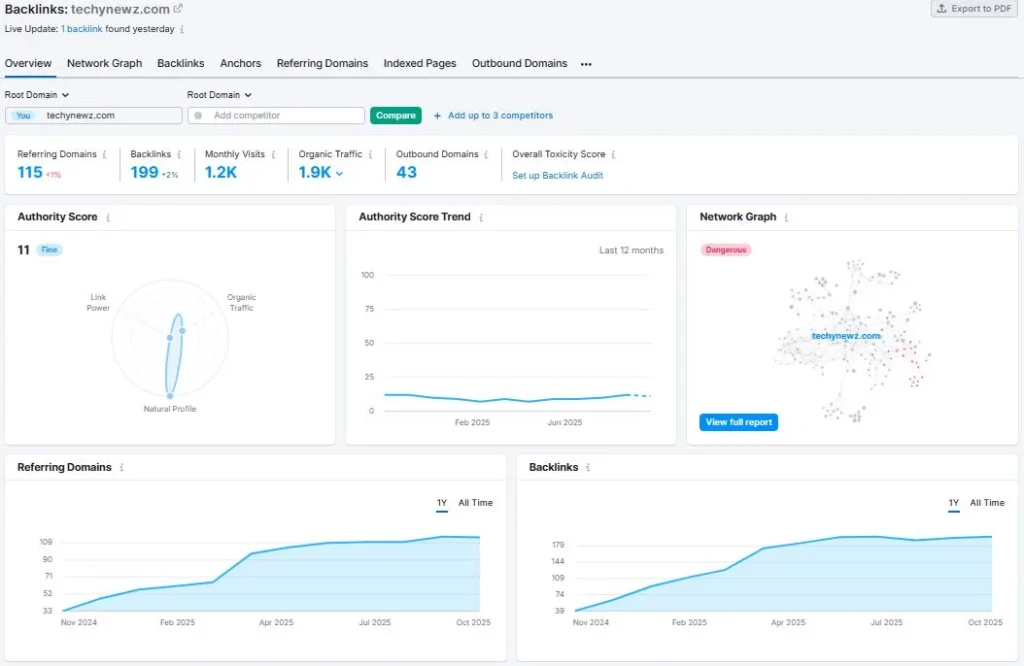
The flat Authority Score is the tell. They’re building links but not building authority. That can’t continue indefinitely. Either they change approach or Google’s algorithm catches up and drops the hammer.
The Warning Signs to Watch
If you’re running TechyNewz or a similar site, here are the signals that you’re about to get hit:
Early warning signs:
- Authority Score stays flat despite link building ✓ (they have this).
- Network graph flagged as “Suspicious” or “Dangerous” ✓ (they have this).
- Traffic volatility increases ✓ (they have this).
- Rankings fluctuate randomly without clear cause ✓ (they have this).
Late warning signs (usually 1-3 months before penalty):
- Sudden ranking drops for multiple keywords.
- Loss of featured snippets or rich results.
- Manual action notice in Search Console.
- Indexed pages decrease significantly.
They’re at the early warning stage. Not in immediate danger, but the foundation’s shaky. Next major algorithm update could be the one that tips them over.
What Other Small News Sites Can Learn
TechyNewz isn’t unique. Tons of small news blogs, niche content sites and micro-publishers operate in this same grey area—some things working, some things questionable, traffic stuck at low levels.
Lessons from this analysis:
- Technical SEO alone doesn’t save you: TechyNewz has decent technical fundamentals (except mobile), but it’s not enough. You also need clean link profile and content strategy.
- Niche specificity beats broad coverage: Their consumer electronics content wins because it’s specific. Their general news content goes nowhere because everyone publishes general news.
- Paid links are a short-term play with long-term risks: Maybe you get some initial traction. But the pattern catches up with you. Not worth it.
- Mobile failures kill everything: You can do everything else right, but if mobile doesn’t work, you’re capped at maybe 20-30% of your potential traffic.
- Focus matters more than volume: Better to publish 50 great articles in one niche than 500 mediocre articles scattered across 11 categories.
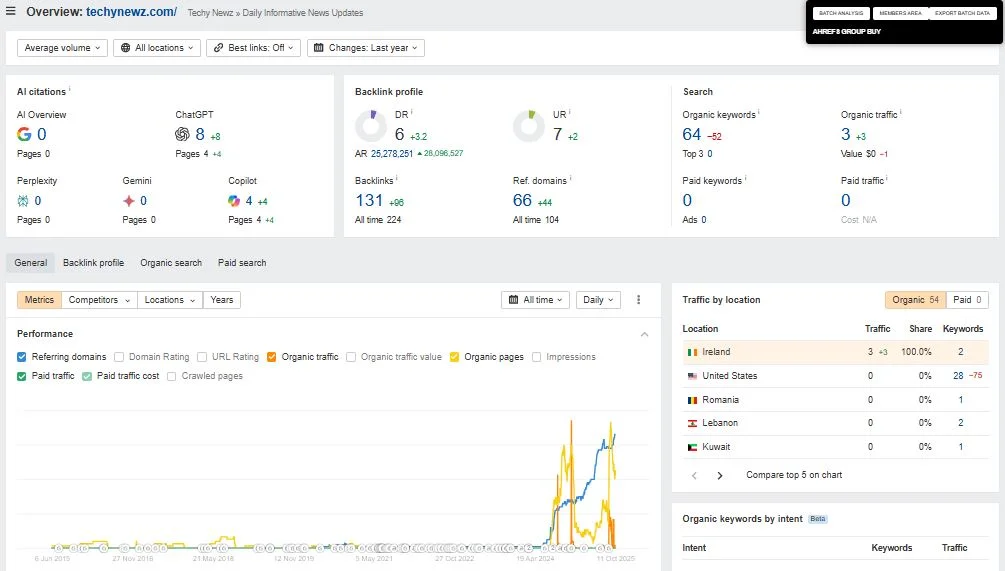
The Ahrefs data showing 64 keywords and 3 traffic estimate tells the real story. Strip away all the optimistic metrics and you’ve got a site barely surviving.
But it’s salvageable. The content exists. The technical foundation mostly works. The domain isn’t burned yet.
They just need to make hard choices:
- Fix mobile
- Clean up links
- Pick a lane
- Stop chasing shortcuts
Do those four things and a year from now they could be at 10K monthly instead of 1.9K.
Don’t do them and a year from now they’ll be writing “why did Google penalize my site” forum posts wondering what happened.
The data’s all there. The warning signs are clear. Now it’s just a matter of whether they listen.