If you’re looking to level up your career with high-impact skills in both technology and marketing, two standout options are worth your attention:
- The premium Python Programming Course
- The Digital Marketing Course
Python runs most of what you see online now. Those AI tools everyone’s using? Python. The recommendation engines on Netflix, Amazon? Python. Even the data systems tracking how people interact with websites—yep, Python again. It’s not just some programming language developers geek out over. It’s literally the backbone holding up the modern internet economy.
And here’s what’s wild: knowing Python without understanding how to market yourself is like owning a Ferrari but never getting your driver’s license. You could build the most elegant automation tool or train a machine learning model that predicts customer behavior, but if nobody knows you exist, what’s the point? That’s where digital marketing comes in. You need both sides of this coin—the technical skill to build something valuable and the marketing chops to actually get it in front of people who’ll pay for it.
Most people pick one or the other. They either go deep into coding and wonder why clients aren’t lining up, or they master marketing but have nothing substantial to sell. Combining a solid Python foundation with real digital marketing skills? That’s when you actually have a business, not just a hobby that occasionally makes money.
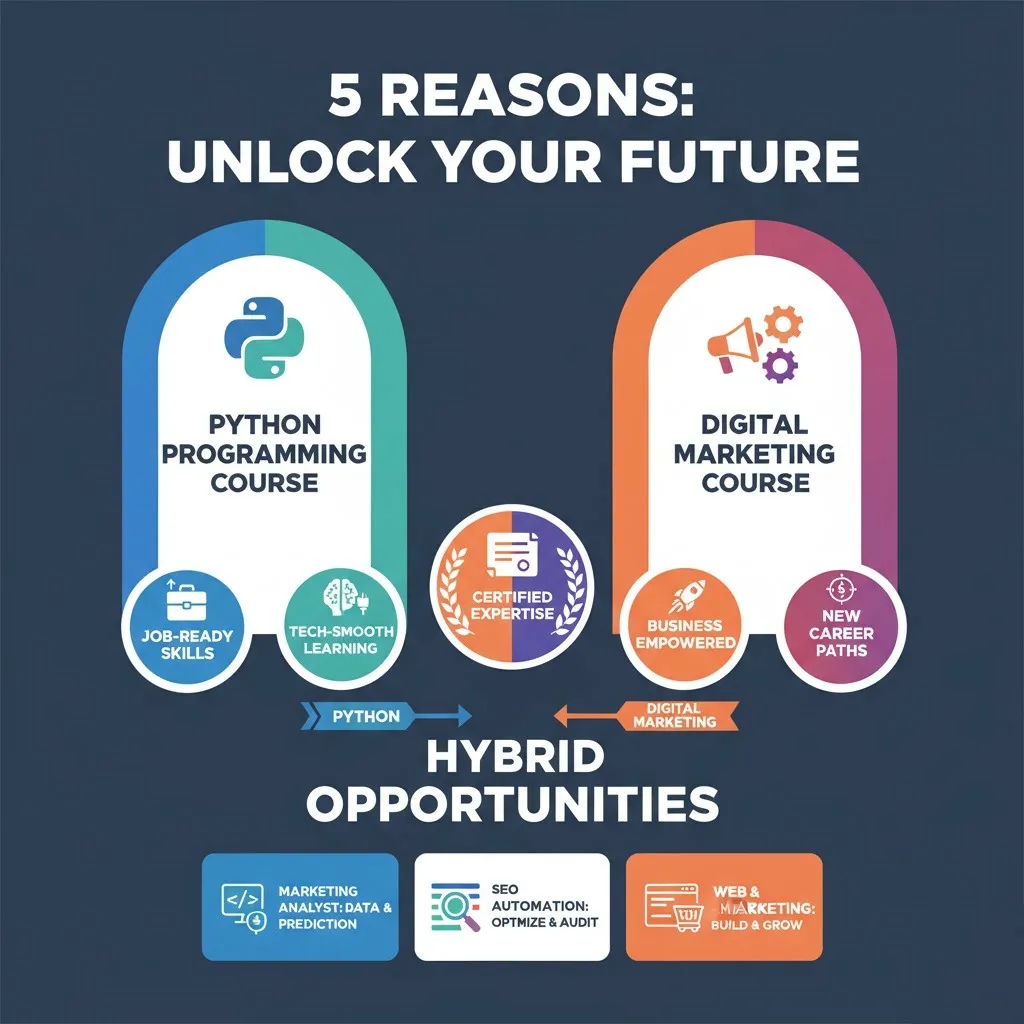
Here are five compelling reasons these courses deserve a spot in your learning plan.
1. Industry-Relevant Curriculum That Gets You Job-Ready
The most important factor when choosing any course is relevance to today’s job market. Both of these programs score high on that front.
- Python developers in the US pull $80K to $123K annually on average, with senior-level folks hitting $177K+ in specialized fields like AI and data science.
- Digital marketing specialists start around $60K but experienced managers easily clear $95K-$125K, especially with skills in SEO, social media strategy, and analytics.
- Both fields show consistent year-over-year growth—marketing jobs expanding 8% through 2033 according to the Bureau of Labor Statistics.
- Global digital marketing spending just crossed $730 billion and climbing.
Python is one of the most in-demand programming languages in the world. It powers web apps, data analysis, machine learning, automation, and even cybersecurity.
This premium course covers everything from:
- Core syntax and functions
- Object-oriented programming (OOP)
- Working with APIs and files
- Real-world projects that simulate job tasks
It’s not just about writing code—it’s about thinking like a developer.
Digital marketing has become a must-have skill in nearly every industry—from tech to fashion to finance. This course introduces you to:
- SEO fundamentals
- Social media marketing
- Email strategy
- Campaign planning and measurement
The numbers don’t lie. Right now in the USA alone, there are roughly 18,000 Python developer positions sitting open on Glassdoor. Add Indeed to the mix and you’re looking at another 11,000+ listings. Worldwide? Python’s ranked as the third most sought-after programming language by recruiters. Companies like NASA, Google, Instagram, and Dropbox run their core systems on it.
Digital marketing tells a similar story. Around 94,000 active job openings exist in the US market currently, with over 42,000 specialists already employed. The projection? Another 150,300 new positions opening up over the next decade. That’s a 19% growth rate, which beats most other career tracks by a long shot.
2. Learn at Your Own Pace with Zero Pressure
Tech education has this reputation for being brutal. Hours staring at error messages you don’t understand. Jargon that sounds like another language. Digital marketing training often goes the opposite way—too surface-level, all theory, zero practical application.
- Why It Matters:
- Learn when your mind is most focused—early morning, lunch breaks, or weekends
- Pause and revisit lessons anytime
- Avoid the pressure of live deadlines or fixed schedules
These two courses dodge both problems.
Python’s actually easier to pick up than languages like Java or C++. The syntax reads almost like English. Instead of wrestling with semicolons and brackets, you’re writing code that makes intuitive sense. Compare this to JavaScript where you’re constantly debugging scope issues, or C++ where memory management alone could take weeks to grasp. Python handles the complicated stuff under the hood so you can focus on solving actual problems.
Digital marketing might be even more accessible. No math degree required. No prior business experience needed. You’re learning how Google’s algorithm thinks, how to craft Facebook ads that convert, why certain email subject lines get opened while others get ignored. It’s pattern recognition and creativity combined—way different from memorizing formulas or technical specifications.
Take SEO as an example. You’re not coding anything. You’re understanding what people search for, how to structure content so Google notices it, and which keywords actually drive traffic versus which ones waste your time. Social media management? You’re analyzing what posts perform well, when to publish for maximum reach, how to respond to comments in ways that build community. These are skills you can start applying immediately, not six months from now after you’ve finished ten prerequisite courses.
3. Running Your Own Business Gets Way Easier
Business owners face a particular problem. They understand their product or service inside and out, but translating that knowledge into online growth? That’s where most get stuck. Either they hire expensive agencies who may or may not deliver results, or they try figuring it out themselves through random YouTube tutorials and blog posts—which works about as well as you’d expect.
Take someone running a small ecommerce store selling handmade furniture. Decent traffic comes to their site, but conversion rates sit around 1%. They’ve got a Facebook page that barely gets engagement. Their email list exists but they only send newsletters when they remember to, maybe once a quarter.
After going through the digital marketing course, they implement some basics: clean up their product descriptions using SEO principles so Google actually ranks them for “custom oak dining tables” instead of just their brand name nobody’s searching for. Set up automated email sequences that trigger when someone abandons their cart, bringing back about 15% of those lost sales. Launch targeted Facebook ads to lookalike audiences based on their best customers, cutting acquisition costs by 30%.
None of that required hiring anyone. Just learning what actually works versus what sounds good in theory.
Python opens different doors for business owners. Maybe you’re spending hours each week pulling data from multiple sources—sales from Shopify, traffic from Google Analytics, social stats from three different platforms—then manually building reports in Excel. A few Python scripts automate that entire workflow. What took you Friday afternoons now runs itself every morning before you’ve had coffee.
Or you need to personalize customer experiences at scale. Python handles that through data analysis and automation. You can segment your customer base by behavior patterns, send targeted recommendations, adjust pricing dynamically based on demand—things that previously required expensive enterprise software.
The combination creates serious advantages. You’re building tools in Python that give you capabilities most competitors don’t have, then using digital marketing knowledge to actually get those capabilities in front of the right audience. Most business owners who try online education pick one or the other. Getting both simultaneously means you’re not dependent on contractors or agencies for either the technical infrastructure or the customer acquisition strategy.
In short, you learn by doing—not just watching.
4. Certification That Adds Weight to Your Resume
A course without proof of completion often goes unnoticed on a resume. That’s not the case here.
- Python Programming Online Course
Once you complete this course, you earn a certificate that shows recruiters and hiring managers you’ve mastered one of the most valuable tech skills in the industry. This can:
- Help you stand out in job applications
- Support internal promotions
- Validate your skills for freelance or project-based work
- Free Digital Marketing Course
Yes, it’s free—but still comes with a verified certificate of completion. Add it to your LinkedIn profile or CV to signal that you’re actively building marketing expertise.
Employers don’t just want to hear you know Python or understand SEO. They want proof. Certifications solve that problem.
Finishing these courses gives you credentials that show up on LinkedIn, go at the bottom of your resume, and act as conversation starters in interviews. When you’re competing against other candidates, these certificates signal you took the initiative to learn rather than just claiming skills you picked up casually.
For Python specifically, certification demonstrates you understand object-oriented programming, can work with APIs, know how to manipulate data efficiently, and have built actual projects. That last part matters—employers care less about theoretical knowledge and more about whether you can ship working code.
Digital marketing certification proves you’re not guessing. You understand campaign metrics, conversion funnels, A/B testing methodology, and platform-specific best practices. Marketing departments want people who can justify their budget spend with data, not gut feelings.
Career trajectories change with the right credentials:
- Entry-level developers with Python certification land roles faster than those without formal training, even when they’re self-taught
- Marketing specialists who can show coursework in analytics and paid advertising move into coordinator and manager positions quicker
- Freelancers use certifications to justify higher rates—clients pay more when they see you’ve invested in professional development
- Career switchers rely on these credentials to prove competency when they don’t have years of direct experience in the field
Whether you’re a job seeker or already employed, these certificates prove you’re not waiting—you’re evolving.
5. Perfect Starting Points for Bigger Learning Journeys
Neither of these courses claims to make you an expert overnight—but they’re ideal launchpads.
Start with Python, Grow into Data Science or Software Development
After completing the Python Programming Online Course, you can move into:
- Data science and analytics
- Web development (using Django/Flask)
- Machine learning and AI
- Automation engineering
The foundation you build here will support nearly every tech specialization moving forward.
These courses aren’t endpoints. They’re foundations for wherever you want to go next.
Finish Python basics and suddenly machine learning doesn’t seem impossible. TensorFlow documentation makes sense now. You can follow along with advanced tutorials on neural networks, natural language processing, or computer vision. The barrier to entry drops dramatically once you’ve got core programming concepts locked in.
Same pattern with digital marketing. Once you understand campaign fundamentals, specialized areas open up. Maybe you dive into conversion rate optimization, learning how tiny changes in landing page design can double sales. Or you focus on marketing automation, building complex workflows that nurture leads through multiple touchpoints. Perhaps SEO becomes your thing, where you’re doing technical audits and building backlink strategies that move the needle on organic traffic.
The real power shows up in combination. Python skills let you build custom analytics dashboards that surface insights your competitors miss. You can scrape competitor data, analyze market trends, automate social media posting at optimal times based on your audience’s behavior patterns. Digital marketing knowledge ensures you’re asking the right questions when you’re writing that code—what metrics actually matter, which channels deserve attention, how to interpret the data you’re collecting.
Career paths branch out fast:
- Python developer who understands marketing becomes a marketing automation specialist—building systems that major enterprises pay six figures to have implemented
- Digital marketer with Python skills evolves into a growth hacker—someone who can both identify opportunities and build tools to exploit them without needing a development team
- Python + analytics background leads into data science roles where you’re predicting customer behavior, optimizing pricing, forecasting demand
- Marketing foundation + technical skills creates technical content creators who can explain complex products in ways that actually convert
You’re not locked into one trajectory. These skills stack. Every advanced course you take afterward builds on what you’re learning now. The Python developer who later picks up web development with Django and React has a much easier time than someone starting from zero. The marketer who adds SQL and data visualization on top of their digital marketing base becomes invaluable to employers who need people bridging the gap between data and strategy.
Final Thought: The Best Time to Learn Is Now
In-demand skills like Python and digital marketing are shaping how businesses operate, innovate, and grow. Whether you’re looking to launch your career, upgrade your skills, or switch domains—these two programs are excellent ways to begin.
- Explore the Python Programming Online Course to learn the world’s most versatile language and open tech career doors.
- Try the Free Digital Marketing Course to build marketing fluency and stay relevant in any business role.
Small steps lead to big outcomes. Start yours today.