Your brand’s online reputation isn’t just about feeling good when people say nice things. It directly impacts whether Google ranks your pages or buries them on page 12 where nobody looks.
- Why Reputation Actually Affects Your Rankings
- What You Get from Managing Reputation Properly
- Building Your Monitoring System
- Search Result Monitoring
- Review Platform Tracking
- Social Media Monitoring
- Automated Alert Systems
- The Review Response Framework
- Getting More Reviews Without Begging
- Timing Matters Most
- The Ask That Works
- The Incentive Question
- Review Generation for Different Business Types
- User-Generated Content That Actually Helps SEO
- Handling Reputation Attacks and Negative Content
- The Review Velocity Problem
- Reputation Management for Different Business Types
- What the Data Shows About Reputation Impact
- Building a Sustainable Reputation System
- What Most People Get Wrong
- The Bottom Line
Google’s E-E-A-T framework (Experience, Expertise, Authoritativeness, Trustworthiness) determines rankings more than most SEOs want to admit. And reputation sits at the core of each component. A company with 4.8 stars and 2,000 reviews ranks differently than one with 2.3 stars and 47 reviews—even with identical content and backlinks.
Why Reputation Actually Affects Your Rankings
Google doesn’t have a “reputation score” metric you can track in Search Console. But the algorithm pulls signals from multiple sources that collectively paint a picture of how trustworthy your brand is:
- Review ratings and volume across platforms – Google Business Profile, Yelp, Trustpilot, industry-specific sites. Higher ratings correlate with better local pack rankings. A BrightLocal study found that 98% of consumers read online reviews for local businesses, and the average consumer reads 10 reviews before trusting a business.
- Brand mentions and sentiment – When reputable sites mention your brand positively (even without linking), Google notices. Conversely, widespread negative coverage tanks your perceived authority.
- User behavior signals – If people search your brand name, click your result, and stay on your site, that signals trust. High bounce rates from branded searches suggest reputation problems.
- Social proof indicators – While social signals aren’t direct ranking factors, the visibility and sentiment of your social presence contributes to overall brand authority.
- Content quality and author reputation – Sites consistently publishing high-quality content by recognized experts build E-E-A-T over time. Google’s Quality Rater Guidelines specifically mention checking author backgrounds and credentials.
The compounding effect matters most. A single negative review won’t destroy your rankings. But a pattern of poor reviews + negative press coverage + high bounce rates + thin content creates a reputation hole that’s hard to climb out of.
What You Get from Managing Reputation Properly
- Increased organic click-through rates: Your star rating shows in search results for local businesses. A jump from 3.5 to 4.5 stars can increase CTR by 25-35% without changing your ranking position.
- Better conversion rates: Users who see positive reviews before visiting your site arrive with higher purchase intent. Conversion rates improve 15-20% on average when reputation signals are strong.
- More earned backlinks: Journalists and bloggers link to brands they trust. A solid reputation makes outreach easier and increases your backlink acceptance rate by 40-60% compared to brands with reputation issues.
- Improved local search visibility: For local businesses, Google Business Profile reviews directly impact local pack rankings. Moving from 20 reviews to 100+ reviews typically improves local visibility significantly.
- Lower paid advertising costs: Better Quality Scores in Google Ads when your brand has strong reputation signals. This translates to 10-30% lower cost-per-click for branded campaigns.
- Defense against negative SEO: A strong foundation of positive content and reviews makes it harder for negative content to rank prominently for your brand terms.
Building Your Monitoring System
You can’t manage what you don’t measure. Most companies check their reputation sporadically when they remember. That’s too late—reputation damage happens fast and spreads faster.
Search Result Monitoring
Search your brand name, product names, and key executive names weekly in Google. Check the first three pages, not just page one. Look for:
- Negative content ranking higher than it should
- Review sites showing up with low ratings
- Competitor comparison articles that frame you unfavorably
- Outdated information that no longer represents your company
- Press coverage you weren’t aware of
Use incognito mode or a rank tracking tool to avoid personalized results distorting what normal users see.
Review Platform Tracking
Claim and monitor your profiles on:
- Google Business Profile (mandatory)
- Industry-specific platforms (G2, Capterra for SaaS; Healthgrades for healthcare; Avvo for legal)
- General review sites (Yelp, Trustpilot, Better Business Bureau)
- Social commerce platforms (Amazon, Etsy if you sell products)
Check these weekly minimum, daily if you operate in a reputation-sensitive industry like hospitality or healthcare.
Social Media Monitoring
Track brand mentions across platforms even when you’re not tagged. People complaining about your company don’t always tag your account—they just tell their 5,000 followers about their bad experience.
Monitor:
- Direct mentions and tags
- Misspellings of your brand name (common source of missed complaints)
- Product names and common abbreviations
- Competitor mentions (understand what they’re saying about you)
- Industry hashtags where your brand comes up
Automated Alert Systems
Google Alerts: Free and basic but catches most published content mentioning your brand. Set up alerts for:
- Your exact brand name (in quotes)
- Brand name variations and common misspellings
- Product/service names
- Key executives’ names
- “[Your brand] review”
- “[Your brand] scam” (catches negative sentiment early)
- Brand monitoring tools: Mention, Brand24, or Brandwatch provide more comprehensive tracking with sentiment analysis. They catch social mentions Google Alerts misses.
- AI search visibility tracking: With AI Overviews and ChatGPT changing how people search, monitor whether AI tools mention your brand and what they say. Must use tools for AI search visibility to track this.
The Review Response Framework
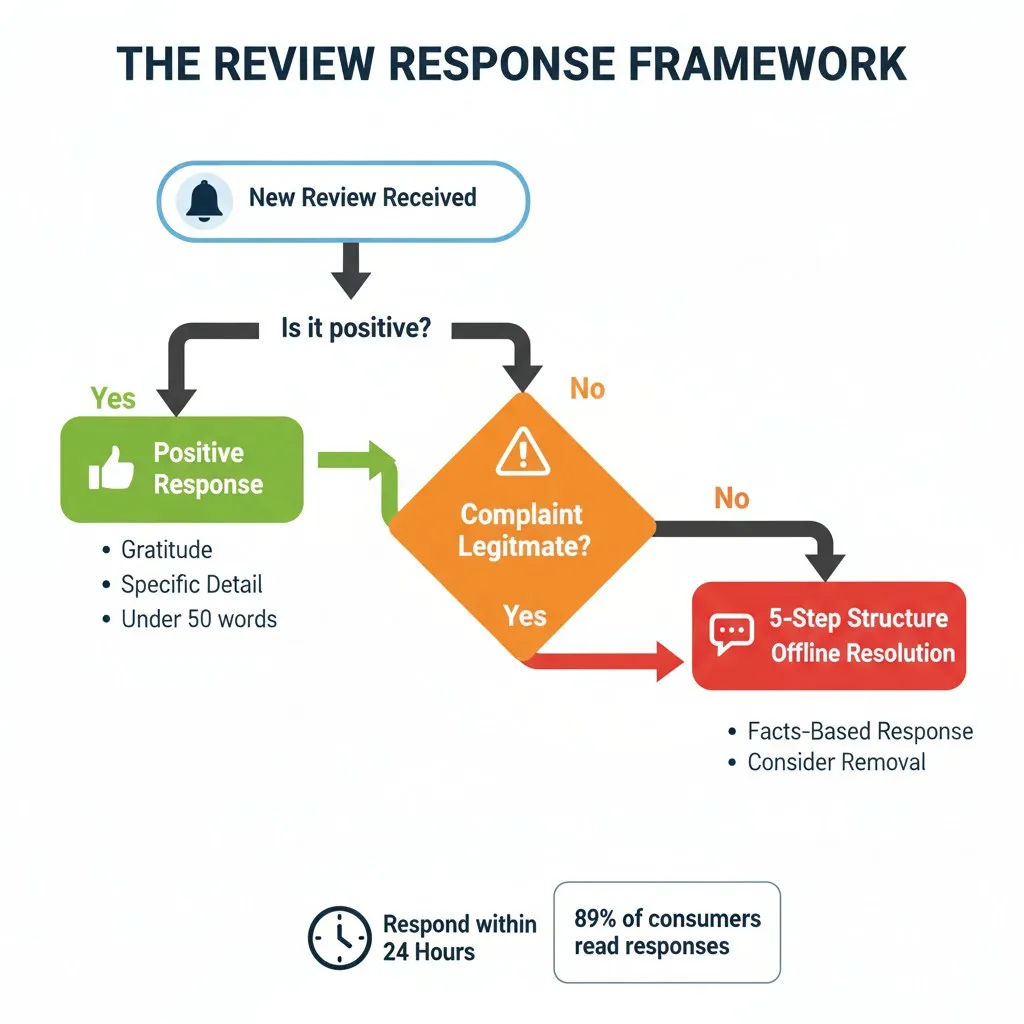
Speed matters. Data shows that responding to reviews within 24 hours increases the likelihood of a reviewer updating their rating if the experience was negative.
For positive reviews (80% of your responses):
Template that works:
“Hi [Customer Name], thank you for choosing [Company]. We’re glad [specific detail they mentioned] worked well for you. [Optional: mention related product/service they might be interested in]. We appreciate you taking time to share your experience.”
Keep it under 50 words. Don’t make it about you—acknowledge what they specifically valued.
For negative reviews (20% of your responses but 80% of your effort):
Response structure:
- Acknowledge the specific issue without making excuses
- Apologize for their experience
- Explain what happened (if appropriate) without blaming
- Offer a concrete solution or next step
- Provide direct contact info to resolve offline
Example:
“Hi (X), I’m sorry your order arrived damaged. That’s not the experience we want anyone to have. Our fulfillment team has already issued a replacement which should arrive Tuesday, and I’ve added a [specific compensation]. Please contact me directly at [email] if anything else comes up. Thank you for giving us the chance to make this right. – [Name, Title]”
What not to do:
- Don’t argue or get defensive.
- Don’t use the same generic template for every review.
- Don’t ignore negative reviews hoping they’ll disappear.
- Don’t ask customers to remove negative reviews (violates most platform policies).
- Don’t respond only to negative reviews (makes you look reactive rather than engaged).
Getting More Reviews Without Begging
Most businesses get 1-3% of customers to leave reviews organically. You can push that to 10-15% with the right approach.
Timing Matters Most
Ask at the moment of peak satisfaction, not days later when the experience has faded. For e-commerce, that’s right after delivery confirmation. For services, it’s immediately after project completion or the final session.
The Ask That Works
Email template with 25-30% response rate:
Subject: Quick question about your experience with [Company]
“Hi [Name],
Your [product/service] was delivered/completed [timeframe]. How’s it working for you?
If you’re happy with [specific thing they bought/hired you for], would you mind sharing that on [Google/Trustpilot/G2]? Takes about 2 minutes and helps other [customers/clients] make decisions.
[Direct link to review page]
Thanks for choosing [Company].
[Your name]”
Short, specific, single call-to-action. The direct link removes friction—every extra click reduces completion rates by 20-30%.
The Incentive Question
Offering incentives for reviews violates policies on most platforms. Google explicitly prohibits it. So does Amazon. Yelp will bury reviews they suspect were incentivized.
What you can do: Offer incentives for completing satisfaction surveys, then within that survey (after they’ve provided feedback), ask if they’d be willing to post a public review. The incentive isn’t conditional on the review itself.
Review Generation for Different Business Types
- E-commerce: Automate review requests 7-10 days post-delivery. Include product image in the email to remind them what they bought. Segment by order value—high-value customers get personalized requests, lower-value orders get automated sequences.
- Local services: Ask in person at the end of service while they’re still there. “If you’re happy with how this turned out, would you mind leaving a quick review? Here’s a card with a QR code that takes you right to our Google page.” Physical QR code cards convert 3-5x better than follow-up emails.
- B2B/SaaS: Time review requests around successful milestones—project completion, hitting a key metric, renewal date. Frame it as helping peers in their industry: “Other [finance directors/HR managers] often look for [type of tool] reviews when evaluating options. Would you be willing to share your experience on G2?”
- Professional services (medical, legal, financial): More regulated. Focus on testimonials for your website that you can request directly, then gently ask satisfied clients if they’d be comfortable posting on relevant platforms. Many won’t due to privacy concerns, so your ask-rate needs to be higher.
User-Generated Content That Actually Helps SEO
UGC does more than build trust—it creates fresh, unique content Google loves. A product page with 200 customer reviews has 10,000+ words of unique content that updates regularly. That’s harder for competitors to match than anything you write yourself.
What Counts as Valuable UGC
- Customer reviews and Q&A: Amazon’s success partially comes from their review ecosystem. Each product page becomes a comprehensive resource with details no product description could cover.
- Customer photos and videos: Visual UGC increases conversion rates by 25-30% and gives you content for social media, ads, and email campaigns. Request photos showing your product in use, not just unboxing shots.
- Case studies and testimonials: More detailed than reviews. These work for complex B2B sales where decision makers need proof of ROI, not just general satisfaction.
- Social media mentions: Content customers create without being asked. The most valuable because it’s genuinely unsolicited. Create situations worth sharing—unboxing experiences, unexpected service, remarkable results.
- Forum and community content: If you run a community or forum, user discussions create massive amounts of unique, helpful content. Look at how Reddit’s user-generated content ranks for nearly everything.
How to Encourage UGC Creation
- Run campaigns with clear prompts: “Show us how you use [product] in your daily routine” works better than “share photos.” Specific prompts get 3-4x more participation.
- Feature customers prominently: Create a “Customer Spotlight” section on your site or social channels. People want recognition. Getting featured is often more motivating than small discounts.
- Make sharing easy: Branded hashtags, tag suggestions, clear instructions. Remove friction at every step.
- Create share-worthy moments: Include something in your packaging or service delivery that makes people want to share. A handwritten note, unexpected bonus, clever packaging design—something that sparks “I have to post about this.”
UGC Integration That Helps Rankings
Don’t just collect UGC—deploy it strategically:
- Product pages: Display reviews prominently, including images. Schema markup for review stars shows ratings in search results.
- Landing pages: Add testimonials with customer names, companies, photos. Specific results (“increased conversion rates by 23%”) beat generic praise (“great service”).
- Blog content: Turn customer stories into case studies. These rank for long-tail keywords and provide proof for prospects researching solutions.
- Video content: Customer testimonial videos rank in video results and can appear in standard search results. A 60-90 second customer video explaining results outperforms any marketing copy you write.
- FAQ pages: Customer questions from reviews, social media, and support tickets create FAQ content that answers real search queries.
Handling Reputation Attacks and Negative Content
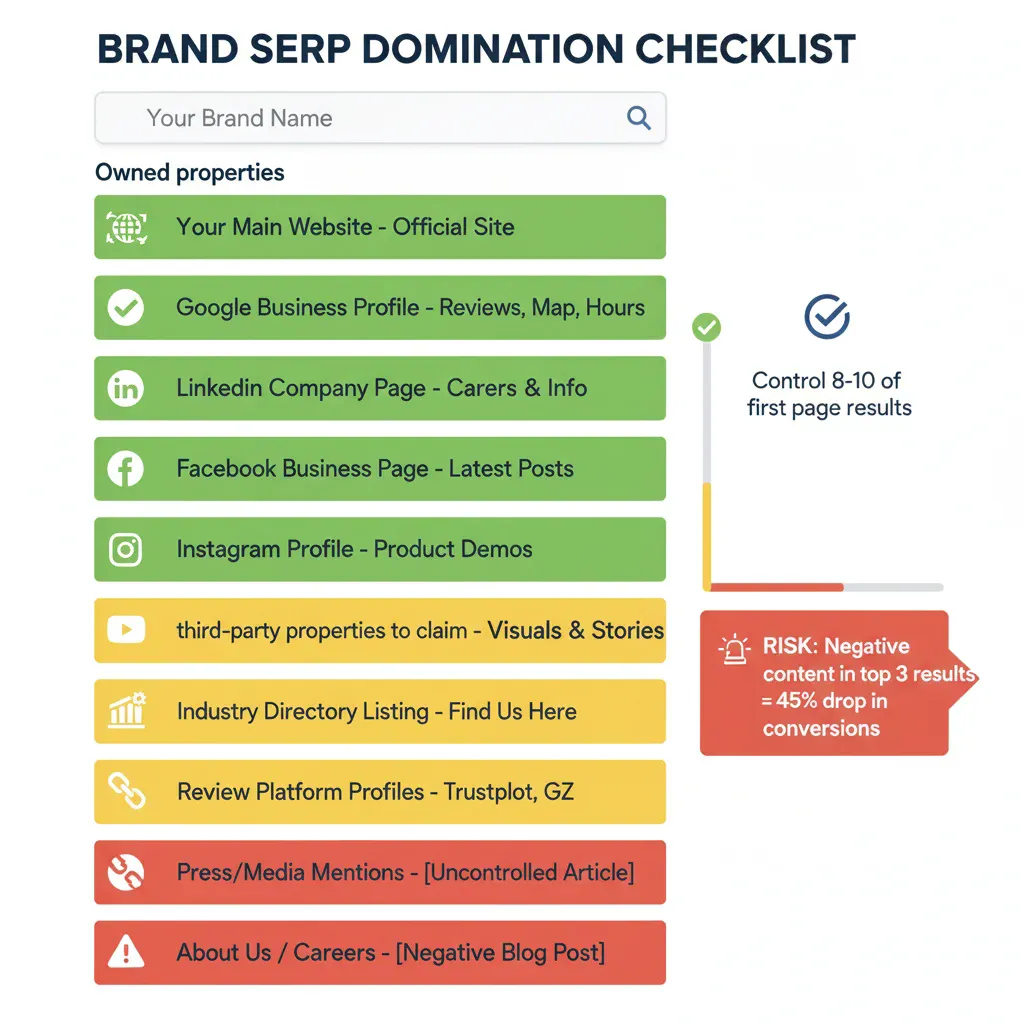
Negative content ranking for your brand terms destroys conversions. Someone searches your company name and finds “Is [Company] a Scam?” articles or complaint sites ranking page one—that’s the end of that potential customer.
When Negative Content Appears
Assess the damage first:
- What’s ranking? (review sites, complaint articles, social posts, competitor comparisons)
- Which keywords? (brand name, brand + scam, brand + review, brand + competitor name)
- How accurate is it? (legitimate complaints vs false information vs competitor attacks)
Responding to legitimate criticism:
If the negative content is accurate—you screwed up, provided poor service, had a bad product batch—you can’t make it disappear and shouldn’t try. Instead:
- Fix the underlying problem immediately
- Respond publicly acknowledging the issue and explaining what changed
- Create content showing the improvements
- Generate new positive reviews that mention the improvements
- Over time, positive content outweighs the negative
Handling false or misleading information:
Contact the site owner first. Many complaint sites will update or remove content if you provide evidence it’s false. Use a professional, factual tone. Threatening legal action usually backfires—site owners dig in and the situation escalates.
If they won’t remove it, respond publicly on their platform (if possible) with facts and evidence. Keep it short, factual, and professional. Don’t argue or get emotional.
Dealing with defamatory content:
For seriously false and damaging content, legal action might be necessary. Defamation law varies by jurisdiction, but generally requires proving:
- The statement is false
- It was published to others
- It caused harm to your reputation
- It was made without adequate research into truthfulness
Consult a lawyer before pursuing this route. Legal threats often make the situation worse by drawing more attention.
The Content Suppression Strategy
You can’t remove negative search results (usually), but you can bury them by outranking them with positive content.
Own your brand name SERP:
Claim and optimize these profiles to dominate page one for your brand name:
- Your website (obviously)
- Google Business Profile
- LinkedIn company page
- Facebook business page
- Instagram profile
- Twitter/X account
- YouTube channel
- Relevant industry directories
- Wikipedia page (if notable enough)
- Crunchbase or similar databases
Create branded content hubs:
Build out content specifically to rank for “[Brand name] + [keyword]” variations:
- About us page (ranks for “[brand name] company”)
- Careers page (ranks for “[brand name] jobs”)
- Press/Media page (ranks for “[brand name] news”)
- Review landing page (ranks for “[brand name] reviews”)
- FAQ page (ranks for “[brand name] questions”)
Generate press coverage:
Positive press articles from reputable sites often outrank complaint sites. Create newsworthy announcements:
- Product launches
- Company milestones
- Industry research/surveys
- Expert commentary on trends
- Partnership announcements
- Award wins
Leverage third-party review platforms:
Get your reviews up on multiple platforms. When someone searches “[brand] reviews,” you want YOUR profiles on trusted review sites ranking, not complaint sites.
Monitor and maintain:
Reputation management isn’t a project with an end date. Rankings shift, new content appears, old issues resurface. Check your brand name SERP weekly and respond to changes quickly.
The Review Velocity Problem
Google (and other platforms) watch for unnatural review patterns. Suddenly getting 50 reviews in one week after months of nothing looks suspicious, especially if they’re all 5-star.
Normal review velocity varies by business type:
- High-volume e-commerce: 10-50+ reviews weekly
- Local service business: 2-10 reviews monthly
- B2B SaaS: 1-5 reviews monthly
- Professional services: 1-10 reviews quarterly
Spikes aren’t always bad—holiday season, major promotion, viral moment can legitimately drive review surges. But sustained unnatural patterns trigger filters.
How to build reviews naturally:
Start your review generation program slowly. Month one, aim for 5-10 reviews. Month two, 8-15. Gradually increase as it becomes part of your process. This looks natural to platform algorithms.
Vary the platforms. Don’t dump 100 reviews on Google and ignore Yelp. Spread them across relevant platforms based on where your customers naturally leave feedback.
Mix review ratings. All 5-star reviews look fake. Real customers leave 4-star reviews mentioning minor issues. In fact, displaying some 4-star reviews increases trust more than showing only perfect 5-star reviews—consumers are skeptical of perfection.
Reputation Management for Different Business Types
E-commerce brands:
- Focus heavily on product review generation (SKU-level)
- Monitor marketplace reviews (Amazon, eBay, Etsy)
- Track unboxing content and social mentions
- Respond to shipping/delivery complaints publicly
Local service businesses:
- Google Business Profile is 80% of your reputation work
- Respond to every review within 24-48 hours
- Post photos showing your work regularly
- Use Q&A feature to address common concerns
SaaS companies:
- G2, Capterra, TrustRadius are your primary battlegrounds
- Detailed reviews matter more than volume
- Respond to feature requests mentioned in reviews
- Create comparison pages for “[Your tool] vs [Competitor]”
Healthcare providers:
- Healthgrades, Vitals, RateMDs are key platforms
- HIPAA limits what you can say in responses
- Focus on process and care quality, not medical details
- Patient privacy concerns mean lower review volume is normal
Professional services (legal, financial, consulting):
- Fewer public reviews due to confidentiality
- Focus on detailed case studies and testimonials
- Avvo for lawyers, Martindale-Hubbell for attorneys
- Personal brand reputation of partners matters significantly
Restaurants and hospitality:
- Google, Yelp, TripAdvisor dominate
- Photos and response times matter enormously
- Bad reviews spread faster in this industry
- Resolution offers should be public (within reason)
What the Data Shows About Reputation Impact
BrightLocal’s Local Consumer Review Survey found:
- 98% of consumers read online reviews for local businesses
- 76% of consumers trust online reviews as much as personal recommendations
- 89% of consumers read businesses’ responses to reviews
- 54% of consumers visit a business website after reading positive reviews
ReviewTrackers’ research on review volume and ratings:
- Businesses with 1-25 reviews average 3.9 star rating
- Businesses with 26-50 reviews average 4.1 stars
- Businesses with 200+ reviews average 4.3 stars
- Moving from 1-3 reviews to 11+ reviews correlates with 5-10% ranking improvement in local pack
Harvard Business School study on review impact:
- One-star increase in Yelp rating leads to 5-9% increase in revenue
- Chain restaurants see smaller impact (less affected by reviews)
- Independent restaurants see larger impact
Spiegel Research Center findings on conversion impact:
- Displaying reviews can increase conversion rates by 270%
- Products with reviews are 63% more likely to be purchased
- Products with 5 reviews have 270% higher purchase likelihood than products with no reviews
Northwestern University study on negative reviews:
- A few negative reviews (alongside positive ones) increase credibility
- All 5-star products are viewed with skepticism
- Optimal rating for credibility is 4.2-4.5 stars
Building a Sustainable Reputation System
One-off reputation campaigns don’t work. You need processes that run continuously without constant manual effort.
Monthly reputation audit:
- Search brand terms and check top 30 results
- Review all platform ratings and recent feedback
- Analyze sentiment trends (improving or declining)
- Check competitor reputation changes
- Assess any new negative content
Weekly monitoring:
- Check Google Alerts and monitoring tools
- Respond to new reviews across platforms
- Address any urgent reputation issues
- Track review velocity and ratings
Quarterly strategy review:
- Evaluate what’s working in review generation
- Adjust messaging and timing
- Identify new platforms to focus on
- Create content to address reputation gaps
- Analyze ROI of reputation efforts
Team responsibility:
- Assign ownership (don’t make it “everyone’s job”)
- Train customer-facing staff on review requests
- Create response templates and guidelines
- Set up alerts so the right person sees issues immediately
What Most People Get Wrong
- Mistake: Focusing only on Google Reviews You need presence across multiple platforms. Different customers check different sites. Multi-platform reputation signals carry more weight.
- Mistake: Only responding to negative reviews Engage with positive reviews too. Customers who leave positive reviews and get acknowledged become more loyal and refer more people.
- Mistake: Identical response templates Reviewers can tell when you’re copy-pasting. Personalize each response with specific details from their review.
- Mistake: Asking for reviews too early Don’t ask before customers have fully experienced your product/service. Premature requests get ignored or result in incomplete reviews.
- Mistake: Neglecting old negative reviews Even if a negative review is two years old, respond to it. Future customers reading reviews see whether you engage with criticism.
- Mistake: Trying to bury legitimate criticism Fix the actual problem instead of spending energy hiding evidence of it. Transparency builds more trust long-term.
- Mistake: Treating reputation management as a project It’s an ongoing process, not something you do once and forget. Markets shift, competitors attack, issues emerge—continuous work required.
The Bottom Line
Reputation management directly impacts your SEO performance through E-E-A-T signals, user behavior metrics, and brand search volume. It’s not separate from SEO—it’s foundational to it.
Start with monitoring so you know what you’re working with. Build review generation into your customer journey. Respond to feedback consistently. Create positive content that outranks negative content. Make it systematic rather than reactive.
The businesses winning at SEO aren’t necessarily the ones with the best content or most backlinks. They’re the ones customers trust—and that trust shows up in rankings.