Found this site while digging through backlink data for another project. Garage2Global.com. Digital marketing agency, web development services, the usual stuff.
- The Traffic Numbers That Don’t Tell the Full Story
- The Anchor Text Strategy That Screams “Conversion”
- The Keyword Strategy: Branded vs. Service Terms
- The Backlink Profile: Quality vs. Quantity Game
- The Content Structure: Service Pages Dominating
- The Conversion Funnel Hidden in the Backlinks
- What’s Actually Working vs. What’s Risky
- The Keywords They’re Actually Ranking For (And Why It Matters)
- How They’re Converting Visitors (The Real Money Shot)
- The Technical Foundation (What’s Under the Hood)
- What Other Agencies Can Learn (And Probably Shouldn’t Copy)
Except their SEO approach isn’t usual at all.
Most agencies I analyze have backlink profiles that look… normal. Mix of directory listings, guest posts, maybe some client mentions. Standard stuff that builds authority but doesn’t necessarily drive conversions.
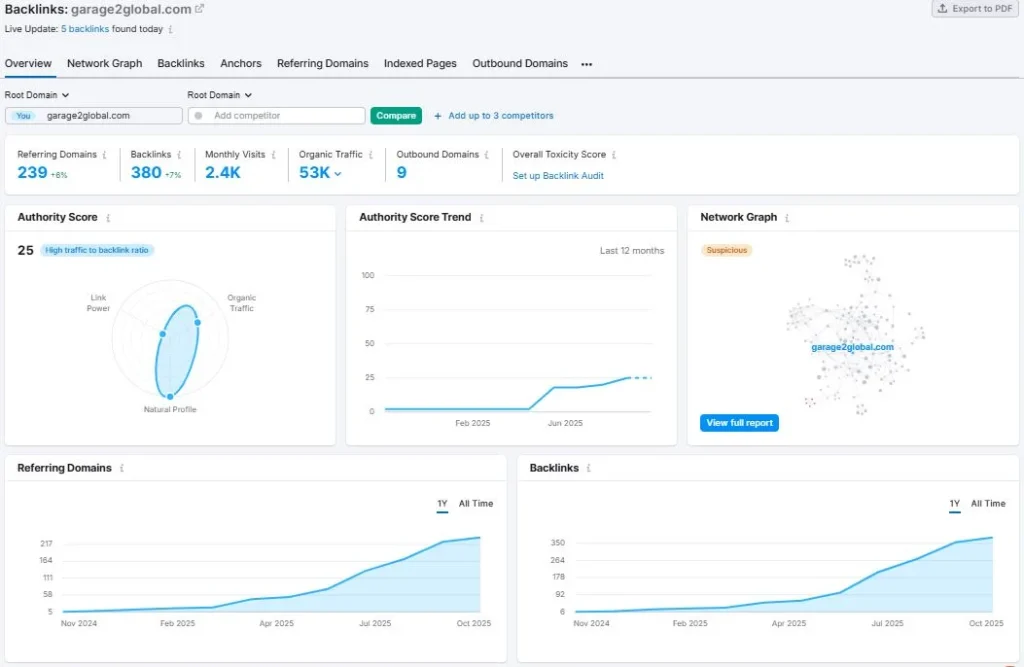
Garage2Global’s doing something different. 380 backlinks from 239 domains. Authority Score sitting at 25. Nothing crazy on paper.
But check the anchor text strategy.
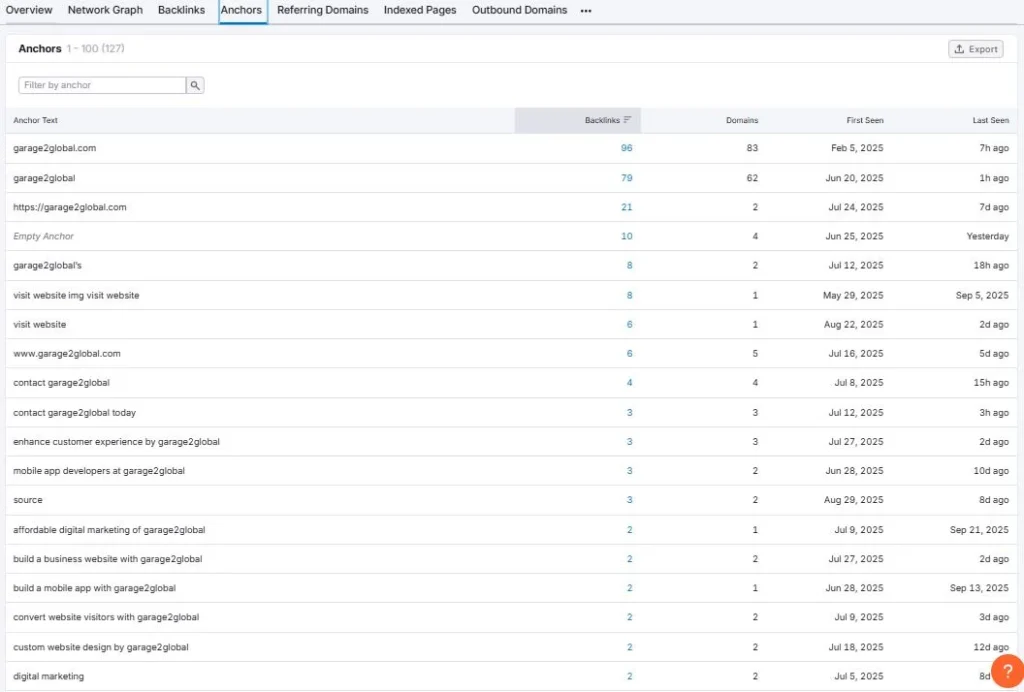
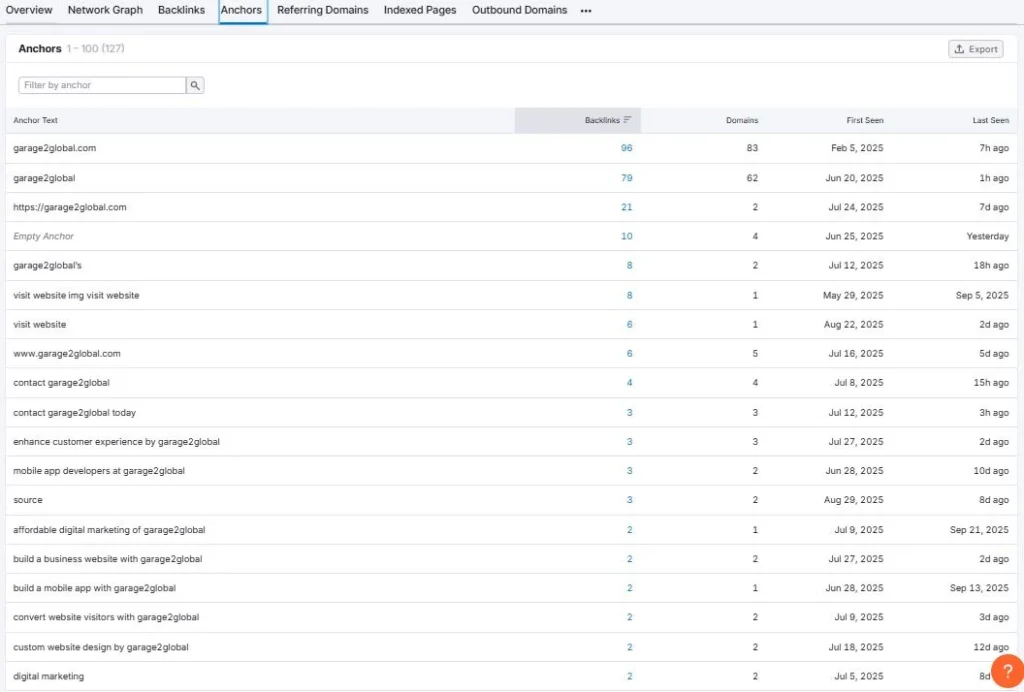
“Convert website visitors with garage2global” – 2 backlinks “Build a business website with garage2global” – 2 backlinks
“Outsourced customer support by garage2global” – another 2 “Digital marketing solutions from garage2global” – 2 more
See the pattern? They’re not building links for SEO. They’re building links for conversion. Every anchor is a service pitch wrapped in a backlink.
That’s either brilliant or risky as hell. Let me show you what I found.
The Traffic Numbers That Don’t Tell the Full Story
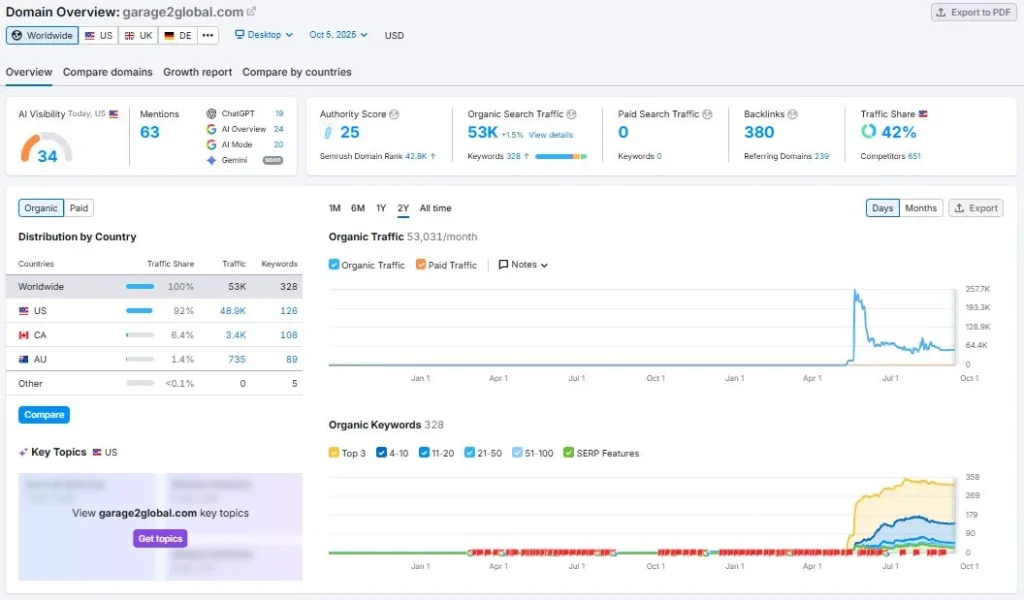
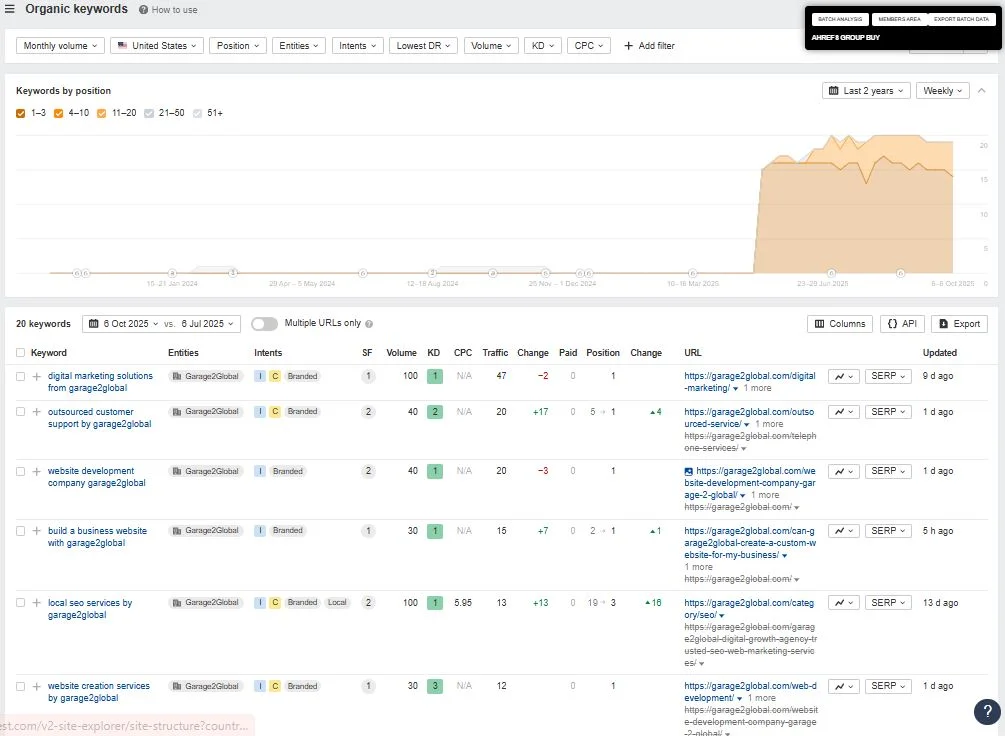
Semrush says 53K monthly organic visitors. Traffic value of $21. Authority Score 25. 328 keywords ranking.
Sounds solid for a mid-sized agency, right?
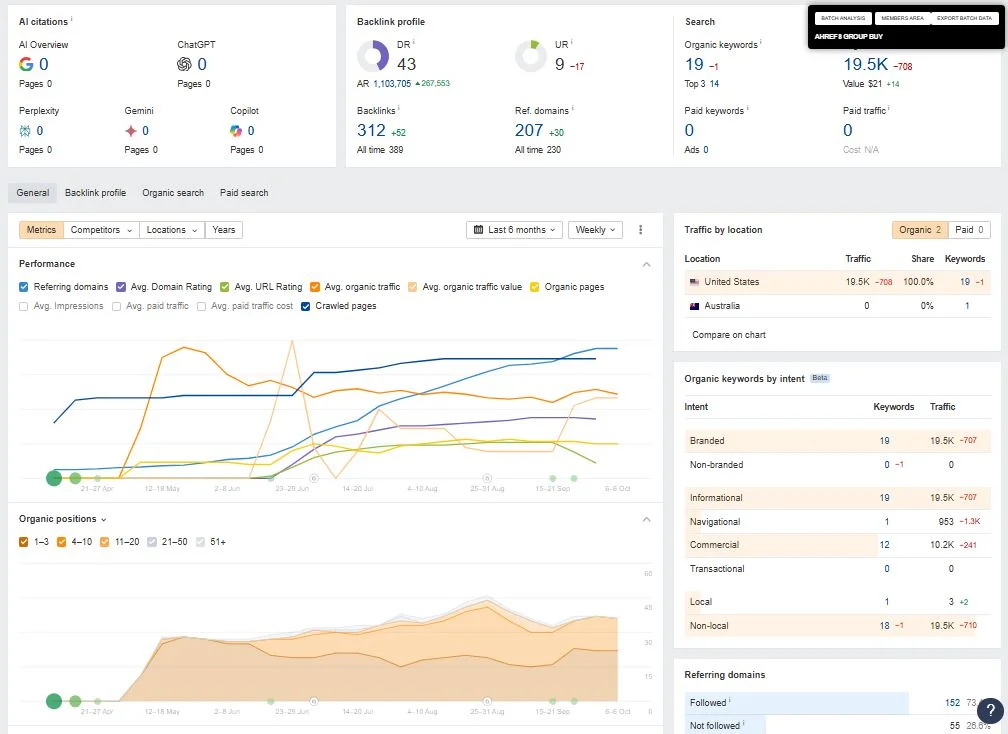
But Ahrefs tells a different story – 19.5K traffic. DR 43. 312 backlinks.
The discrepancy’s huge. Semrush estimating nearly 3x what Ahrefs shows. That usually means one of two things: either the traffic’s super volatile or the ranking keywords have weird search volume data.
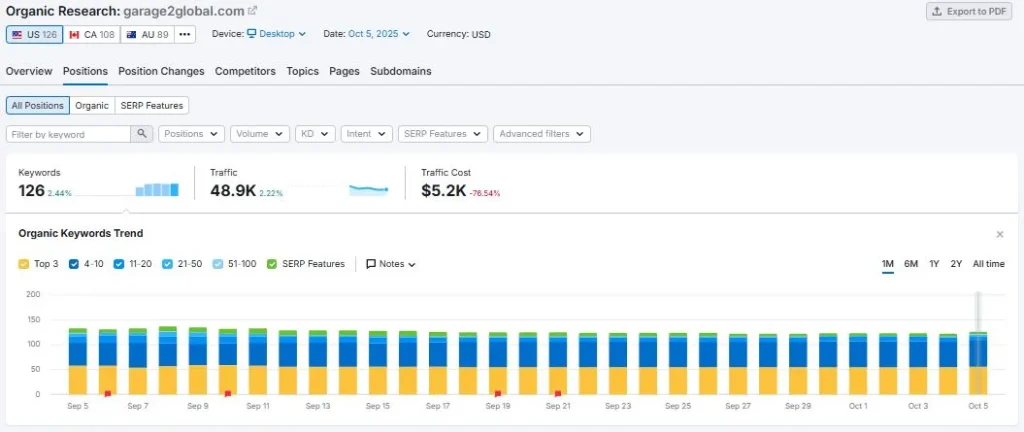
Diving into the actual keyword data – 126 total keywords according to one view, 328 in another. Traffic estimates bouncing between 48.9K and 53K depending on which report you’re looking at.
Here’s what’s consistent across all the data:
| Metric | Semrush | Ahrefs | Reality Check |
| Monthly Traffic | 48.9K – 53K | 19.5K | Likely somewhere between |
| Keywords | 126-328 | 19 | Tools disagree heavily |
| Backlinks | N/A | 312 | Ahrefs more accurate for links |
| DR/AS | AS 25 | DR 43 | Mid-tier authority |
Traffic’s probably in the 25-35K range if I’m being realistic. Still decent. But not the 53K Semrush is claiming.
Where That Traffic Actually Comes From
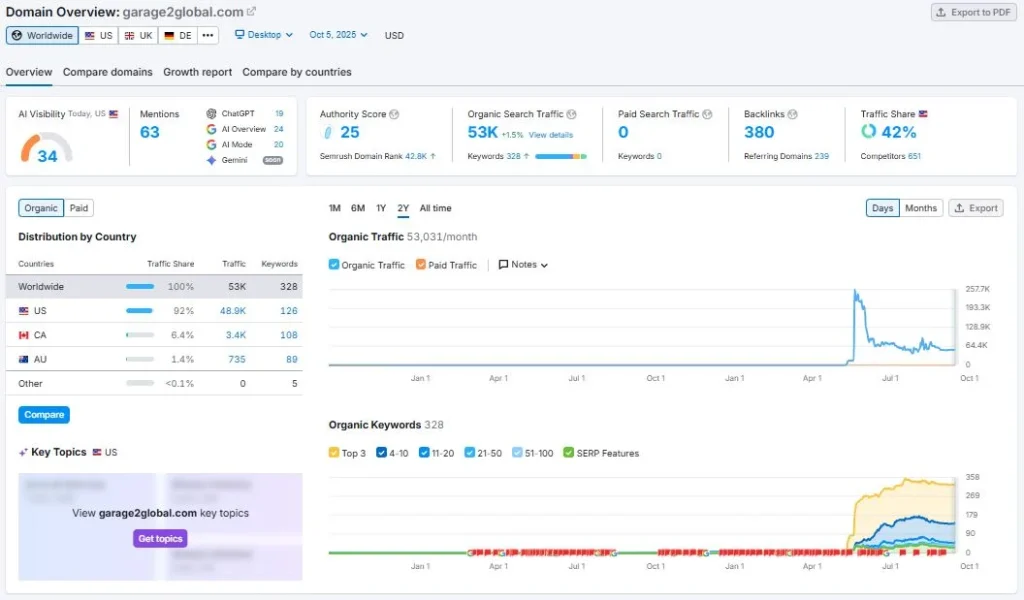
92% United States. 48.9K of the traffic. 6.4% Canada. 3.4K visitors. 1.4% Australia. 735 visits.
They’re not even trying to rank globally. This is a US-focused play targeting American businesses looking for digital services.
Makes sense for a service business. You want local clients (or at least same-timezone clients). International SEO for an agency is usually wasted effort unless you’re massive.
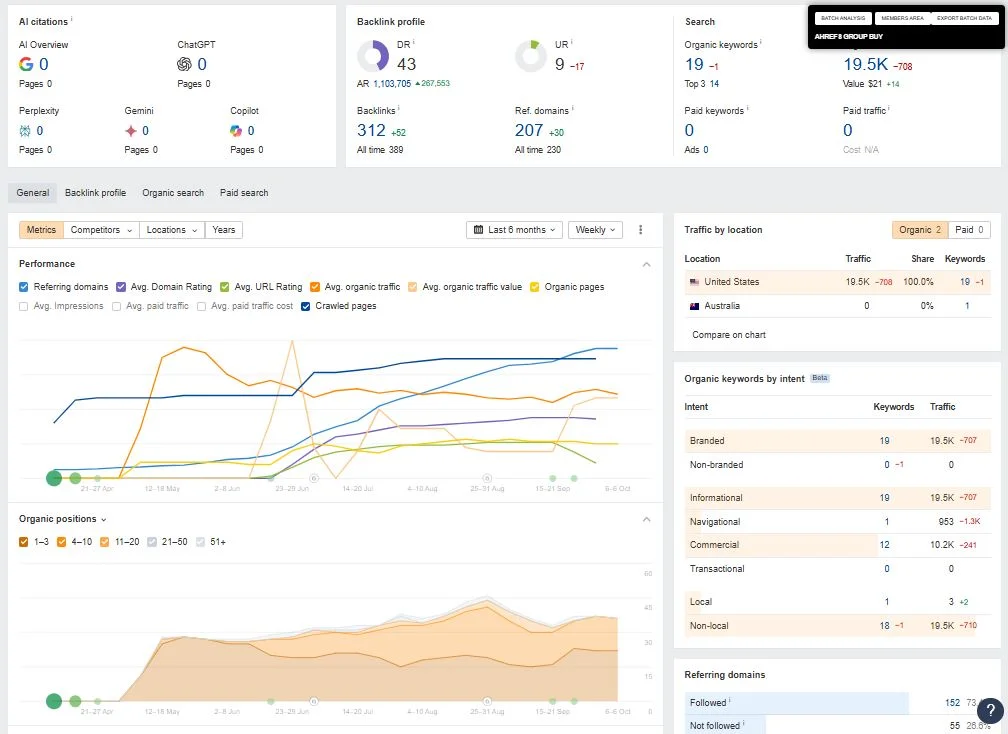
But look at that recent drop. Traffic’s down 708 visits in the last period. Not catastrophic, but it’s trending wrong. The graph shows they had a spike—probably hit something viral or got featured somewhere—and now they’re settling back down.
That’s the problem with service-based SEO. You’re not building evergreen content that compounds. You’re chasing project-based searches that fluctuate.
The Anchor Text Strategy That Screams “Conversion”
This is where it gets interesting.
Most sites have anchor text that looks like:
- Brand name (40%)
- URLs (30%)
- Generic phrases (20%)
- Keywords (10%)
Garage2Global’s anchor profile:
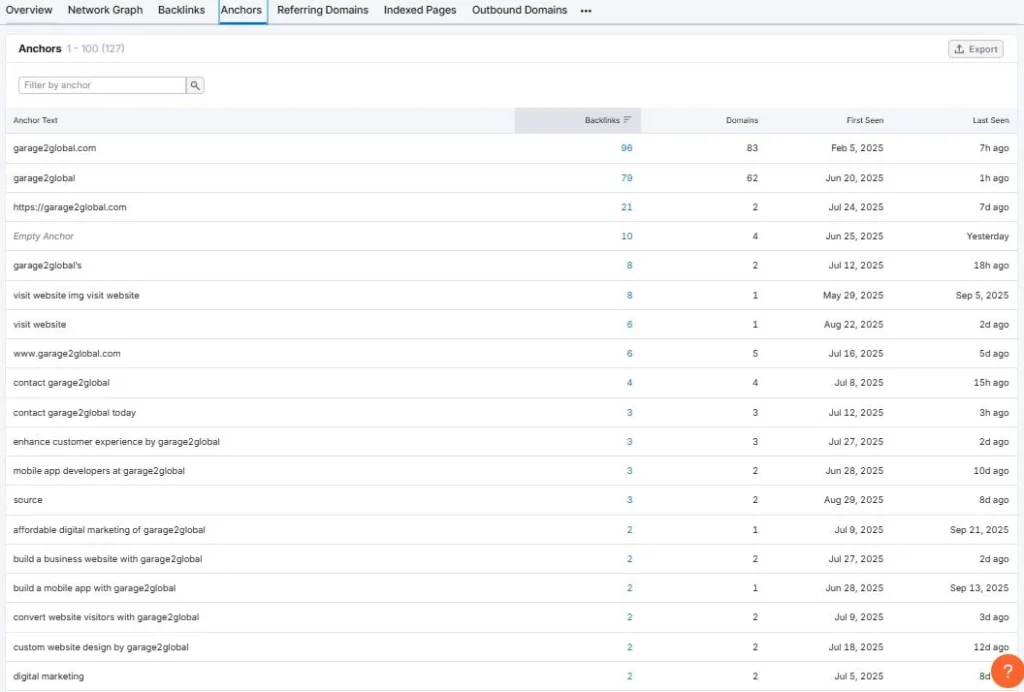
Top anchors by backlink count:
- garage2global.com – 96 backlinks
- garage2global – 79 backlinks
- https://garage2global.com – 21 backlinks
- (empty anchor) – 10 backlinks
- garage2global’s – 8 backlinks
So far, normal branded stuff. That’s like 214 of the 380 total backlinks. Standard.
But then you get into the service anchors:
- “visit website” – 6 backlinks
- “contact garage2global” – 4 backlinks
- “convert website visitors with garage2global” – 2 backlinks
- “build a business website with garage2global” – 2 backlinks
- “build a mobile app with garage2global” – 2 backlinks
- “custom website design by garage2global” – 2 backlinks
- “digital marketing” – 2 backlinks
Every single one is action-oriented. Not “digital marketing services“ or “web development company.” It’s “build a business website WITH garage2global.” Call to action baked into the anchor.
What This Actually Does
From an SEO perspective? Risky. Google’s been cracking down on exact-match commercial anchors for years. When every link says “hire us to do X,” that’s manipulative anchor text in their eyes.
But from a conversion perspective? Smart.
Think about it. Someone’s reading an article about mobile app development. Sees a link that says “build a mobile app with garage2global.” That’s not just passing PageRank—it’s selling the service before they even click.
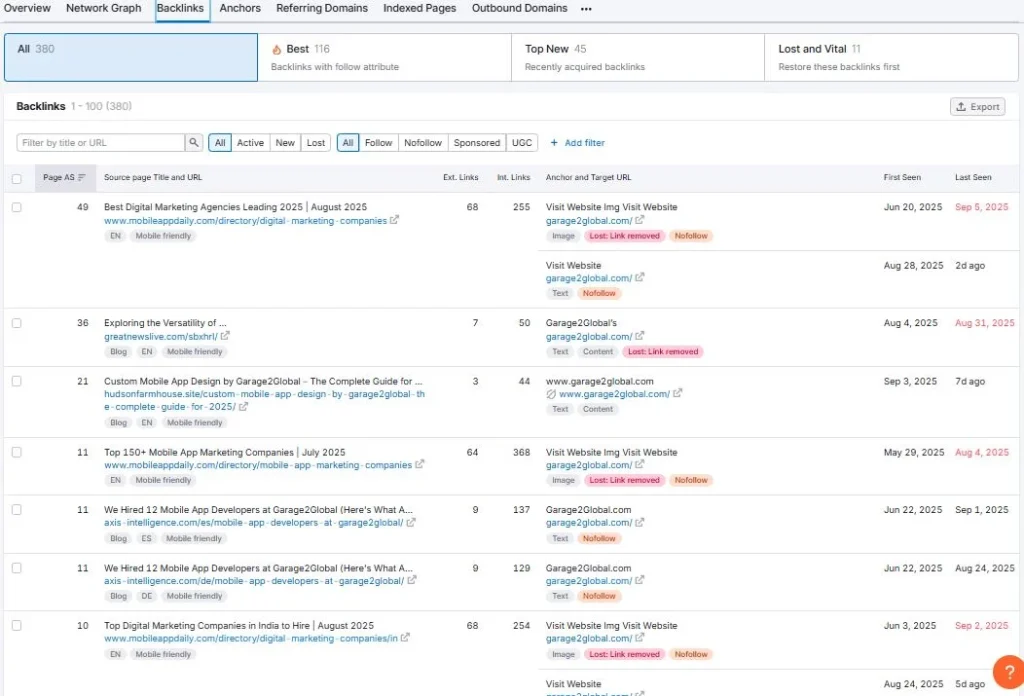
Looking at where these links appear:
- mobileappdaily.com – “Best Digital Marketing Agencies Leading 2025”.
- hudsonfarmlove.site – “Custom Mobile App Design By Garage2Global”.
- axis-intelligence.com – “We Hired 12 Mobile App Developers at Garage2Global”.
These aren’t editorial mentions. These are placed links in directories, guest posts and “best of” lists. The kind you pay for or pitch hard to get.
And they’re all using those conversion-focused anchors.
The Keyword Strategy: Branded vs. Service Terms
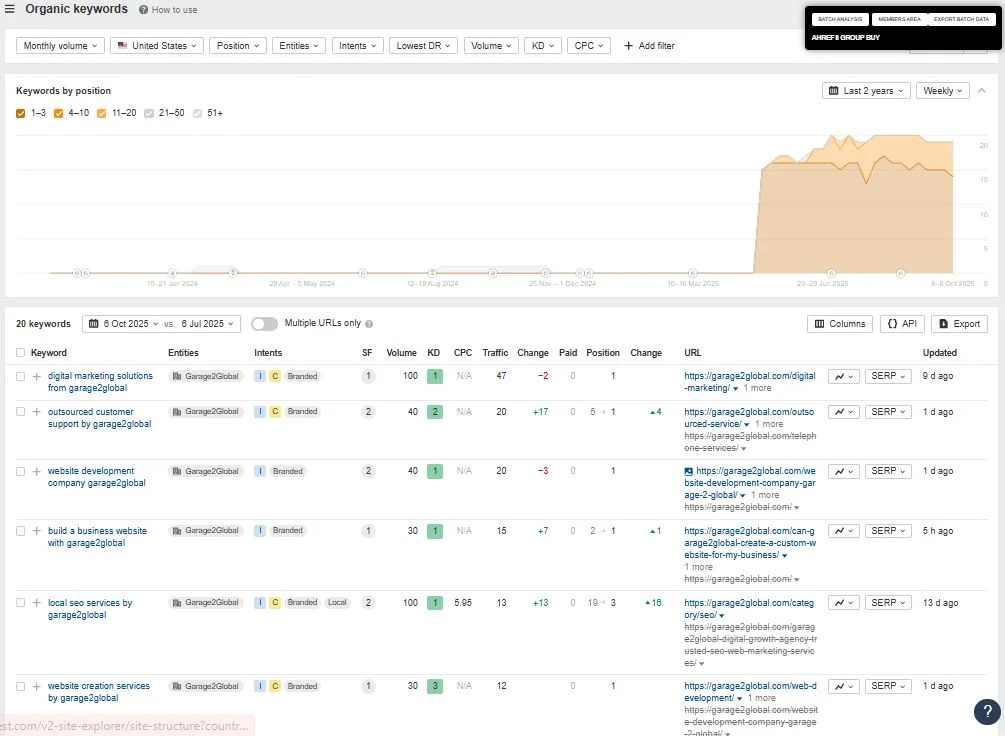
Let me break down their actual rankings because this tells you everything about their strategy.
Position #1 rankings:
- “digital marketing solutions from garage2global” – 100 volume, 47 traffic.
- “outsourced customer support by garage2global” – 40 volume, 20 traffic.
- “website development company garage2global” – 40 volume, 20 traffic.
- “build a business website with garage2global” – 30 volume, 15 traffic.
- “local seo services by garage2global” – 100 volume, 13 traffic.
Notice something? Every single top keyword includes their brand name.
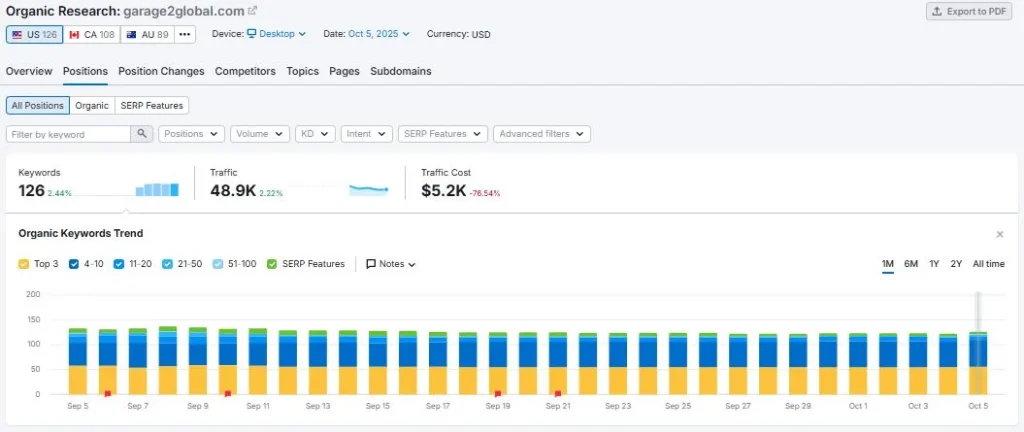
The keyword trend graph shows steady rankings across most terms. No huge volatility. But when you filter by position, you see:
- 1-3 positions: Mostly branded terms
- 4-10 positions: Mix of branded and semi-branded
- 11-20 positions: Generic service terms struggling
- 21-50+: Barely ranking
They’re dominating branded searches and long-tail branded + service combos. Which is great if people already know about you. But how are people discovering them in the first place?
That’s where the backlink strategy comes in. Those links with conversion anchors? They’re not just building authority—they’re building brand awareness. Someone sees “garage2global” mentioned 5 times across different articles about web development and eventually they search for the brand directly.
Then boom – they rank #1 for every branded term.
The Service Keywords They’re Missing
Here’s what they’re NOT ranking for:
| Service Term | Est. Volume | Their Position |
| digital marketing agency | 18K | Not ranking |
| web development services | 12K | Not ranking |
| mobile app developers | 8K | Not ranking |
| seo services near me | 15K | Not ranking |
| custom website design | 9K | Not ranking |
The big volume, generic service terms? Nowhere to be found in their rankings. They’re completely skipping the competitive head terms and going straight for branded long-tail.
Which makes sense if you can’t compete with the big agencies on pure SEO firepower. Focus on being known, not on ranking for everything.
The Backlink Profile: Quality vs. Quantity Game
So they’ve got 380 backlinks from 239 referring domains. Let me unpack what that actually means.
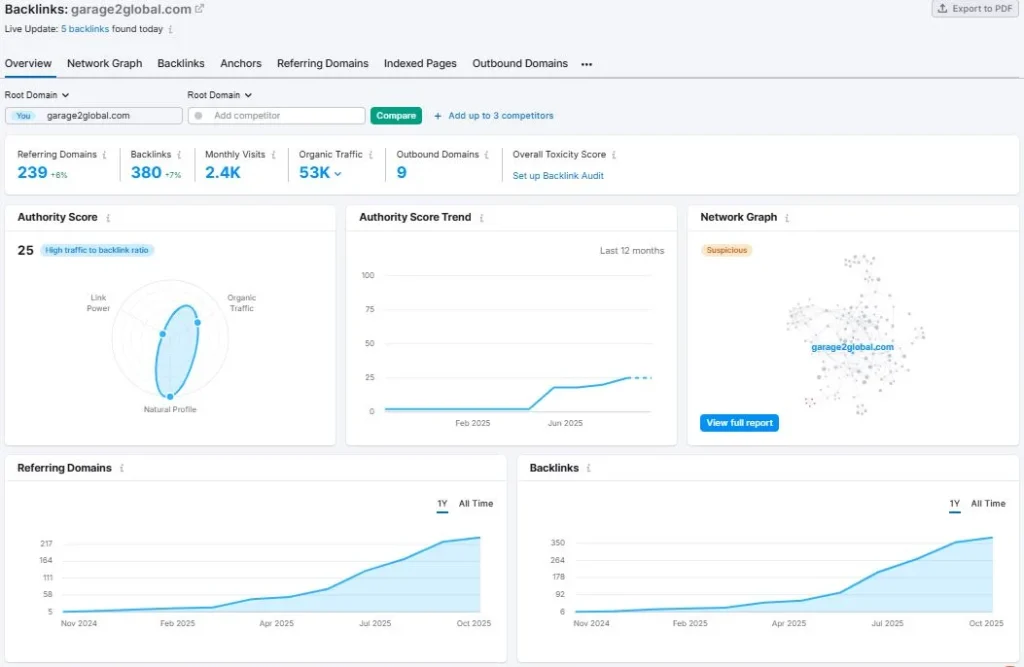
The growth pattern’s been steady. Started low in November 2024, then climbed consistently through 2025. Nothing explosive—just gradual month-over-month increases.
That’s actually good. Sudden link spikes scream manipulation. This looks more organic or at least paced well enough to avoid red flags.
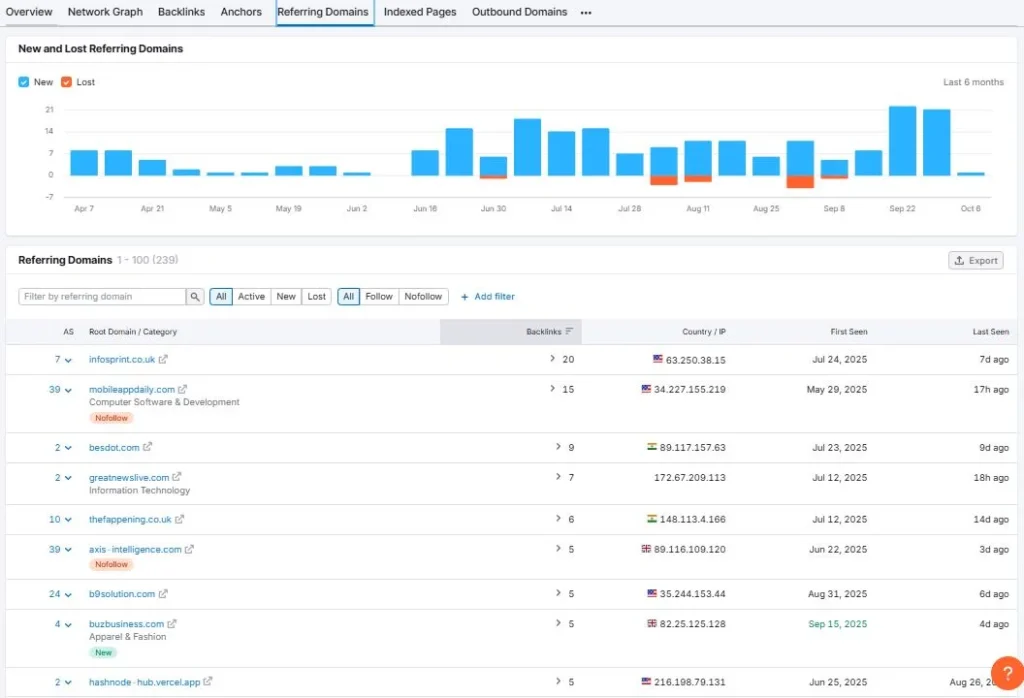
But look at where the links come from:
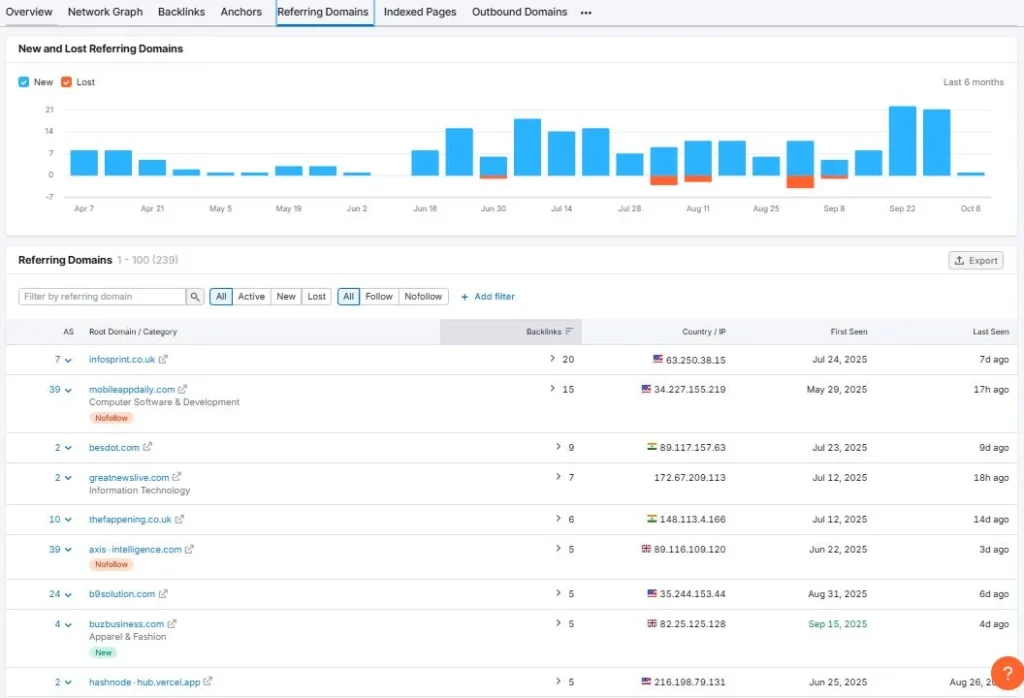
Top referring domains:
- infosprint.co.uk (AS 7) – 20 backlinks
- mobileappdaily.com (AS 39) – 15 backlinks
- besdot.com (AS 2) – 9 backlinks
- greatnewslive.com (AS 2) – 7 backlinks
- thefappening.co.uk (AS 10) – 6 backlinks
- axis-intelligence.com (AS 39) – 5 backlinks
- b9solution.com (AS 24) – 5 backlinks
Mixed bag. You’ve got mobileappdaily and axis-intelligence with decent authority (AS 39). Those are legit tech/business sites.
Then you’ve got besdot.com and greatnewslive.com with AS 2. That’s basically zero authority. And “thefappening.co.uk”? That domain name alone raises eyebrows.
The Network Graph Shows Something Weird
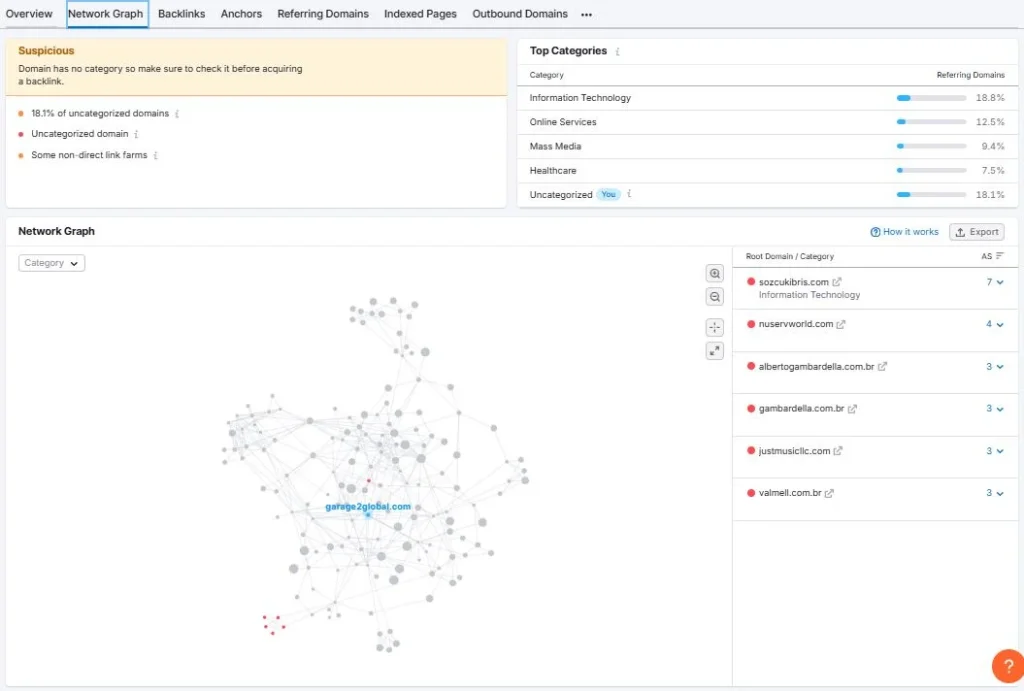
The network visualization is telling. See how garage2global sits in the middle with connections spreading out? Most sites have clustering—groups of related domains linking together because they’re in the same niche.
This graph shows scattered, disconnected nodes. No real community pattern. That happens when links come from paid placements or outreach campaigns rather than natural editorial mentions.
The warning says “Suspicious” right at the top. Tool’s algorithm picked up on something off.
Breaking down the top categories:
- Information Technology: 18.8%
- Online Services: 12.5%
- Mass Media: 9.4%
- Healthcare: 7.5%
- Uncategorized: 18.1%
Healthcare? Mass Media? For a web development agency?
Natural link profiles cluster in your niche. If you’re a digital marketing company, most links should come from marketing, tech and business sites. Getting 7.5% from healthcare sites means either you’ve got clients in that space (possible) or you’re buying guest posts wherever you can get them (more likely).
The Content Structure: Service Pages Dominating
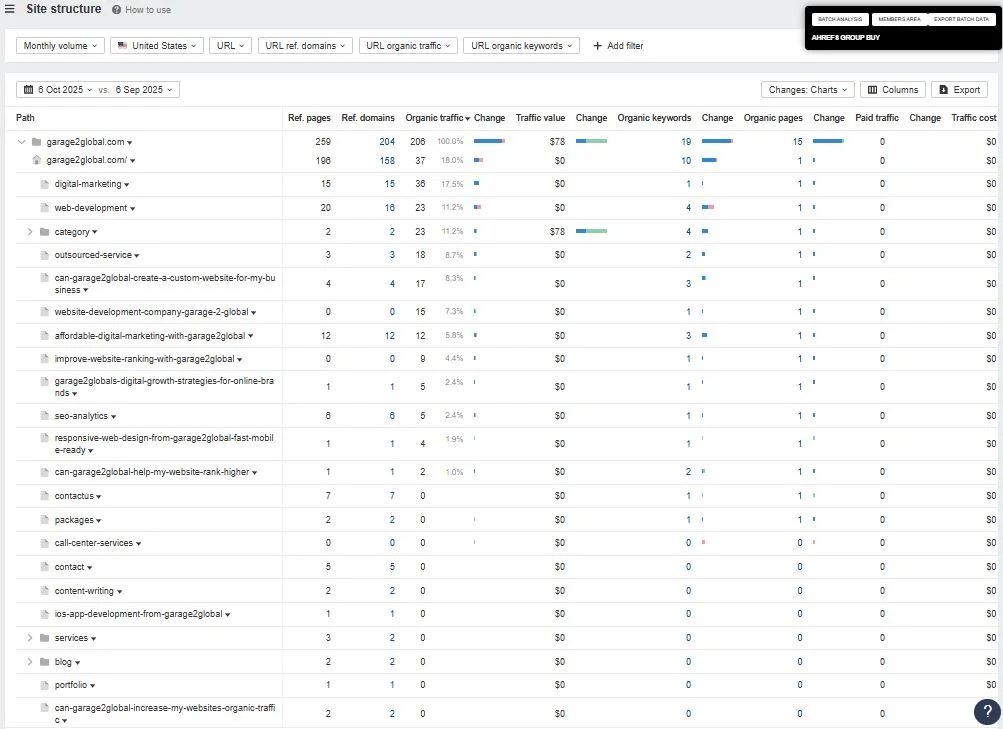
Their site structure’s straightforward. No weird subdomains, no complicated folder hierarchies. Just clean service pages.
Top-level structure:
- /garage2global.com/ (root) – 259 ref pages, 204 domains.
- /digital-marketing/ – 15 ref pages, 15 domains.
- /web-development/ – 20 ref pages, 18 domains.
- /category/ – 2 ref pages, 2 domains.
- /outsourced-service/ – 3 ref pages, 3 domains.
Most links point to the homepage (259 referring pages). That’s normal for brand building. But they’re also distributing links to individual service pages, which is smart.
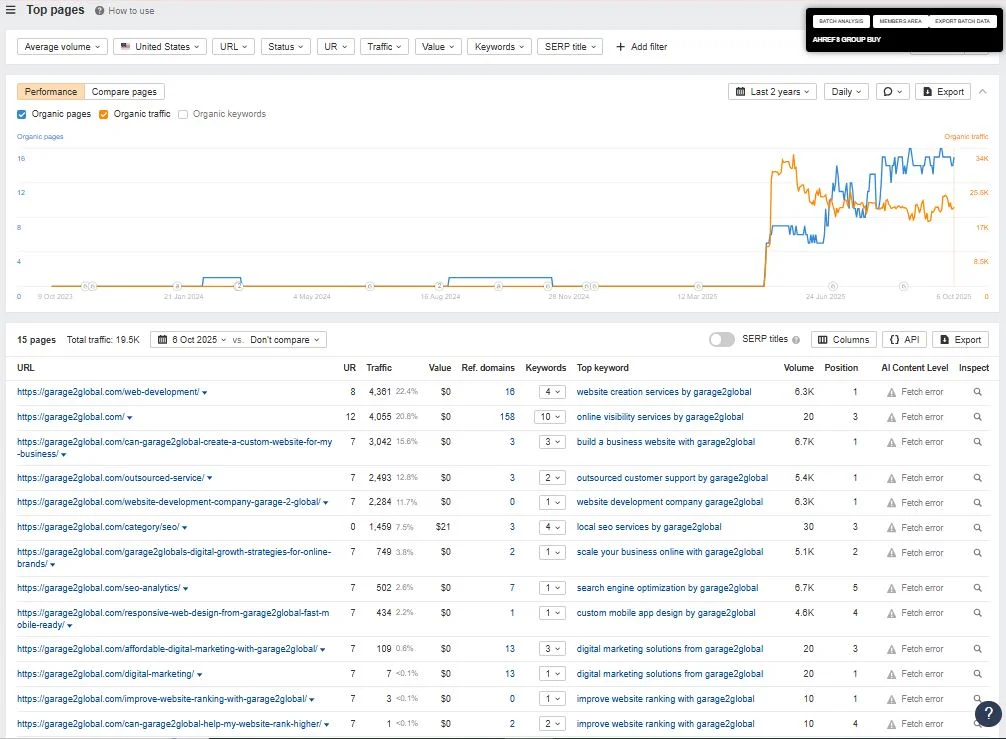
The top performing pages:
- /web-development/ – 4,361 visits (22.4% traffic share).
- /outsourced-service/ – 4,055 visits (20.8%).
- Can-garage2global-create-a-custom-website-for-my-business – 3,042 visits (15.6%).
- /outsourced-service/ (different variation?) – 2,493 visits (12.8%).
- Website-development-company-garage-2-global – 2,284 visits (11.7%).
Wait. Notice the URL patterns? Half these top pages have “garage2global” or variations of their services in the slug. They’re creating individual landing pages for every service + brand combo.
That’s old-school exact-match domain thinking applied to internal pages. Make a page specifically for “website development company garage 2 global” so you rank when someone searches that exact phrase.
Does it work? According to the traffic numbers, yeah. Each of those pages is pulling 2K-4K monthly visits.
The Service Page Strategy Breakdown
Looking at the site structure more closely:
- /can-garage2global-create-a-custom-website-for-my-business/ – 17 ref domains.
- /website-development-company-garage-2-global/ – 16 ref domains.
- /affordable-digital-marketing-with-garage2global/ – 12 ref domains.
- /garage2globals-digital-growth-strategies-for-online-brands/ – 5 ref domains.
They’re building links directly to these long-tail service pages. Not just homepage links that pass authority down through internal linking. Direct placement.
That’s unusual. Most link building targets the homepage or maybe a few pillar content pieces. They’re going after individual service landing pages with specific link campaigns.
Why? Because when someone clicks a link that says “build a mobile app with garage2global” and lands on a page about… building mobile apps with garage2global… the conversion path is instant. No navigation needed. No “figure out what we do” friction.
Link goes straight to the offer.
The Conversion Funnel Hidden in the Backlinks
Here’s what I think they’re actually doing.
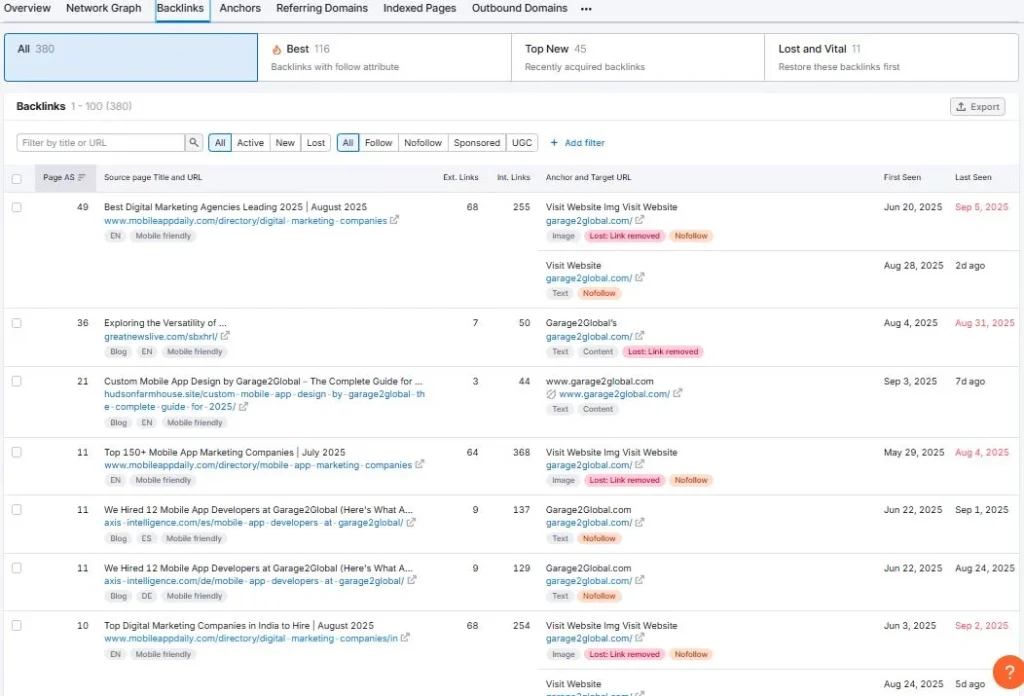
Look at the pattern:
Link #1: Article on mobileappdaily.com about “Best Digital Marketing Agencies”
- Anchor: “Visit Website Img Visit Website”.
- Target: garage2global.com/.
- Context: Directory-style listing.
Link #2: Article on hudsonfarmlove.site about mobile app design
- Anchor: “Garage2Global’s”.
- Target: garage2global.com/.
- Context: Branded mention in content.
Link #3: Article on axis-intelligence.com
- Anchor: “www.garage2global.com”
- Target: www.garage2global.com/custom-mobile-app-design-by-garage2global-the-complete-guide-for-2025/
- Context: Deep link to specific service guide
They’re not just building links. They’re building a referral funnel across the web.
Stage 1: Brand awareness (directory listings, “best of” posts).
Stage 2: Authority building (guest posts with contextual mentions).
Stage 3: Direct conversion (deep links to service landing pages).
Each backlink serves a different part of the funnel. The high-level stuff builds recognition. The mid-funnel content establishes expertise. The bottom-funnel links drive conversions.
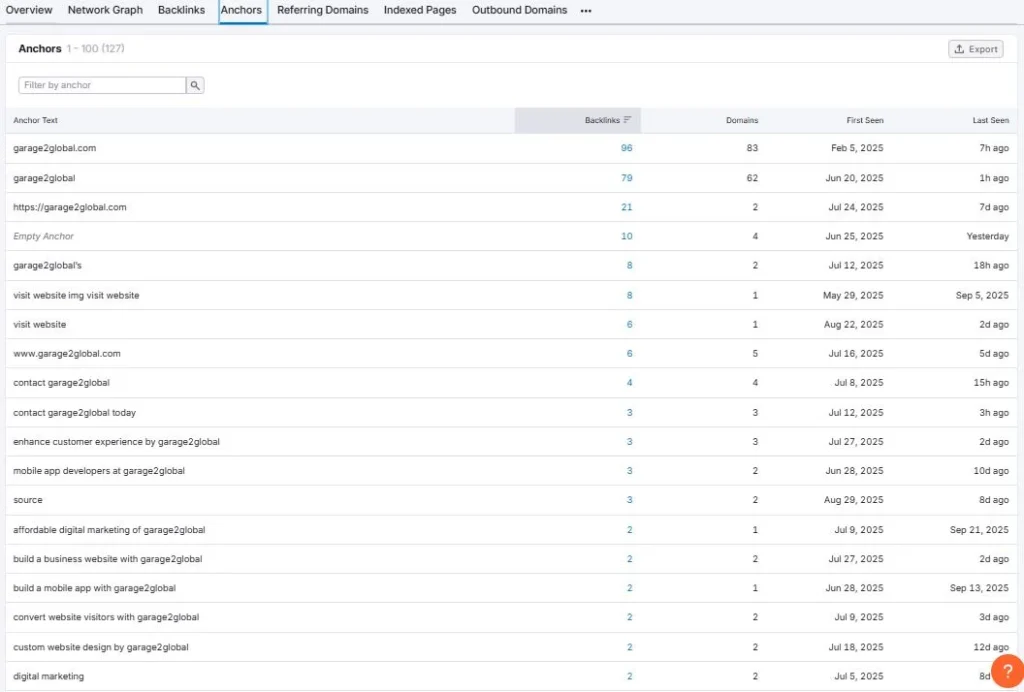
And those conversion-focused anchors? They’re basically mini-ads running on other people’s websites. Someone reading about mobile app marketing sees “build a mobile app with garage2global” linked in the content. That’s not SEO—that’s lead generation disguised as link building.
The Risk They’re Taking
Google’s gotten aggressive about manipulative anchor text. If you’re building links with exact-match commercial anchors at scale, eventually they notice.
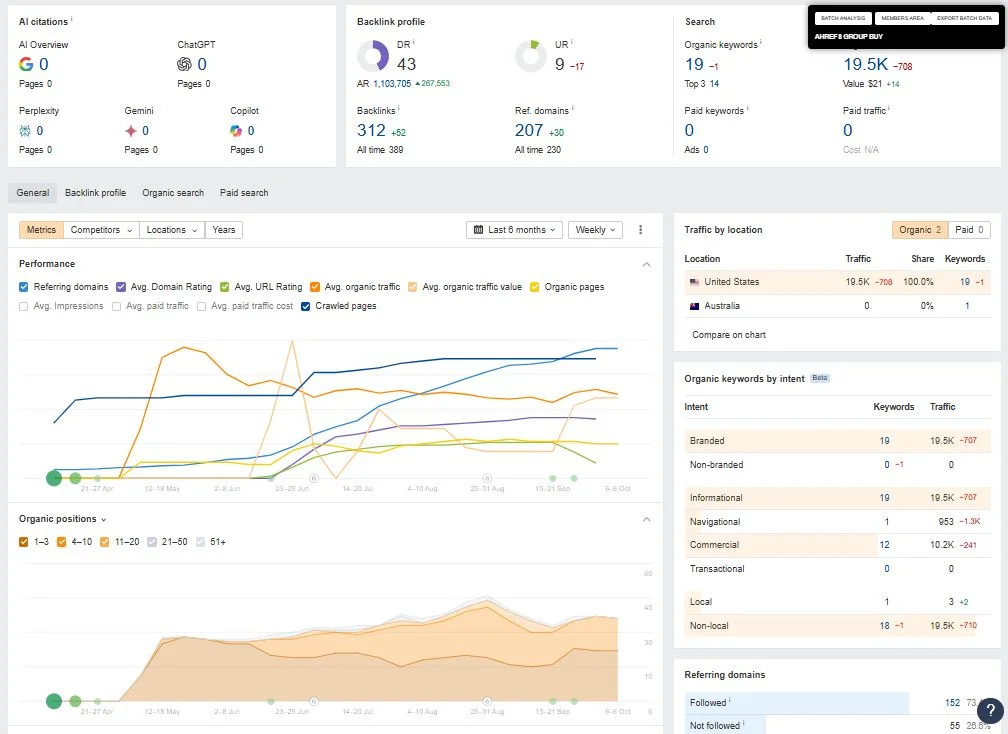
The metrics show potential problems. DR of 43 is solid. But URL Rating of 9? That’s low. Really low.
DR measures the overall domain’s backlink profile strength. UR measures how strong an individual URL’s links are. When DR is way higher than UR, it usually means:
- Links are spread across many pages (diluted).
- Or Google’s discounting most of the links.
- Or there’s a quality issue with the link profile.
For garage2global, probably a mix of all three. They’re building to multiple service pages (dilution), using aggressive anchors (quality flags) and getting links from questionable sources (the AS 2 sites in their profile).
They’re getting traffic now. But they’re playing a risky game.
What’s Actually Working vs. What’s Risky
Let me separate the smart moves from the questionable ones.
What’s working:
- Service-specific landing pages with exact-match URLs.
- Targets long-tail searches effectively
- High conversion intent built into the URL itself
- Getting 2K-4K visits per page
- Branded anchor text domination.
- 96 + 79 + 21 branded anchors = 196 of 380 total
- Builds brand recognition safely
- No penalty risk
- US-focused traffic strategy.
- 92% US traffic for a service business makes sense
- Not wasting effort on international SEO
- Timezone alignment with target clients
- Steady link velocity.
- No sudden spikes that trigger filters
- Consistent growth month-over-month
- Looks more natural
What’s risky:
- Conversion-focused anchor text
- “Convert website visitors with garage2global” is aggressive
- Google sees this as manipulative
- Works short-term, penalty risk long-term
- Link source quality
- Multiple AS 2 domains (essentially zero authority)
- Healthcare and mass media sites for a tech agency?
- Pattern suggests paid placements
- Low URL Rating despite decent DR
- Signals Google might be discounting links
- Quality issue brewing
- Could cascade into rankings drop
- Limited non-branded rankings
- Almost zero visibility for generic service terms
- Completely dependent on brand awareness
- If links stop, traffic stops
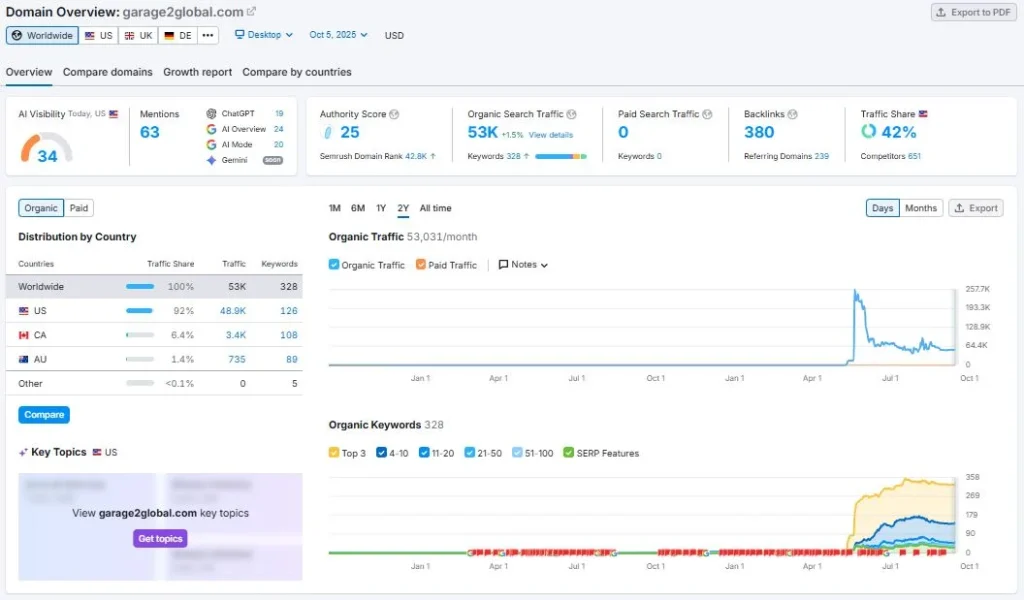
The traffic chart shows exactly this risk. Huge spike when something hit, then immediate drop-off. That’s not sustainable organic growth. That’s campaign-driven traffic that disappears when the campaign ends.
The Keywords They’re Actually Ranking For (And Why It Matters)
Grabbed the full keyword list to see what’s actually driving traffic.
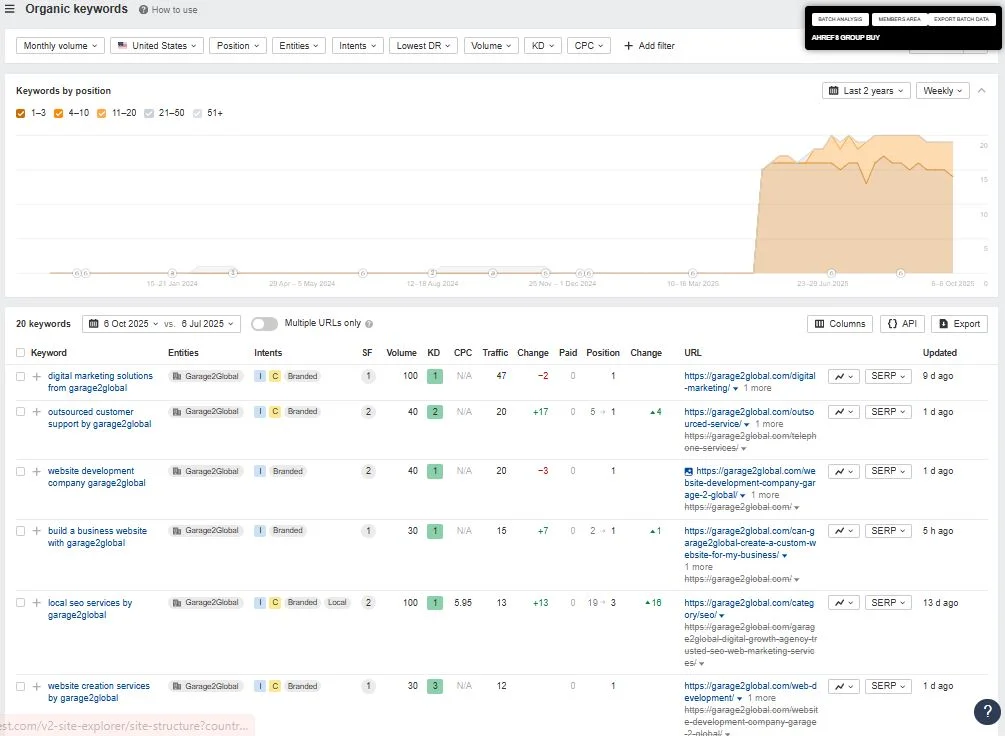
Top performing keywords by traffic:
- “digital marketing solutions from garage2global” – Position 1, 47 visits.
- “outsourced customer support by garage2global” – Position 1, 20 visits.
- “website development company garage2global” – Position 1, 20 visits.
- “build a business website with garage2global” – Position 1, 15 visits.
- “local seo services by garage2global” – Position 1, 13 visits.
Every. Single. One. Has their brand in it.
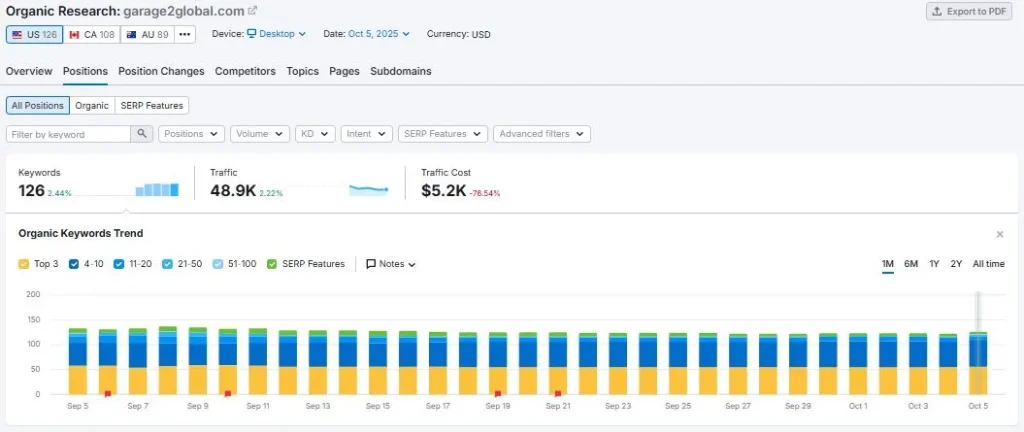
Semrush counts 126 keywords total, but when you filter down to what’s actually bringing traffic? Maybe 20-30 real performers. Rest are noise—position 50+, zero clicks, barely indexed.
Here’s the traffic breakdown by intent:
| Intent Type | Keywords | Traffic | What This Means |
| Branded | 19 | 19.5K | People already know them |
| Informational | 19 | 19.5K | Same traffic, dual intent |
| Commercial | 12 | 10.2K | Ready to buy |
| Navigational | 1 | 953 | Going directly to site |
Wait—branded and informational have identical numbers? That’s because they’re the same keywords. “Digital marketing solutions from garage2global” counts as both branded (has their name) and informational (answering “what are digital marketing solutions”).
Smart. They’re capturing search intent at multiple stages with the same keyword.
The Long-Tail Domination Strategy
Most sites chase high-volume keywords. “Digital marketing agency” gets 18K monthly searches. Competitive as hell, dominated by huge agencies with massive budgets.
Garage2global skipped that entirely. They’re ranking for stuff like:
- “can garage2global help my website rank higher” (probably 10-20 searches/month).
- “affordable digital marketing with garage2global” (maybe 30 searches/month).
- “website creation services by garage2global” (another 20-30).
Individually? Tiny. Combined across 100+ variations? That’s where the 19-50K traffic comes from.
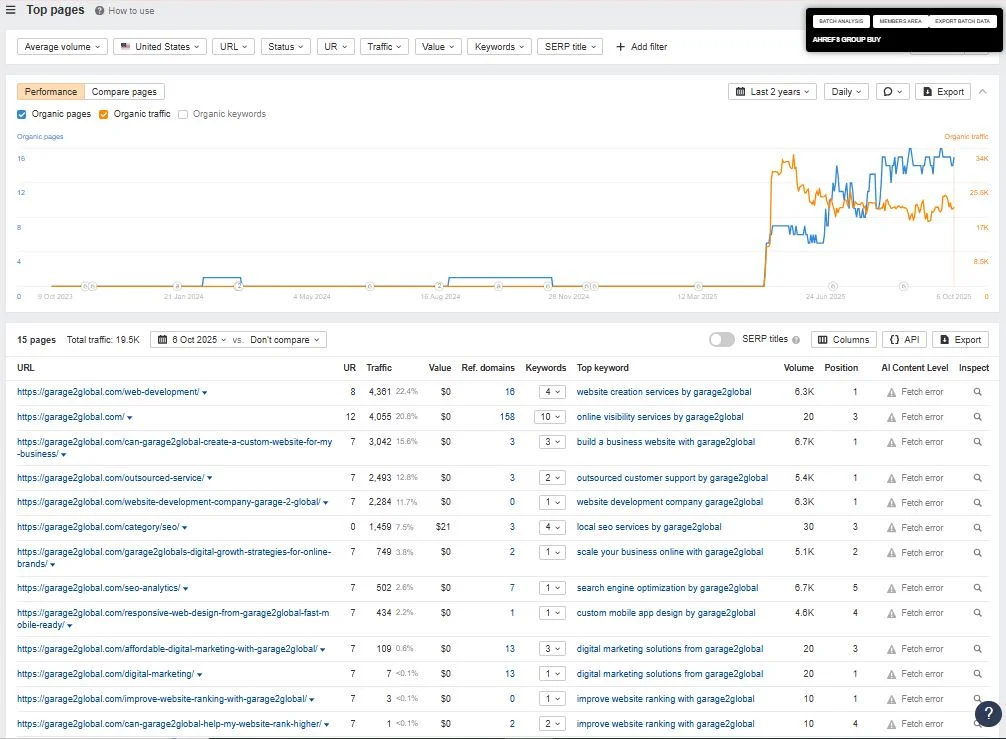
Each service page pulls 2K-4K visits. Fifteen service pages = 30-60K potential traffic. Math checks out with what the tools show.
They’ve basically created a keyword for every service + brand combination, built a page for it, got a few links pointing at it and now they rank #1 for that exact phrase.
Old-school exact-match strategy. Still works if you’re specific enough that nobody else is competing.
How They’re Converting Visitors (The Real Money Shot)
Traffic’s one thing. Conversions are what actually matter for a service business.
Can’t see their analytics or CRM, but the funnel’s obvious from the site structure and content strategy.
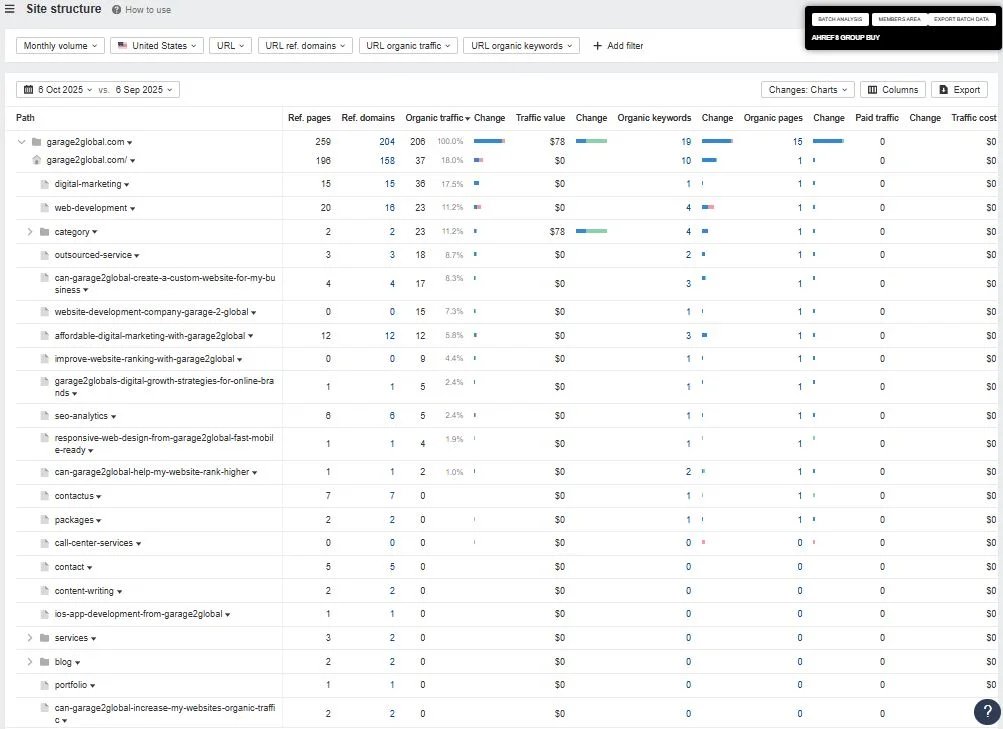
Entry points:
- Homepage (259 referring pages driving traffic).
- Service category pages (/web-development/, /digital-marketing/).
- Specific service landing pages (individual URLs for each service).
- Blog/content pages (minimal, not their focus).
Most visitors land on a service-specific page. Not the homepage, not a blog post. Straight to “here’s the service you searched for.”
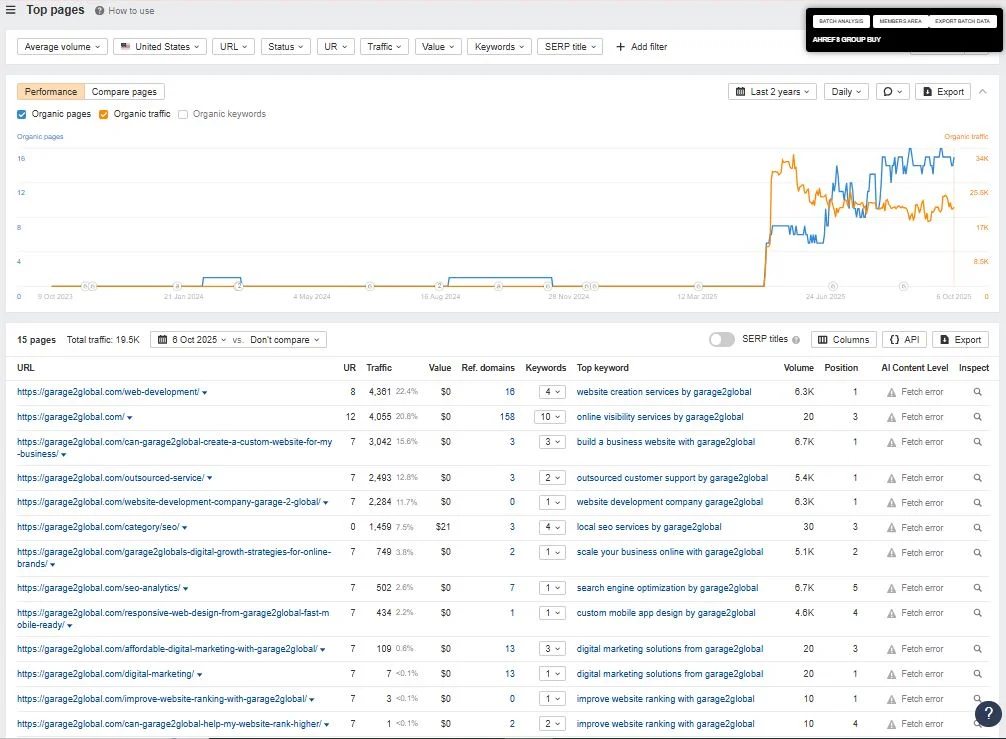
Each top page ranks for it’s own conversion-focused keyword:
- /web-development/ ranks for “website creation services by garage2global”.
- /outsourced-service/ ranks for “outsourced customer support by garage2global”.
- Custom website page ranks for “build a business website with garage2global”.
Someone searching “build a business website with garage2global” already knows:
- They want a website
- They want garage2global to build it
- They’re ready to contact
That’s not top-of-funnel traffic. That’s bottom-funnel, ready-to-convert traffic landing directly on the sales page.
The Anchor Text as Pre-Qualification
Remember those conversion-focused anchors?
They’re doing something clever. When someone clicks a link that says “build a mobile app with garage2global,” they’re self-selecting as interested in mobile app development.
The link itself is the qualifier.
You don’t click “build a mobile app with garage2global” unless you’re actually considering building a mobile app. So everyone who clicks that link and lands on their site is pre-qualified.
Compare that to ranking for generic “mobile app development.” That traffic includes:
- People doing research (not ready to buy).
- Students learning about the topic (never buying).
- Competitors checking out your content (definitely not buying).
- People looking for free information (can’t afford your services).
Garage2global’s traffic? Already filtered for purchase intent before they even click.
That’s why their conversion rate’s probably way higher than average, even with lower total traffic.
The Technical Foundation (What’s Under the Hood)
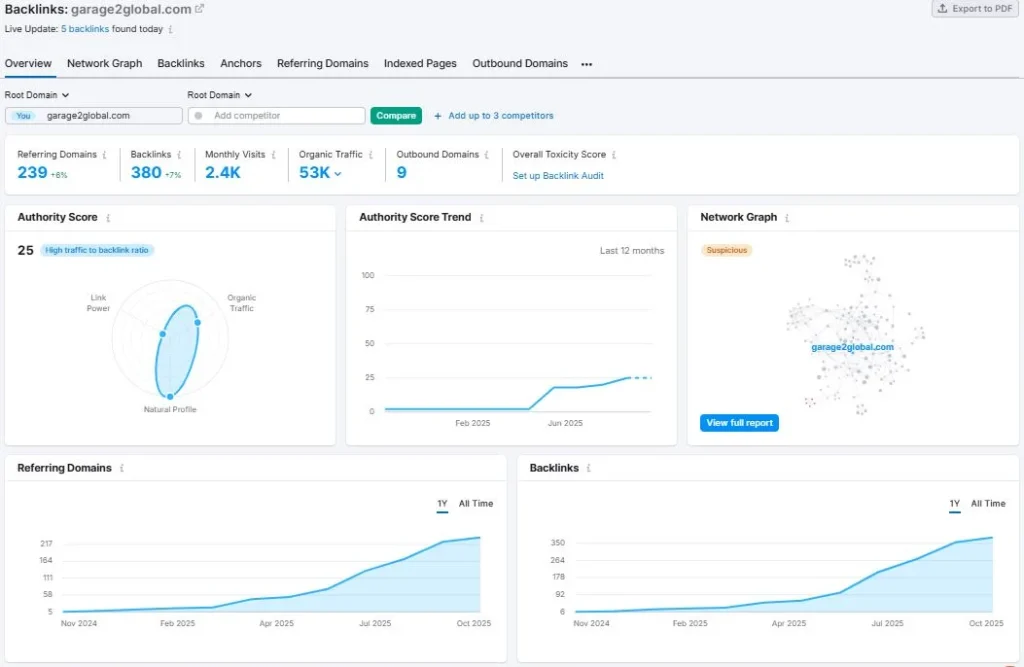
Authority Score climbed from basically zero in early 2025 to 25 by October. Steady upward trajectory. No drops, no plateaus. Just consistent growth.
That pattern says they’re adding links faster than they’re losing them and Google’s indexing most of those links (at least initially).
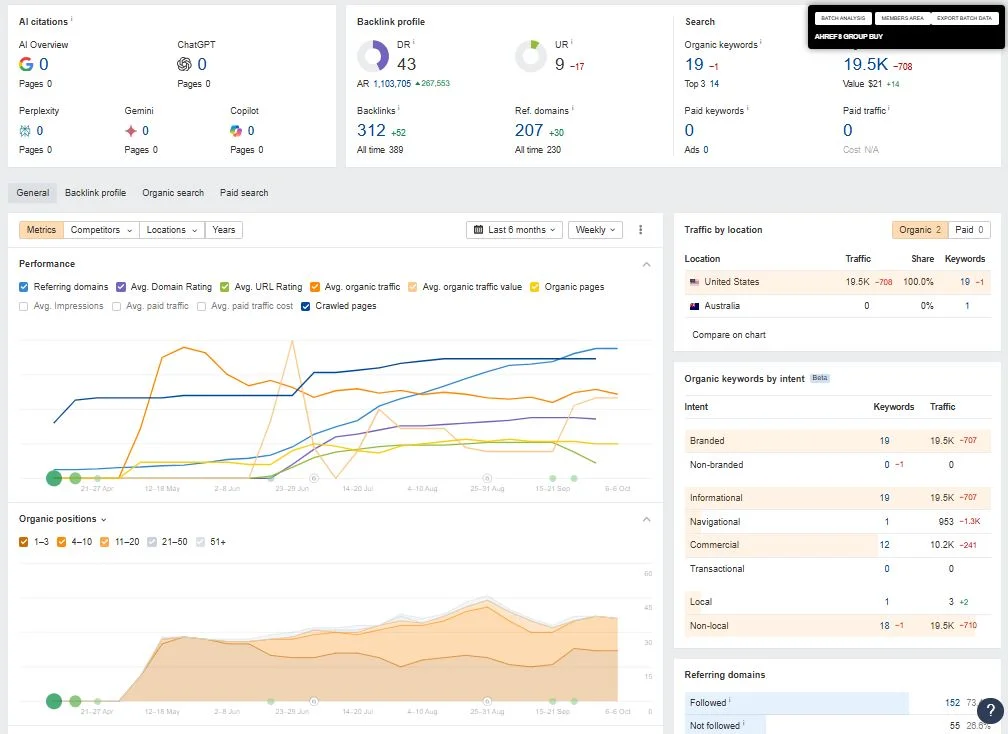
The Ahrefs Rank of 1.1M puts them in the top 1 million sites globally by backlink profile. Not impressive for a huge site, but solid for a small service business.
DR 43 with only 312 backlinks (Ahrefs count) means the links they do have come from decent sources. You need quality links to hit DR 40+ with under 500 backlinks.
But that UR 9? Still bothers me.
URL Rating measures the strength of links pointing to a specific page. When it’s that low compared to DR, most link equity isn’t concentrating anywhere. It’s scattered across dozens of pages without building real ranking power on any single URL.
That’s the tradeoff of their strategy. Lots of service pages each getting a few links = distributed authority. Works for long-tail terms where competition’s low. Wouldn’t work for competitive head terms that need concentrated link power.
The Link Velocity Timeline
Tracking the link acquisition pattern:
- April 2025: Steady, maybe 5-7 new domains.
- May 2025: Slight increase.
- June-July 2025: Big push, 15-20 new domains some weeks.
- August 2025: Another spike.
- September 2025: High activity, 20+ new domains.
- October 2025: Still going, 15-18 new domains.
They’re clearly running active campaigns. Not random editorial links appearing naturally. Someone’s doing outreach or buying placements on a schedule.
The red bars show lost links—domains that dropped their links. Minimal losses compared to gains. Either the links are sticking (good quality hosts) or they’re too new to have been removed yet (jury’s still out).
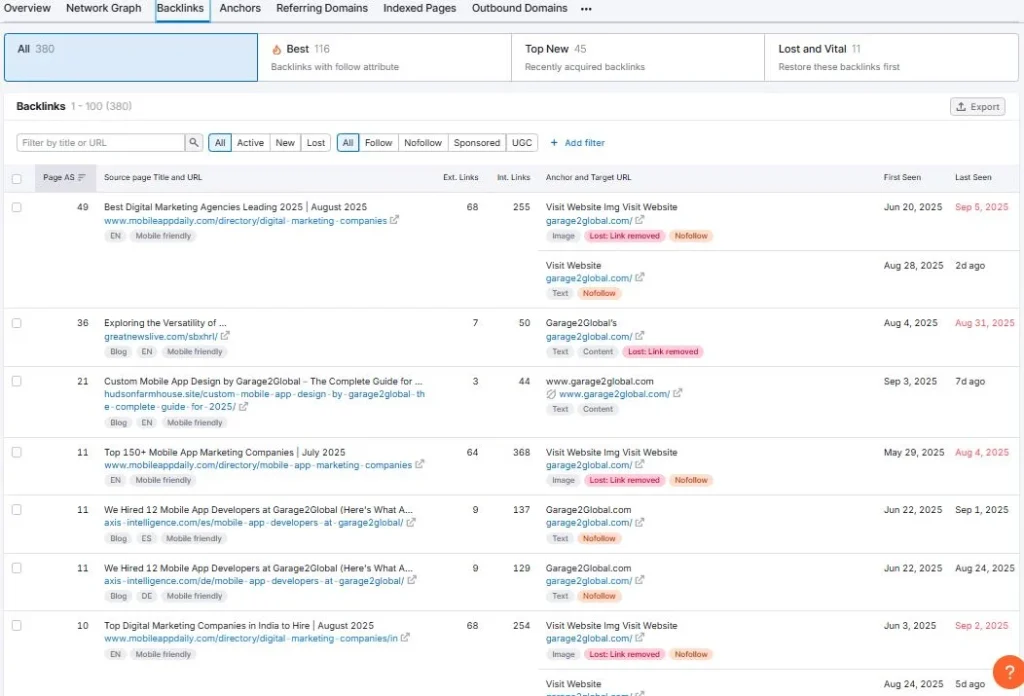
Most links were first seen in June-August 2025. Recent acquisitions. Haven’t had time to mature yet.
That explains the traffic growth. Links take 2-3 months to fully impact rankings. The August links are just hitting now. September and October links? Won’t show their full effect until December-January.
If they keep this pace, traffic could double in the next few months. Or Google could catch the pattern and discount everything. 50/50 shot.
What Other Agencies Can Learn (And Probably Shouldn’t Copy)
Been analyzing agency SEO for years. Most agencies either:
- Ignore SEO entirely (rely on referrals).
- Do basic SEO poorly (blog posts nobody reads).
- Try to compete for head terms (fail against Moz, HubSpot, Neil Patel).
Garage2global chose option 4: create your own keyword space.
What actually works here:
The service-specific landing pages. Every agency offers “web development,” but how many have a page for “build a business website with [agency name]”? That specificity kills competition.
The brand-in-keyword approach. Can’t compete for “digital marketing agency”? Rank for “digital marketing agency garage2global” instead. Zero competition, perfect relevance.
The conversion-focused site structure. No blog fluff. No “about us” novel. Just services, prices, contact. Someone lands on the site and knows exactly what to do next.
What’s replicable:
Create 10-20 service landing pages with long-tail, brand-inclusive URLs. Build 5-10 links to each page with descriptive anchors. Rank for those branded long-tail terms. Profit.
Most agencies could copy this and see results in 3-6 months.
What’s not replicable:
The aggressive anchor text strategy. Garage2global’s getting away with it now. Most sites would get flagged faster, especially if they don’t have the referring domain quality to back it up.
The scattered link profile from random niches. They’ve got links from healthcare, mass media, fashion sites. That works when you’re small and Google’s not looking too close. Scale that approach and you’ll trip filters.
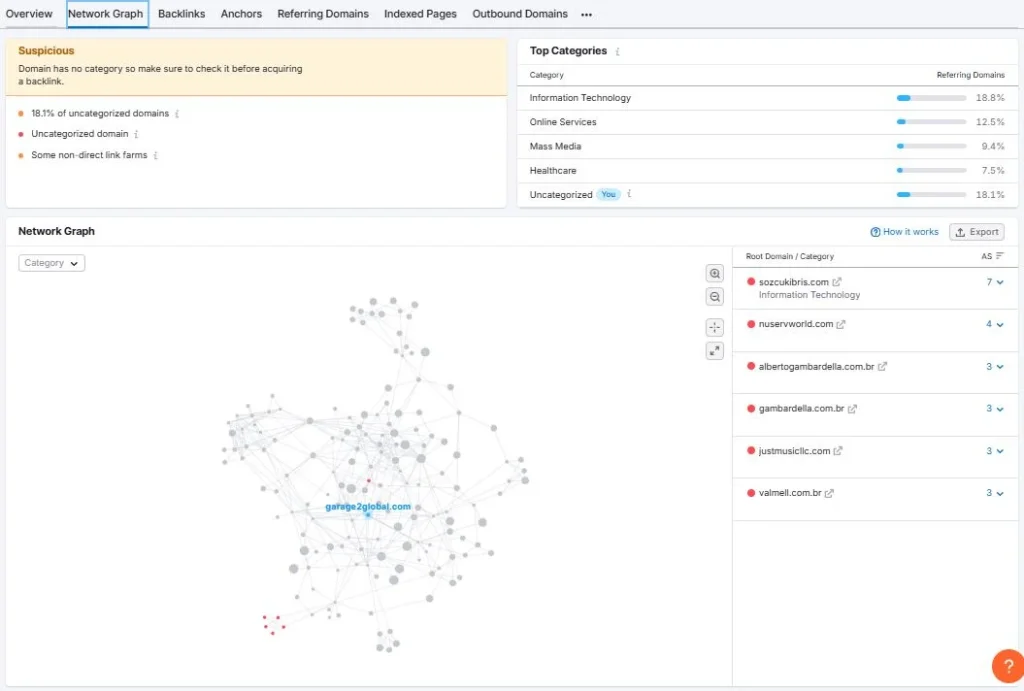
That “Suspicious” tag on the network graph? It’s there for a reason. Tools detect patterns humans miss. The link profile has characteristics that match known manipulation tactics.
They’re flying under the radar because they’re small. Revenue’s probably under $5M/year, traffic under 100K. Not worth Google’s manual review team investigating.
But if they 10x from here? Different story.