
Brand and SEO Strategy: Why Strong Brands Rank Higher
You can still rank without a strong brand. For now. But look at who stays ranked—and the pattern becomes hard to ignore. It’s not just better SEO. It’s recognition. Familiarity. Trust that existed before the click. Search engines aren’t just evaluating pages anymore. They’re evaluating who is behind
 Ahsan SoomroHead of SEO6 min read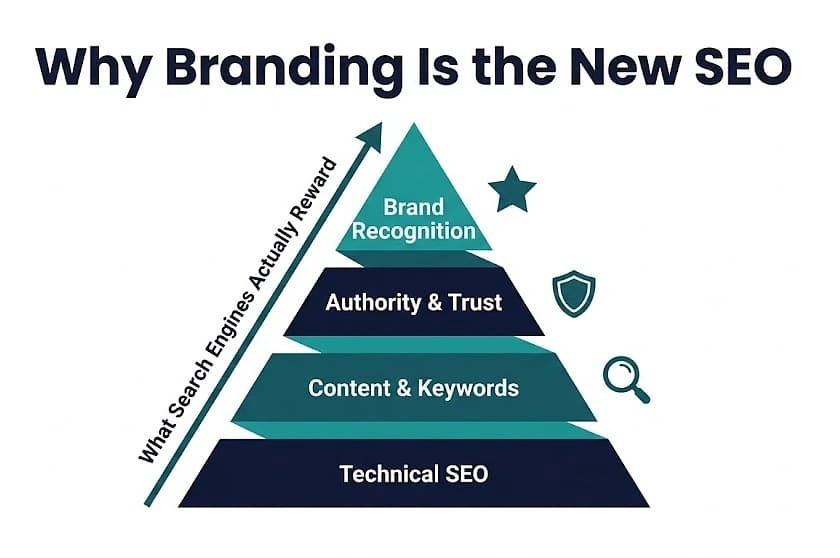
You can still rank without a strong brand.
For now.
But look at who stays ranked—and the pattern becomes hard to ignore.
It’s not just better SEO. It’s recognition. Familiarity. Trust that existed before the click.
Search engines aren’t just evaluating pages anymore. They’re evaluating who is behind them—and whether that “who” deserves to be surfaced repeatedly.
That’s the shift.
And here’s the part most people miss:
SEO didn’t get harder.
It got absorbed into something bigger.
What We Thought Was SEO… Was Only the Surface
For years, the playbook was clear:
- Find keywords
- Build pages
- Earn links
- Scale
It worked because the system was mechanical.
But that system assumed something flawed—that pages compete independently.
They don’t.
Search engines now operate on context, relationships, and identity. According to Google’s quality framework, high-ranking content is tied directly to signals of expertise, authority, and trust.
Not just at the page level, but at the entity level.
And once you see that, a lot of confusing ranking behavior suddenly makes sense.
Entity-Based SEO for Brands: The Layered Most Strategies Ignore
Here’s what’s actually happening under the hood:
Search engines are mapping:
- Who you are
- What you’re known for
- How consistently the web agrees
That’s entity-based SEO for brands.
As outlined by HubSpot, modern search systems connect information across sources to build a structured understanding of entities—not just pages.
Which explains a frustrating reality many teams run into:
- You publish better content… and still don’t outrank established players
- You optimize perfectly… but results plateau
- You build links… yet authority doesn’t compound
Because the system isn’t asking
“Is this page good enough?”
It’s asking:
“Is this brand already trusted?”
Where Brand Signals Quietly Influence Rankings
That is where things stop being obvious—and start being decisive.
1. Brand Search Volume: The Signal You Can’t Fake
When people search for your name directly, it tells search engines something simple but powerful:
“That entity matters.”
It signals:
- Demand
- Recognition
- Preference
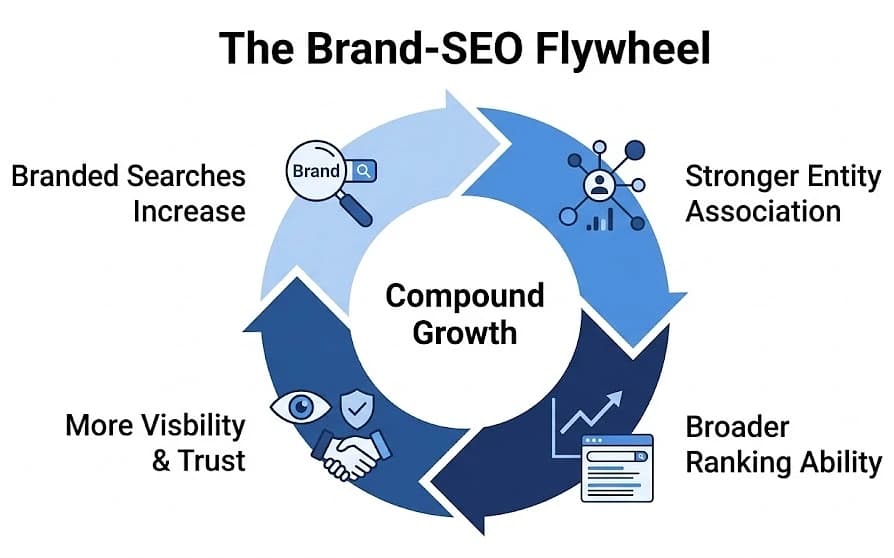
And over time, it creates a flywheel:
- More branded searches → stronger entity association
- Stronger association → broader ranking ability
That’s why brand and SEO strategy are no longer separate decisions. They feed each other.
2. Trust Signals Outside Your Website
Your website is only one piece of the puzzle.
Search engines validate you by looking elsewhere:
- Mentions on credible platforms
- Consistent identity across ecosystems
- Association with trusted sources
In practice, here is where many brands stall.
They invest heavily in on-site SEO… But neglect the off-site signals that actually confirm legitimacy.
And without those signals, authority doesn’t scale.
3. Behavioral Signals That Reveal Trust Instantly
You don’t need a survey to know if a brand is trusted. User behavior tells the story:
- Do people click you over alternatives?
- Do they stay?
- Do they come back?
Strong brands quietly outperform here—and those signals compound.
Not because the content is dramatically better…
…but because the decision was already made before the click.
E-E-A-T Isn’t Something You Add—It’s Something You Become
Most strategies quietly go wrong here.
They treat E-E-A-T like a checklist:
- Add credentials
- Include author bios
- Reference sources
Done.
But that’s surface-level.
According to Google Search Central, content should be built around genuine expertise and trust—not optimized to simulate it.
Which leads to a more uncomfortable truth:
You can’t “optimize” your way into authority. You have to earn recognition for it.
That happens when:
- Your ideas show up consistently
- Your perspective becomes identifiable
- Other sources begin referencing you without prompting
That’s when E-E-A-T stops being theoretical—and starts influencing rankings.
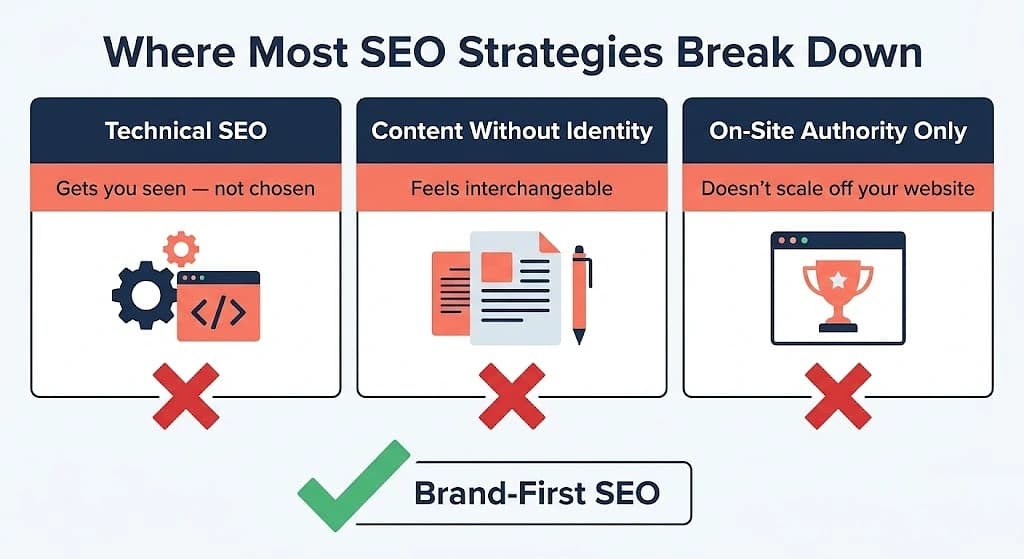
Where Most SEO Strategies Quietly Break Down
Let’s call that out directly.
A lot of SEO strategies fail not because they’re wrong but because they’re incomplete.
Technical SEO Gets You Seen—Not Chosen
Technical SEO helps search engines access your content.
It doesn’t answer the deeper question:
“Why should the brand be trusted over others?”
Content Without Identity Feels Interchangeable
If your content:
- Sounds like everyone else
- Says what’s already been said
- Lacks a clear point of view
Then it blends in.
And when everything blends in, search engines default to the safest choice—the brand they already recognize.
Authority That Lives Only On Your Site Doesn’t Scale
You can claim expertise all day.
But if the rest of the web doesn’t reflect it, it doesn’t carry weight.
Authority needs to exist:
- Across platforms
- Across mentions
- Across time
Otherwise, it resets with every new piece of content.
Rebuilding SEO Through Brand-First Thinking
It isn’t about abandoning SEO.
It’s about evolving how you think about it.
From Pages to Entities
Instead of asking:
“How do we rank the page?”
Ask:
“How does that strengthen what we’re known for?”
That shift changes everything—from content strategy to link acquisition.
From Keywords to Context
Keywords still matter.
But they’re no longer the foundation—they’re the entry point.
What actually builds rankings:
- Topical depth
- Consistent positioning
- Clear association between your brand and a subject
That’s how you build brand authority in SEO that compounds over time.
From Traffic to Trust
Traffic is measurable. Trust is decisive.
Strong brands don’t just attract clicks—they reduce hesitation.
And that reduction is what drives performance across the board.
Local Brand SEO Strategies for Service Businesses
At the local level, it becomes even more visible.
Two businesses can target the same keywords. Only one feels familiar.
That familiarity comes from:
- Consistent presence
- Clear positioning
- Recognizable identity within a region
At this point, execution becomes less about visibility and more about authority. Leveraging Los Angeles SEO services helps transform your presence from another option into a recognized entity within the local search landscape.
Second-Order Effects Most Teams Don’t Plan For
This is where strong branding starts to do the work you didn’t directly optimize for.
You Get Indexed—and Trusted—Faster
Established entities often see:
- Faster crawling
- Faster indexing
- Faster ranking movement
Not because of better tactics, but because of prior recognition.
You Don’t Need to Be Perfect Anymore
Unknown brands have to prove everything.
Recognized brands? They’re given the benefit of the doubt.
That alone changes how consistently you can perform.
Everything Starts Reinforcing Everything Else
Strong brand presence amplifies the following:
- Organic visibility
- Direct traffic
- Referral growth
At that point, SEO stops being a channel…
…and starts behaving like a system.
The Real Question Isn’t “Does Branding Affect SEO?”
It’s this:
What happens to your SEO rankings if your brand disappears?
Because that’s effectively what weak branding looks like to a search engine—absence.
No recognition. No association.
No reason to prioritize you.
And when that’s the case, even great content struggles to break through.
A Reframe Worth Sitting With
If your SEO strategy vanished tomorrow…
Would people still search for you?
Would they trust you without comparison?
Would they recognize your name instantly?
Because that’s the direction research is heading:
Not toward better optimization… But toward stronger, more reliable identities.
Closing Thought
Most teams are still trying to win with tactics.
But search engines are already rewarding something deeper:
- Consistency over bursts
- Recognition over novelty
- Trust over optimization
And once that clicks, SEO stops feeling like something you chase—
…and starts becoming something you build into the foundation of your brand.
Share
You may also like

Send me your site
I'll tell you honestly what's broken. If we can't help, I'll tell you who can.
Free · 45 min · no obligation