

Page Speed: How Important Is It for SEO in 2026 and Beyond?
How Important Is Page Speed for SEO Yes — page speed is a confirmed Google ranking factor.Has been since 2010 for desktop and 2018 for mobile. Google tripled down on it in 2021 when Core Web Vitals became part of the ranking algorithm. But the way most articles explain page speed and SEO is incomple
 Ahsan SoomroHead of SEO9 min read
How Important Is Page Speed for SEO
Yes — page speed is a confirmed Google ranking factor.Has been since 2010 for desktop and 2018 for mobile. Google tripled down on it in 2021 when Core Web Vitals became part of the ranking algorithm.
But the way most articles explain page speed and SEO is incomplete. Speed isn’t just about getting green scores on a testing tool. It’s about how quickly a visitor gets what they came for. And that distinction matters more than any Lighthouse number.
What Google’s Own Engineers Said — And Why They Disagree
Google’s messaging on page speed has been inconsistent for years. That alone tells you something.
John Mueller said on Reddit:
“It is a ranking factor, and it’s more than a tie-breaker, but it also doesn’t replace relevance.”
That was a shift — because before that, Google had implied Core Web Vitals were basically a tiebreaker between pages of similar quality.
Then Gary Illyes at Pubcon 2023 said he doesn’t think most sites will see a great benefit from working on Core Web Vitals. And Martin Splitt from Google’s developer relations added that good Core Web Vitals scores in Search Console don’t guarantee good rankings.
So which one is it?
I think the honest answer sits somewhere in between. If you’re in a competitive niche where 10 pages all answer the same query with similar quality and similar authority — speed becomes what separates position 3 from position 7. That’s where it matters.
But if your content is significantly better or worse than the competition, speed alone won’t save you or sink you.
The data supports this middle ground. MassiveGRID analyzed 10 million search results in late 2025:
- Sites ranking positions 1–3: median TTFB of 180ms
- Sites ranking positions 7–10: median TTFB of 420ms
Correlation, not causation — but consistent across industries. And sites with “Good” LCP scores pulled 23% more organic traffic than those scoring “Poor.” That gap widened from 15% in 2023, which suggests Google is gradually increasing the weight on performance signals.
People Don’t Wait Like They Used To
This part gets overlooked in most speed discussions.
A few years ago, searching for something meant typing a query, scanning blue links, clicking one, waiting for it to load, then reading through it. That whole cycle had built-in patience. You expected it to take a minute.
That tolerance is gone now. ChatGPT, Gemini, Perplexity — they hand you the answer in the response itself. No clicking, no waiting, no scanning through paragraphs. People are conditioned to expect instant answers. And that expectation follows them to every website they visit afterward.
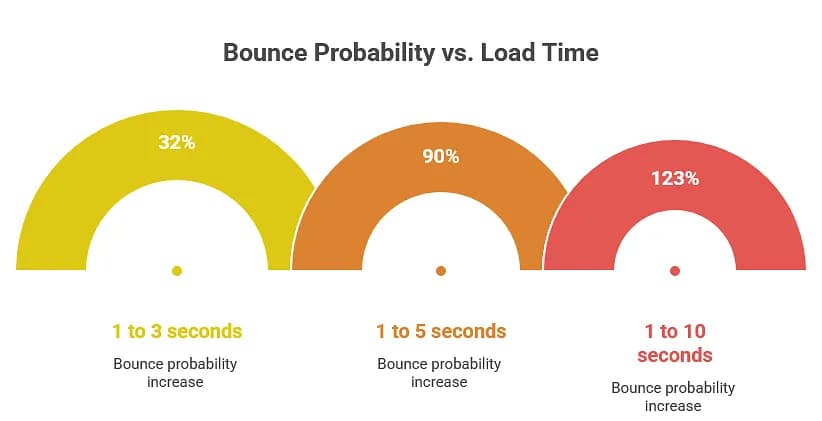
Google’s own research (900,000+ mobile landing pages analyzed) shows what happens when you don’t meet that expectation:
- 1 to 3 seconds load time → 32% increase in bounce probability
- 1 to 5 seconds → 90% increase
- 1 to 10 seconds → 123% increase
53% of mobile visitors leave a site that takes longer than 3 seconds. Not 10. Not 5. Three.
On the conversion side — Portent found sites loading in 1 second convert at 39%. At 6 seconds, that drops to 18%. Roughly 4.42% of conversions disappear for every additional second between 0 and 5.
Every second is costing money whether the analytics dashboard shows it or not.
Speed Isn’t a Green Score
I’ll be direct about this — chasing a PageSpeed Insights score of 95+ is one of the most common wastes of time in SEO.
People open the tool, see 72, and start obsessing. Compress every image. Defer every script. Shave off milliseconds the tool flags. Spend weeks on it.
And the actual user experience? Barely changes.
Because the question was never “how fast does the page technically load.” The question is: how quickly does the visitor accomplish what they came to do?
Think about it this way. You run an APK download site. Everything is optimized — green score, loads under 2 seconds. But the download button? Third fold. Maybe fourth. Because you want people scrolling past ad placements first.
Technically fast. Functionally slow. The thing the user came for is buried.
Your competitor’s page scores 68. Messier code, heavier assets. But the download button is right there on first load. Visible immediately. One tap and done.
That site is faster in the only way that matters to the person using it. And I’d argue Google understands this too — which is exactly why they shifted to measuring the full session experience, not just the initial load.
If your site loads within 2 seconds and visitors can do what they came to do without scrolling through clutter — you’re in good shape. Don’t let a tool score distract you from things that actually move the needle.
What Changed in 2024 — INP Replaced FID
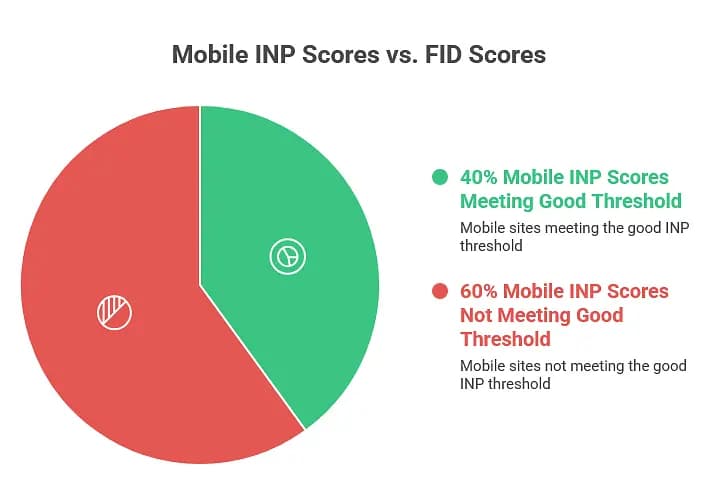
In March 2024, Google swapped out First Input Delay for Interaction to Next Paint as a Core Web Vital. This matters and most site owners haven’t caught up yet.
The difference:
- FID measured only the first interaction — whether the browser responded when you first tapped or clicked something. That’s it. One interaction, one measurement.
- INP measures responsiveness across every interaction throughout the entire visit. Every tap, click, scroll, form input — all of it.
A site could pass FID easily because the first click was fine, even if everything after that was sluggish. INP doesn’t let that slide.
The bar got harder. RebelMouse found mobile INP scores are 35.5% worse than FID on average. Only about 40% of mobile sites meet the “Good” INP threshold of 200ms or under.
The three Core Web Vitals as they stand now:
- LCP (Largest Contentful Paint): How fast the biggest visible element loads. Under 2.5 seconds = Good.
- INP (Interaction to Next Paint): Responsiveness across the full session. Under 200ms = Good.
- CLS (Cumulative Layout Shift): How much the layout jumps around during loading. Under 0.1 = Good.
Your Core Web Vitals Can Fail and It Might Not Be Your Fault
Something I don’t see discussed enough.
Google measures CWV using real Chrome user data — the CrUX dataset, evaluated at the 75th percentile. If 75% of your visits hit “Good,” you pass.
But here’s the catch. If a portion of your traffic comes from users on 3G connections in low-infrastructure regions, or people browsing on 5-year-old Android phones with weak processors — your CrUX data absorbs that. Your scores drop even though your server, your code, and your page are all performing exactly as they should.
That’s not a site problem. That’s a measurement problem on Google’s end.
If you’ve had real users from your actual target audience test the site and they tell you it loads fast, it’s responsive, there’s no clutter — trust that over a dashboard score. A site targeting young professionals in London shouldn’t be penalized because some edge-case visits from slow rural connections dragged the 75th percentile down.
Chase the user experience. Not the number.
What Real Companies Found When They Fixed Speed
No theory here. Just what happened.
Vodafone ran an A/B test on a landing page — same design, same content, same traffic sources. Only difference: one version was optimized for Web Vitals. Result:
- 8% more sales
- 15% better lead-to-visit rate
- 11% better cart-to-visit rate
All from a 31% improvement in LCP.
- BBC found they lost 10% of users for every additional second their pages took to load. Not 10% of revenue — 10% of actual users, gone.
- Walmart measured 2% more conversions for every 1 second saved.
- Rakuten 24 improved CWV and saw 53% more revenue per visitor with a 33% higher conversion rate.
- Pinterest rebuilt their mobile site, cut load times by 60%, and sign-ups went up 40%.
- AutoAnything cut load times in half — sales jumped 12 to 13%.
Different industries, different traffic volumes, same pattern. Faster sites convert. Slower sites lose people before the page finishes rendering.
TTFB — The Part Most People Skip
Time to First Byte. The gap between a user requesting your page and their browser receiving the first byte of data back.
You can compress images all day. Minify CSS, defer JavaScript, lazy load everything below the fold. But if your server takes 800ms to respond before any of that even starts — no amount of front-end optimization fully fixes it.
Google’s benchmarks:
- Under 200ms → excellent
- 200–500ms → standard
- Over 500ms → problem territory
Server location plays a direct role here. Every 1,000km of physical distance between server and user adds roughly 5–10ms of latency. Light through fiber travels at about 200,000 km/s — a New York to London round trip takes 70–100ms on pure physics, before the server even starts processing.
CDNs help with static files — images, CSS, JavaScript get cached on edge servers closer to users. But CDNs don’t replace the origin server. Dynamic content — database queries, checkout flows, server-side rendering, API calls — still routes back to wherever the main server sits.
So if your primary audience is in the southeastern US and your origin server is in Frankfurt, your CDN covers static assets fine. But every dynamic request crosses the Atlantic and back. Moving your hosting to a data center Miami location — or anywhere geographically close to your core user base — directly reduces TTFB for those dynamic requests that no CDN can shortcut.
Best setup: well-located origin server + CDN for global static delivery. One doesn’t replace the other.
Google Crawls Slow Sites Less
Google has said this directly — if your server responds slowly, Googlebot reduces crawl frequency to avoid overloading it.
Sounds considerate. The impact isn’t.
Fewer pages crawled = slower indexing = your new content sits in a queue waiting to be discovered.
For a 20-page brochure site, this doesn’t matter. Googlebot gets through it regardless.
For an ecommerce store with 50,000 product pages? A news site publishing 30 articles a day? Crawl budget becomes a real bottleneck. If Googlebot can only process 500 pages per session instead of 2,000 because the server can’t keep up — your newest products and latest content are invisible until the next crawl cycle picks them up.
Sites with consistently fast response times see over 50% more pages crawled per session. That’s not a small edge. That’s your content getting indexed faster, appearing in search sooner, and staying fresher than slower competitors.
Speed isn’t just a ranking signal for page-level SEO. It’s an access signal. If Google can’t efficiently crawl your site, every other SEO investment — content, links, technical structure — is bottlenecked behind a server that can’t keep up.
Page Speed Goes Beyond Any Single Tool
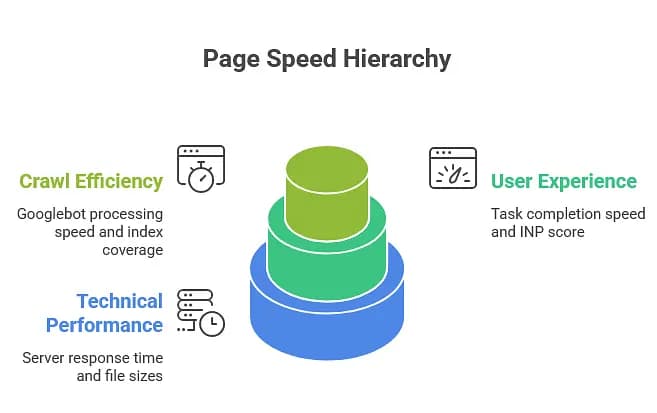
When someone says “page speed” in SEO, the conversation usually defaults to PageSpeed Insights scores or Lighthouse audits. Run a test, get a number, try to make it green.
But page speed as it actually affects your search performance is three layers working together:
- Technical performance — server response time, Core Web Vitals, file sizes, rendering chain. Measurable, fixable, and where most people start and stop.
- User experience speed — how quickly someone accomplishes the task they came for. Harder to measure with a tool, but it’s what Google is increasingly trying to capture with metrics like INP. And it’s what your visitors actually judge you on.
- Crawl efficiency — how fast Googlebot can process your pages and move to the next one. This determines how much of your site even makes it into the index in the first place.
Getting one right while ignoring the others is incomplete work. A perfect Lighthouse score with a buried call-to-action is fast by one definition and slow by the one that counts. Great UX with a 900ms TTFB is fighting uphill on both rankings and crawl budget.
The sites that consistently perform well in search tend to get all three right. Not because they chased a number — but because they built around what makes a site genuinely fast to use, fast to serve, and fast to crawl. That’s the version of page speed that actually moves rankings.
Share
You may also like

Send me your site
I'll tell you honestly what's broken. If we can't help, I'll tell you who can.
Free · 45 min · no obligation