
Google Is Slow but It Catches Up Spam: The Causal SEO Heist That Ended in a Manual Penalty
Causal's mass-produced SEO campaign delivered a dramatic traffic spike, but Google's manual penalty erased nearly all of it and exposed the cost of short-term spam tactics.
 Ahsan SoomroHead of SEO8 min read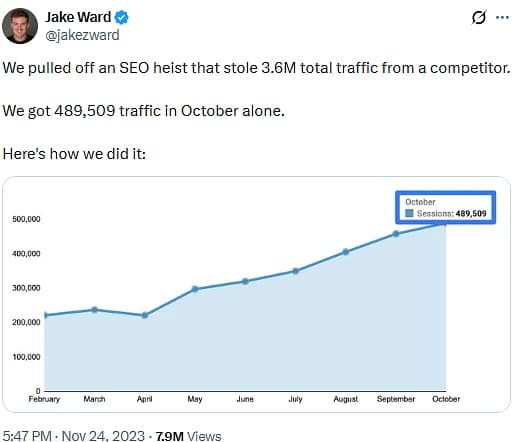
Jake Ward runs an SEO growth agency and in late November 2023 he posted a thread on X bragging about what he called an "SEO heist." The thread pulled tens of thousands of views and the SEO community split clean down the middle on it, half calling it genius and half saying give it time, Google will come for him.
Google came for him.
I'm writing this in July, years after that thread, and the only reason it's worth dragging up again is that I still open Reddit or X most weeks and find someone posting the same playbook like it's a fresh discovery.
Different tool, same trick, same confident tone. So, this is the whole thing laid out, what happened, what it cost, and why the version being sold today is worse odds than it was back then.
What Ward Actually Did to Exceljet
The target was Exceljet, a site that had been building organic traffic for years through genuinely useful Excel formula tutorials and spreadsheet references. Real content, written by people who understood the subject, built page by page over a long time. The kind of operation Google keeps saying it wants to reward through E-E-A-T and the helpful content framework.
Ward basically walked into Exceljet's house, photocopied every document in every drawer, ran them through a machine that made them look slightly different, and filed them all under his client's name. His client was Causal, a London-based fintech company that makes financial modeling software.
The execution was mechanical. Export Exceljet's entire XML sitemap. Pull every URL slug. Rephrase those slugs into 1,800 article titles. Feed all 1,800 into Byword.ai and let it generate full-length articles covering the same topics Exceljet had spent years creating by hand. Batch-upload everything to Causal's domain over a short window.
The window that makes people try it
Here's the part that keeps this tactic alive, and it's worth being honest about instead of pretending nobody would ever be tempted.
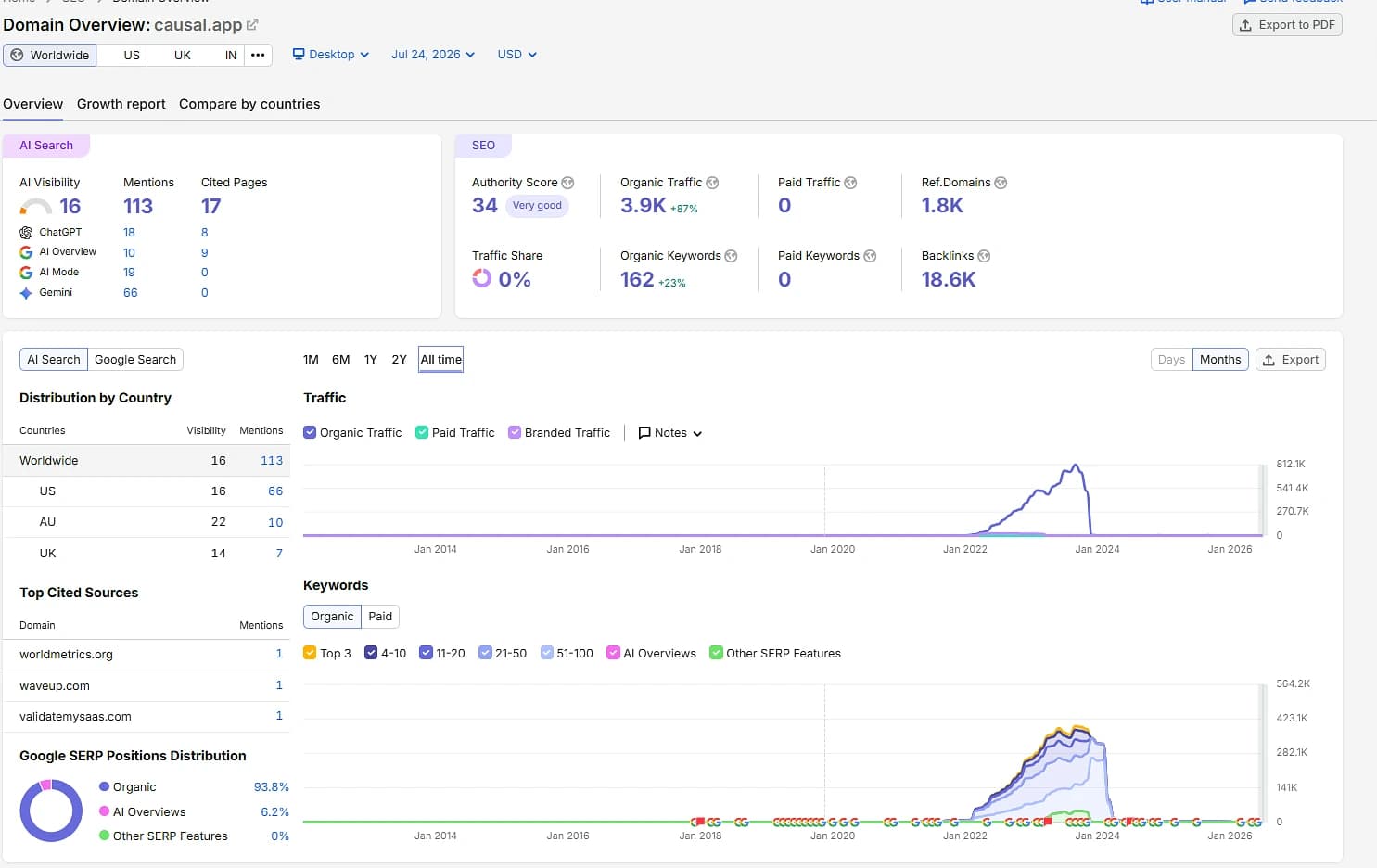
It worked. Causal's traffic went up and stayed up long enough to look like a strategy rather than a stunt, peaking near 490,000 monthly organic sessions. Ward wasn't lying about the numbers. Cloned pages sat above the originals in the results for months while Google's automated systems, the ones built specifically to catch this, apparently noticed nothing.
If detection were instant, nobody would bother. The gap between publishing spam and getting punished for it is the entire business model of every black-hat pitch you've ever read, and anyone telling you otherwise hasn't looked at the data.
What closed the gap here wasn't a classifier. It was the thread. The manual penalty landed within weeks of Ward publicly explaining the method to tens of thousands of people, which raises a question I've never seen answered straight:
Would Google have caught it at all without the confession?
Nobody at Google is going to say. But the timeline doesn't exactly advertise the spam systems, and that's a more uncomfortable fact than the penalty itself.
What the collapse actually looked like
Ahrefs ran the numbers as part of a study covering 1,600 SaaS companies.
Causal went from 307,158 estimated monthly organic visits to 1,485. That's a 99.52% drop. Organic pages fell from 5,868 to 547. Keywords ranking in the top 3 went from 8,969 to twenty-six. Not twenty-six thousand. Twenty-six, in the entire index.
The 1,800 AI-generated articles were what Google flagged, and the manual penalty left no room for interpretation about why.
Nobody Compensated Exceljet
This part gets overlooked constantly and it bothers me every time I read about this case.
While the SEO community was debating whether the thread was genius or reckless, Exceljet was watching roughly half its traffic walk out the door. Someone spent years building a library one book at a time, and someone else photocopied the whole building in an afternoon and started charging admission across the street.
Google eventually resolved it by penalizing Causal. Exceljet was not made whole. No traffic returned retroactively, no compensation for the months of lost visitors and revenue. The system caught the spam and the victim absorbed the damage, which is the part of these stories nobody puts in the case study.
Google is the tax office of the internet. They don't catch you the day you file the dodgy return. They catch you later, when the pattern surfaces in a review cycle, and by then they're not interested in hearing why you thought it was clever at the time.
Google Does Not Protect Favorites Either
Worth connecting one thing that's happening right now.
Google has leaned heavily on Reddit as a trust signal these past couple of years, surfacing Reddit threads in results more aggressively than ever. Reddit is about as favored as a source gets.
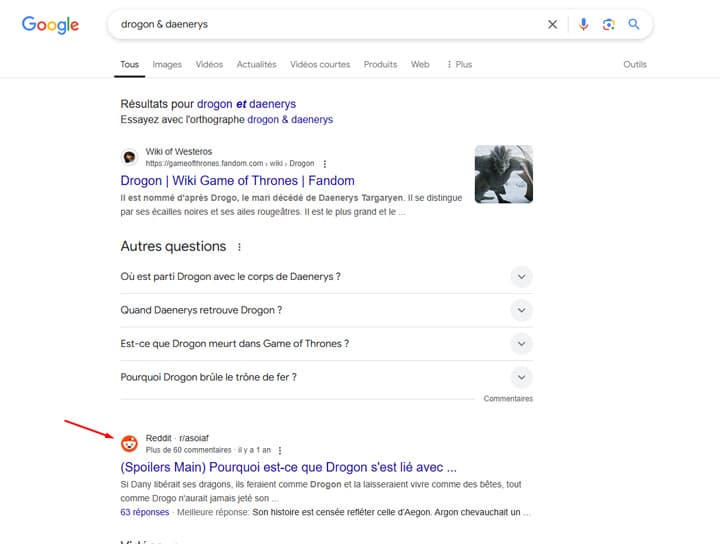
And Google still demoted Reddit's auto-translated pages. Thousands of programmatically generated translations of Reddit threads, ranking, pulling traffic, gone, because Google identified them as low-quality programmatic content.
Reddit. The favorite. Cleaned up without ceremony.
If Google won't protect Reddit permanently, nobody's exemption is permanent either. Ward thought Causal was safe because the traffic kept climbing. Reddit presumably thought the translation pages were fine because Google kept ranking them. Both got corrected on Google's timeline, not theirs.
Can You Move Domains to Escape a Manual Penalty?
This one comes up in migration discussions constantly and nobody's had a straight answer from Google.
If your domain takes a manual penalty and you 301 redirect everything to a fresh domain, does the penalty follow?
Mueller has said 301s pass "most" ranking signals, and has separately noted that spam signals and manual actions travel with them. The guidance stays vague at the edges, but the direction is clear enough.
Changing your name after a criminal record doesn't erase the record. It confuses the paperwork for a while. Google connects the old domain to the new one through the same 301 signals that are supposed to be passing your authority, and the penalty tends to arrive by the same road, because you left the forwarding address in the redirect.
There are edge cases where people report recovering faster on a fresh domain than on a cleaned-up penalized one. Whether the penalty genuinely didn't transfer, or whether the new domain just gave a cleaner baseline to rebuild from, isn't something anyone can prove. Either way, treating a 301 as an escape hatch is a gamble with bad odds and a long memory on the other side of it.
The engineers are learning faster than the spammers are
Here's what's changed since that thread, and it's the reason I'd bet against anyone running this play today.
The people building search are not standing still while the tooling gets better. Every one of these public heists is a labeled training example handed to Google for free. Ward didn't just run the operation, he documented it, tagged it, and published the method with screenshots. Thousands of similar posts have followed. If you were teaching a system to recognize mass-generated clone content, you'd be hard pressed to design a better dataset than the SEO industry voluntarily produced.
And the detection side has the same AI everyone else has. The pitch back in 2023 was that generation had outrun classification. That was briefly true. It isn't a stable condition, and betting your business on it staying true is betting that one side of an arms race simply stops running.
So does that mean don't use AI at all?
No, and anyone telling you that is selling something too. Use it. Draft with it, research with it, build tools with it, clear your grunt work with it. I do. The line isn't AI versus no AI, it's whether the output exists because a reader needed it or because a sitemap existed. One of those survives a review cycle.
Slow and steady isn't a proverb, it's the actual data
The sites that keep winning search look boring next to a heist thread, and that's rather the point.
Look at the numbers on the ones that built properly.
- Wirecutter pulls almost 12 million monthly search visits.
- com sits around 9.5 million.
- Grammarly clears 22 million.
- Wise 6.4 million.
- Zapier gets 1.6 million from its blog alone.
- NerdWallet has been estimated near 11 million monthly organic visits.
None of those arrived in a fortnight, and none of them arrived from a sitemap export.
What they actually do is unglamorous. Wirecutter republishes and updates existing reviews at close to a five-to-one ratio against new ones, which is the opposite of the scale play, going back over old ground instead of grabbing new territory. RTINGS built a moat by testing products themselves in a way nobody could clone from a sitemap, because you cannot generate lab data with a prompt. NerdWallet built tools and original research that earned links because other publishers genuinely needed to cite something.
That's the whole difference, and it isn't a moral one. Cloned content has no floor under it. Original testing, real tools, first-hand experience, a brand people search by name, those are assets that survive an algorithm update because they're not dependent on the update to exist.
If you sell a service, this matters more, not less. Your domain is a business asset with a reputation attached, the same as your company name. Pounding it with programmatic spam for a two-quarter traffic spike is spending an asset you'll need for a decade to buy a result you'll keep for months. And once a domain has a manual action on its history, you're rebuilding trust with a system that keeps very good records.
Solve a problem for the people searching, and Google's interests and yours point the same direction. Become the problem Google is trying to solve, and you're now in a fight with a company that will outlast your patience.
Ward Got His Viral Moment
He got the thread, the engagement, the case study numbers. Causal went from 490,000 monthly sessions to under fifteen hundred. Exceljet carried on doing what it was doing, and its content is still ranking.
The people in that original thread saying "give it time" were right. What worries me is that time is exactly what the next person is counting on. They read this story and don't see the penalty, they see the months of free traffic that came first, and they think they'll time the exit better.
They won't. They'll try anyway, because that window is the entire pitch. And the window keeps getting narrower, because the people on the other side of it are reading these threads too.
Share
You may also like


Send me your site
I'll tell you honestly what's broken. If we can't help, I'll tell you who can.
Free · 45 min · no obligation