

GOOGLE SAFE AI Spam Detector - Is It Focused On Google September Spam Update
Google's SAFE system is being linked to the September spam update, but the research paper itself focuses on coordinated synthetic video and channel abuse. This article separates what the paper says from what SEO commentary inferred.
 Ahsan SoomroHead of SEO5 min read
Google rolled out the September spam update even though one was already done in August, and on that our Twitter SEO gurus, in order to maintain the profile and remain active on the topic, posted some stuff which I disagree with here. There is a post from Glenn Gabe doing the rounds, and before anything else let me say the core purpose is not to mock him, he is a prominent figure and so many people follow him, which is exactly why what he posts matters more than what I post.
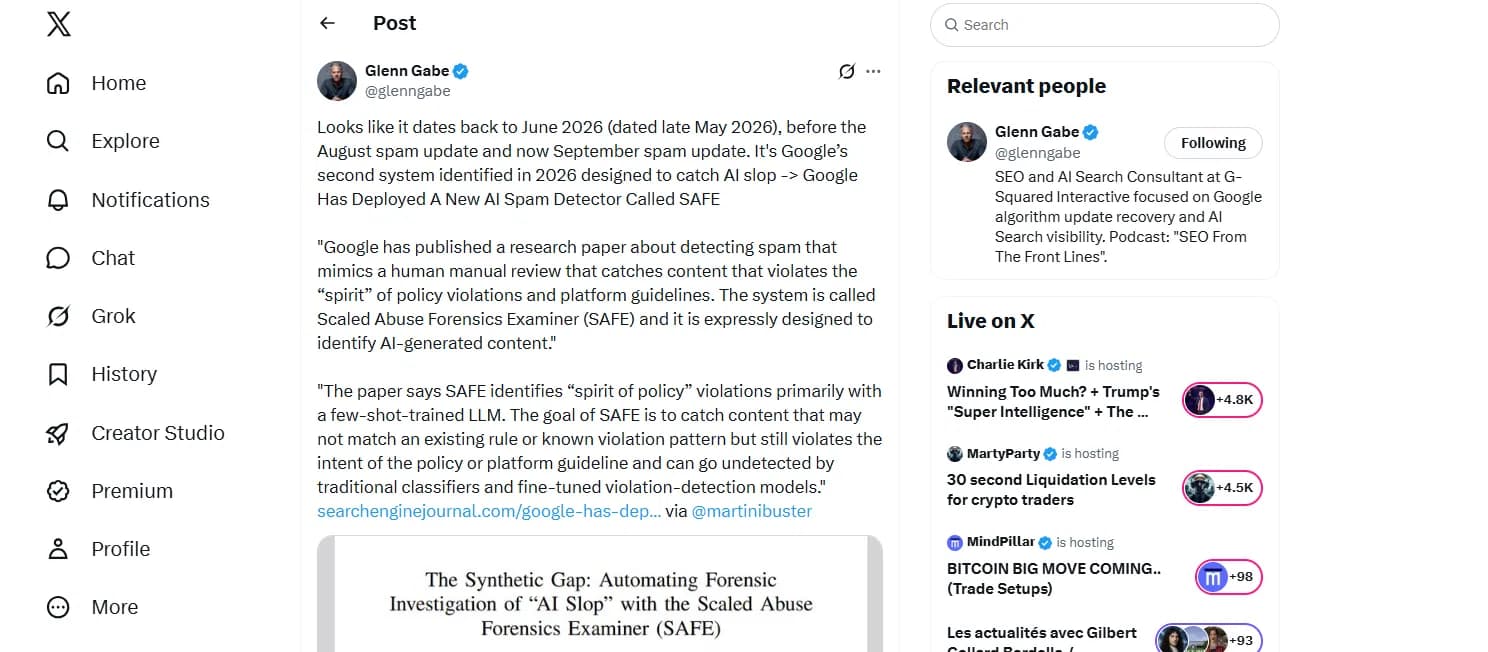
Read his post once. He is calling SAFE Google's second system identified in 2026 designed to catch AI slop, and he lines the dates up against the August spam update and now the September spam update, so the reader walks away connecting SAFE to the update. In the same tweet he quotes Roger Montti, i.e. martinibuster, and his Search Engine Journal article about SAFE.
I visited that article and read it fully, and then I read the actual research paper, all 3 pages of it. Here is where it gets interesting.
What Montti Actually Wrote, Word By Word
Montti wrote this line in his article, and I am quoting it exactly so you can judge it yourself:
"The fact that Google is devoting resources to catching AI slop shows that Google is concerned about AI spam content these systems may be a component of the September Spam update."
May be. He wrote may be, and his own meta description says it "may be a part of Google's Spam Update." So no idea if he is sure about it himself or just floating the possibility, and fair enough, at least he kept the word may in there. But the research paper? The words spam update are not in the paper anywhere. Not once in 3 pages. No mention of Google Search, no mention of websites, no mention of rankings.
And then reposting Mr Glenn's post, the number one SEO queen Lily Ray reposted and said makes a lot of sense??
Excuse me? But how?? If the research paper itself never mentions it.
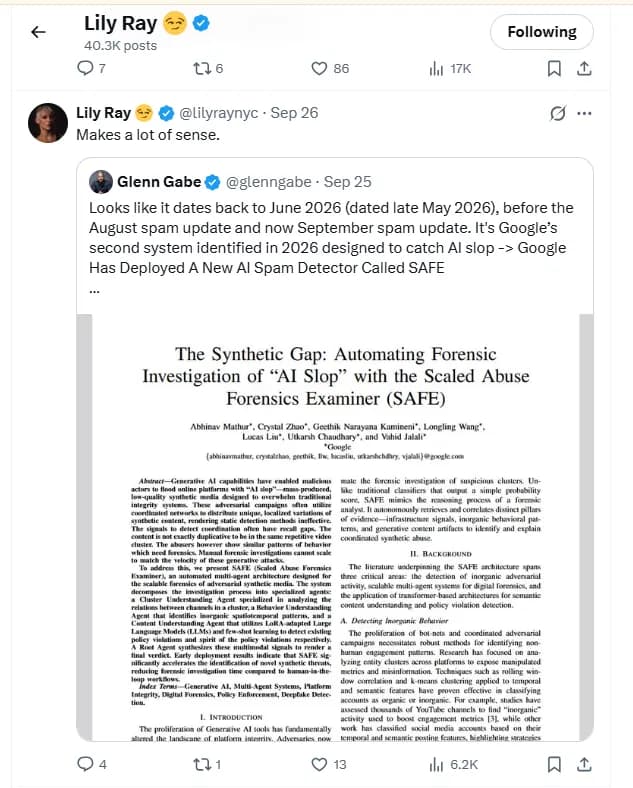
Now I don't have any grudges with them, the concern is the confusion being spread. Glenn's post has received 20K+ views so far and Lily's repost is at 6.3K+ more, and these are the accounts the whole industry reads over morning coffee. Montti wrote may, Glenn's post turned the may into a timeline, Lily's repost stamped it with makes a lot of sense, and somewhere along that chain the may quietly fell off.
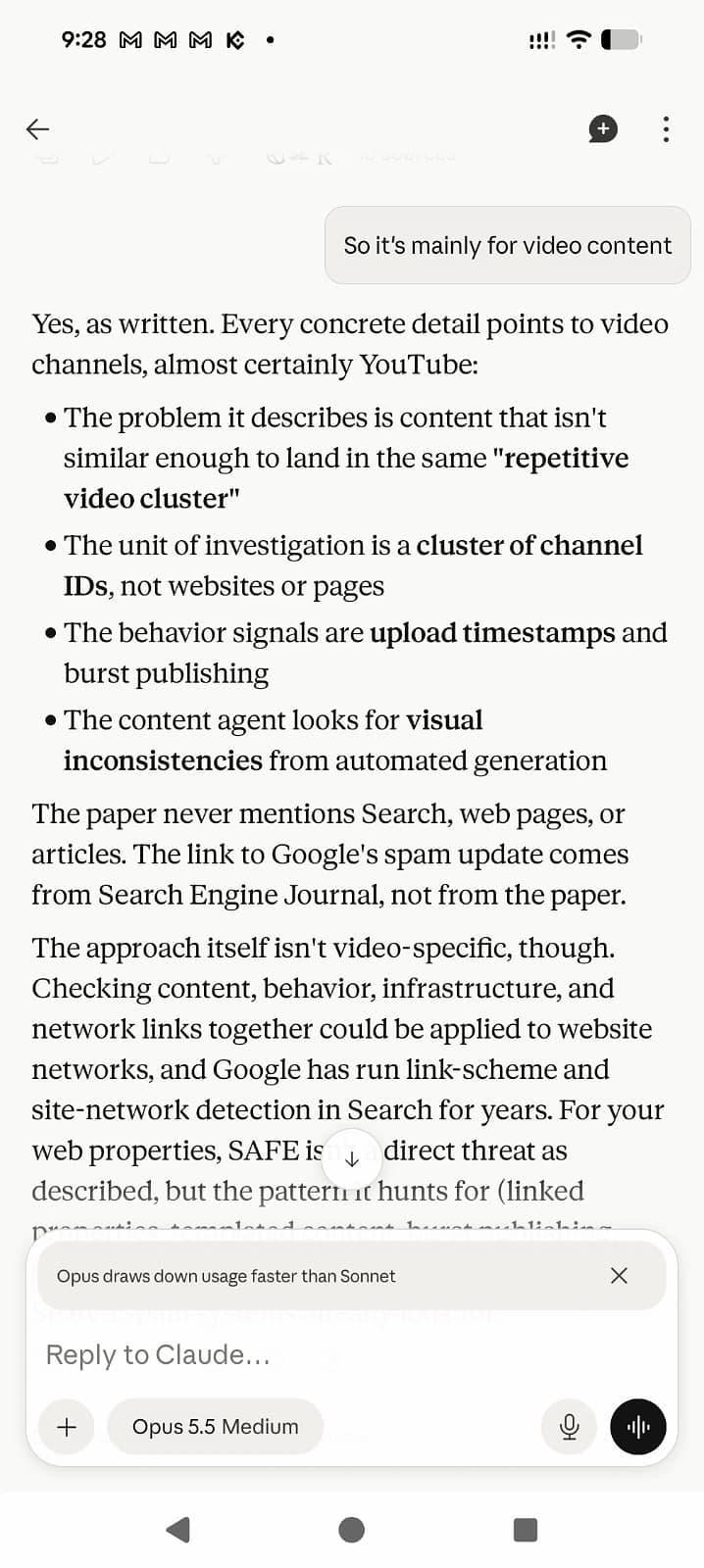
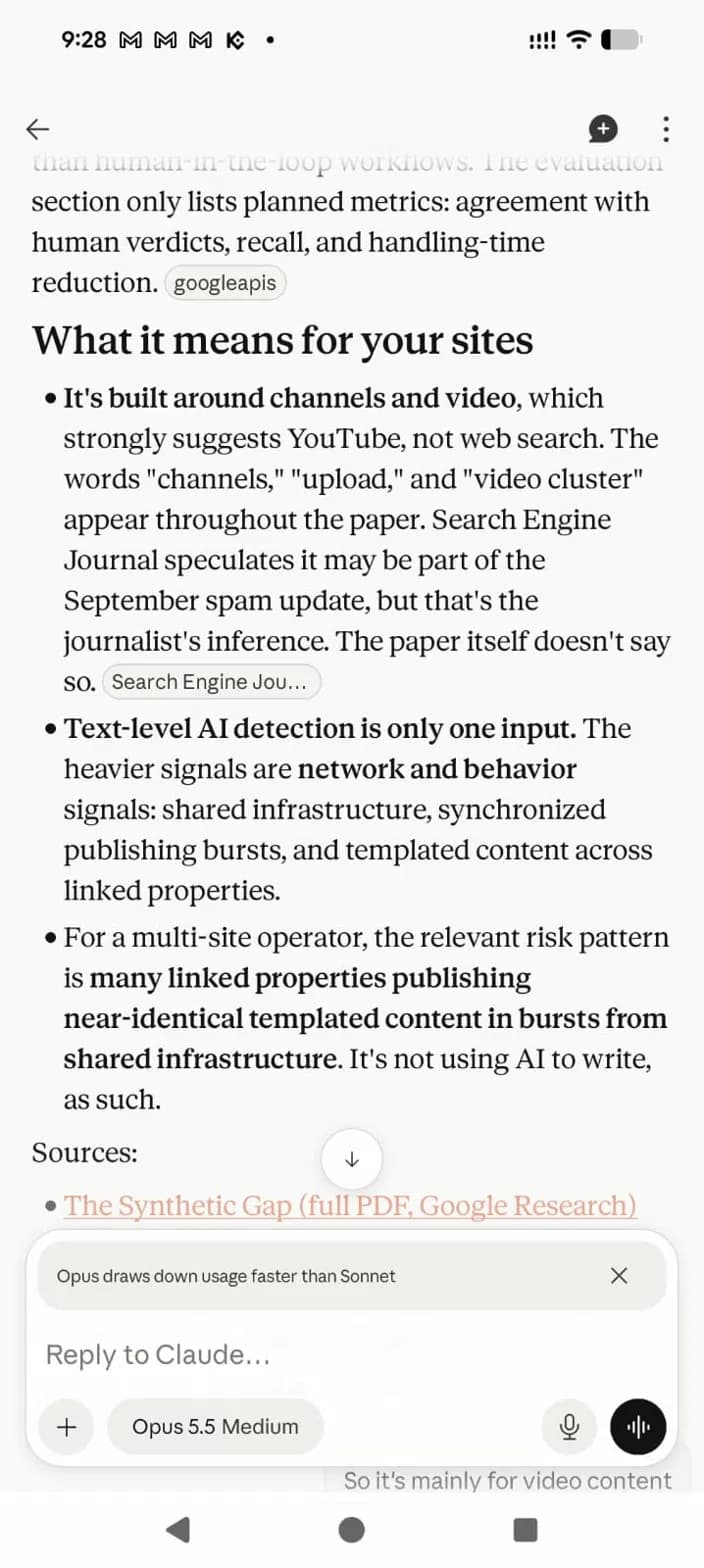
For cross checking I was not relying on my own reading alone, I also asked Claude to go through the same paper and the same article, and it replied with the same finding, that the paper is built around channels and video, and that the spam update link is the journalist's inference which the paper itself does not say. So if I am missing something here as a human, then an AI reading the same 3 pages is missing the exact same thing, and in what way are we both missing it?
Now What SAFE Actually Is, In Simple Terms
Leave them now, coming back to the paper itself, because the paper is short and you can read it in 10 minutes, and it opens by telling you precisely what it hunts:
"Generative AI capabilities have enabled malicious actors to flood online platforms with 'AI slop'—mass-produced, low-quality synthetic media designed to overwhelm traditional integrity systems."
Mass produced. Coordinated networks. That is the target, and the reason Google built an automated system for it is what the paper calls the synthetic gap, the time between a new generative attack appearing and a counter measure being deployed, because human reviewers cannot keep up with the volume.
SAFE itself is 4 AI agents working like a forensics team. One root agent runs the investigation, and under it:
- A content agent that checks the media itself for generative artifacts and repeated "slop scripts".
- A behavior agent that checks when and how accounts post.
- A cluster agent that maps which channels are connected to which, through shared infrastructure.
And specially this line from the behavior section, if you give it a look you will get the idea clearly what kind of abuser they are describing:
"100% of channels utilize identical OS versions and upload within the same 5-second window"
Your website does not upload within a 5 second window. A bot network running 40 channels does. It's channels, the whole paper is talking in channels.
The Diagram Settles Where It Applies
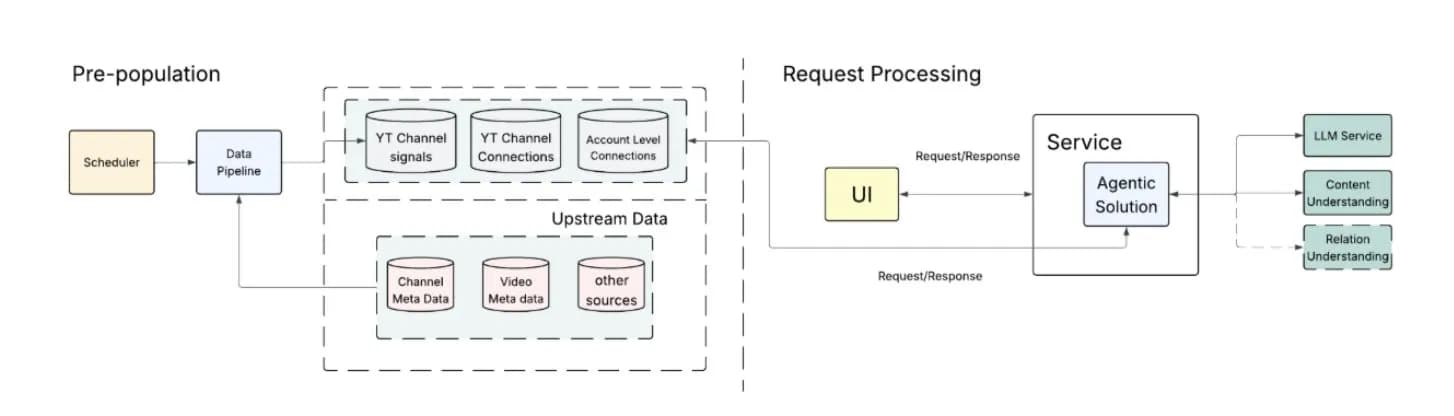
This is Figure 1 from Google's own paper and I did not have to interpret anything, the boxes are labeled in plain text. YT Channel signals. YT Channel Connections. Channel Meta Data. Video Meta data. That is the data SAFE is pre populated with before any investigation even starts. Websites, blogs, search rankings, none of that is in the drawing. The paper never says the word YouTube as the exclusive scope either, to be fair, Montti noted that too, but when the architecture diagram feeds on YT channel signals and video metadata, you can see which platform this was built for.
So Is It Against Using AI Image Generators
No, it is not, and this part matters for every creator reading this. SAFE is against templated low effort mass creation, the 200 near identical videos pushed through a channel farm. It is not against you supporting your original work with an AI image generator or other AI visuals. Even Dhruv Rathee, the most popular YouTuber in his space, if we see his videos there are tons of AI images and illustrations in them, but the quality thing is we are getting the value and it is original researched based content, one person's actual work with AI as the paintbrush. The paper is describing the opposite of that, synthetic content with no human research under it, duplicated across a coordinated cluster.
So where does that leave your sites? If you run one property and publish researched content, this paper is not describing you, and whether SAFE sits inside the September spam update, the paper does not say, Montti said may, and may is not yes.
Share
You may also like

Send me your site
I'll tell you honestly what's broken. If we can't help, I'll tell you who can.
Free · 45 min · no obligation