
Meta.ai Is Down Right Now - Here's What the Error Actually Means
Meta.ai started throwing a 500 error earlier today. The error code MIDDLEWARE_INVOCATION_FAILED is a Vercel hosting error, which means Meta runs their consumer AI chatbot on Vercel's infrastructure. Here's what the error means, why Meta chose Vercel, and how this gets fixed.
 Akash PrajapatiDeveloper6 min read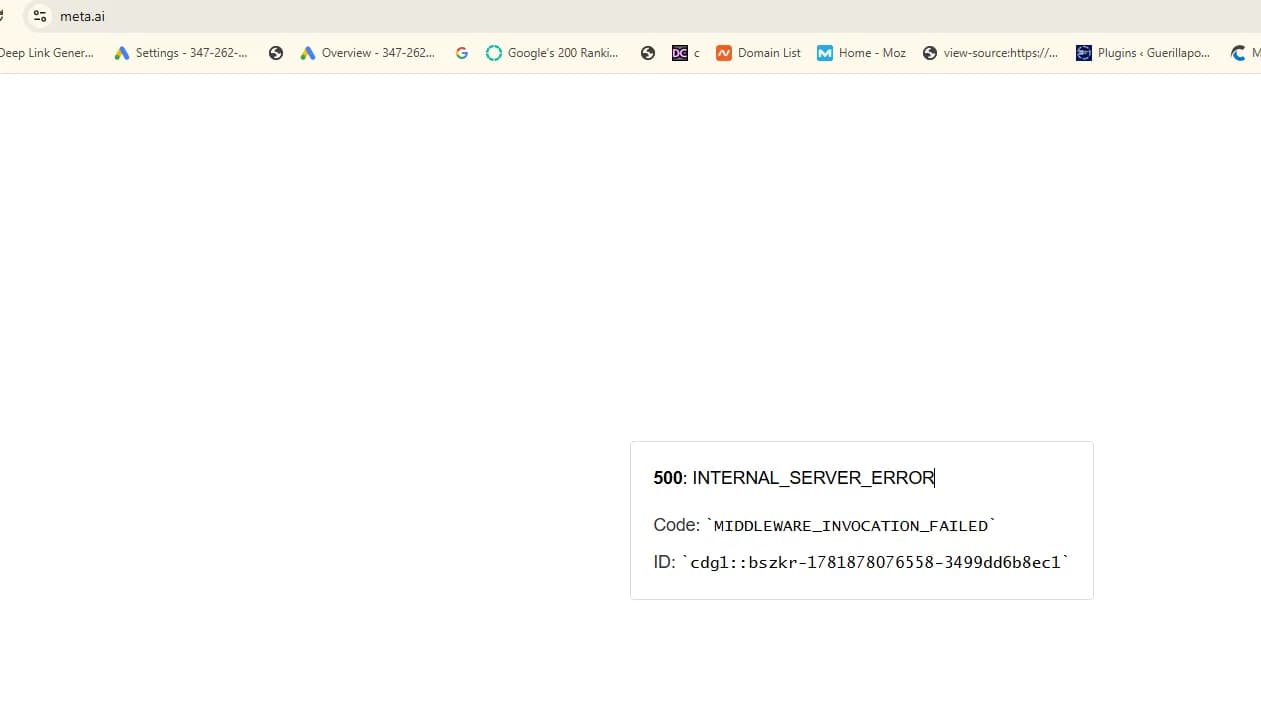
Meta.ai started throwing a 500 error earlier today and if you tried accessing it you probably got a blank white page with this sitting in the middle of it:
500: INTERNAL_SERVER_ERROR
Code: MIDDLEWARE_INVOCATION_FAILED
ID: cdg1::bszkr-1781878076558-3499dd6b8ec1
Not your browser. Not your connection. Meta's own site is the one failing here.
The interesting part is this is a Vercel error, not a Meta-branded error page, which means Meta runs their consumer AI chatbot on Vercel's hosting infrastructure. A company that operates Facebook, Instagram, WhatsApp, and their own massive global data centres, and they went with Vercel for their AI product. Worth noting on its own but more on that further down.
What That Error Code Means
MIDDLEWARE_INVOCATION_FAILED sounds complicated but the concept is fairly simple once you break it apart. Middleware is code that runs on the server before your request ever reaches the actual page you wanted. Think of it as the doorman at a building, it checks who you are, figures out which version of the site to show you based on your region, handles URL rewrites, sets cookies, manages rate limiting. Every single request passes through this layer before anything else happens.
When that layer crashes, your request never makes it past the front door. You knocked, the doorman collapsed, and nobody inside the building even knows you showed up. That is what MIDDLEWARE_INVOCATION_FAILED means in practical terms, the middleware tried to run, threw an error, and the whole thing died before it could hand your request off to the actual page.
What cdg1 Tells You
That trace ID at the bottom of the error is not random characters. The cdg1 part at the start identifies which Vercel edge region handled the request, and CDG is how cloud providers tag their Paris data centres, after Charles de Gaulle airport. The rest of the string is a unique identifier that lets Meta's engineers locate the exact failure in their server logs.
So if you hit this error from anywhere in Europe, what happened is your request travelled to Vercel's Paris edge server, ran into the middleware layer there, and crashed before going any further. Every user hitting that same region got the same result.
Why Meta Chose Vercel for This
This is the part that stands out from a technical perspective because Meta is not a startup that needs third-party hosting to get a product live. They run some of the largest infrastructure on the planet.
But for Meta.ai specifically, the choice makes practical sense when you think about what the product actually is. It is a lightweight web interface sitting on top of their Llama language models, and Vercel is purpose-built for exactly that kind of deployment. Next.js framework, global edge distribution, automatic scaling, and a deployment pipeline that moves fast enough to ship updates multiple times a day without a heavyweight internal review process slowing things down.
The trade-off showed up today. When middleware fails on Vercel, users see a Vercel error page instead of anything Meta-branded. Your visitors are suddenly looking at infrastructure they were never supposed to know about, and there is nothing the frontend team can do about how that error gets displayed because Vercel controls it at the platform level.
What Probably Went Wrong
The most likely explanation for a total failure like this, where every request crashes rather than just some of them, is a bad deployment. Someone on Meta's team pushed new code, the middleware in that build had a bug, and now every request hitting that edge region crashes on the same broken line.
Pure Vercel platform outages that produce this specific error are rarer and would show up on their status page. If Vercel's status page shows everything green while Meta.ai is returning 500s, then this is Meta's own code causing it, not the infrastructure underneath.
Could also be a timeout or resource limit situation since edge middleware on Vercel runs in a constrained environment with hard caps on execution time, memory, and code bundle size. Or a downstream dependency that the middleware calls, like an authentication service or a feature flag system, went down and the middleware was not written to handle that failure without crashing entirely.
How This Gets Fixed
If this is a bad deployment, and for a total site-wide failure like this it almost always is, the first move is not to fix the code. The first move is to rollback.
Vercel keeps every previous deployment live and immutable. That means Meta can switch back to the last working build in seconds without touching any code at all. Users start getting the working version again immediately while the engineering team figures out which line in the new build caused the crash.
Then they pull the logs using that trace ID from the error screen, find the exact stack trace, fix the bug in a separate branch, test it in a preview deployment, and push it live once it passes. Rollback first to stop the bleeding, root-cause second. Standard approach for any team deploying on Vercel or really any modern hosting platform.
The longer-term question is why the middleware was not built to handle the failure gracefully in the first place. Well-written middleware treats every external dependency as something that can and eventually will break. The standard pattern for this is called "fail open," meaning if the auth check or the geo-lookup or whatever the middleware depends on throws an error, you let the request through to a safe default page instead of killing the whole site with a 500. The fact that Meta.ai went fully down instead of degrading gracefully suggests that particular piece of middleware was not hardened against this kind of failure.
Is It Back Up Yet
By the time this goes live it may already be working again. Middleware failures on Vercel tend to get caught and rolled back fast, usually within minutes to maybe an hour, because the error is loud and affects literally every visitor. There is no partial failure with this one. Either the middleware runs or nobody gets through.
If you want to check whether it is a Vercel problem or a Meta problem, Vercel's status page is the place to look. All green on Vercel while Meta.ai is still down means it is Meta's deployment that broke, not the platform it runs on.
Share
You may also like




Send me your site
I'll tell you honestly what's broken. If we can't help, I'll tell you who can.
Free · 45 min · no obligation