

SEO, AEO and GEO Explained as the 3 Layers of AI Search
 Ahsan SoomroHead of SEO11 min read
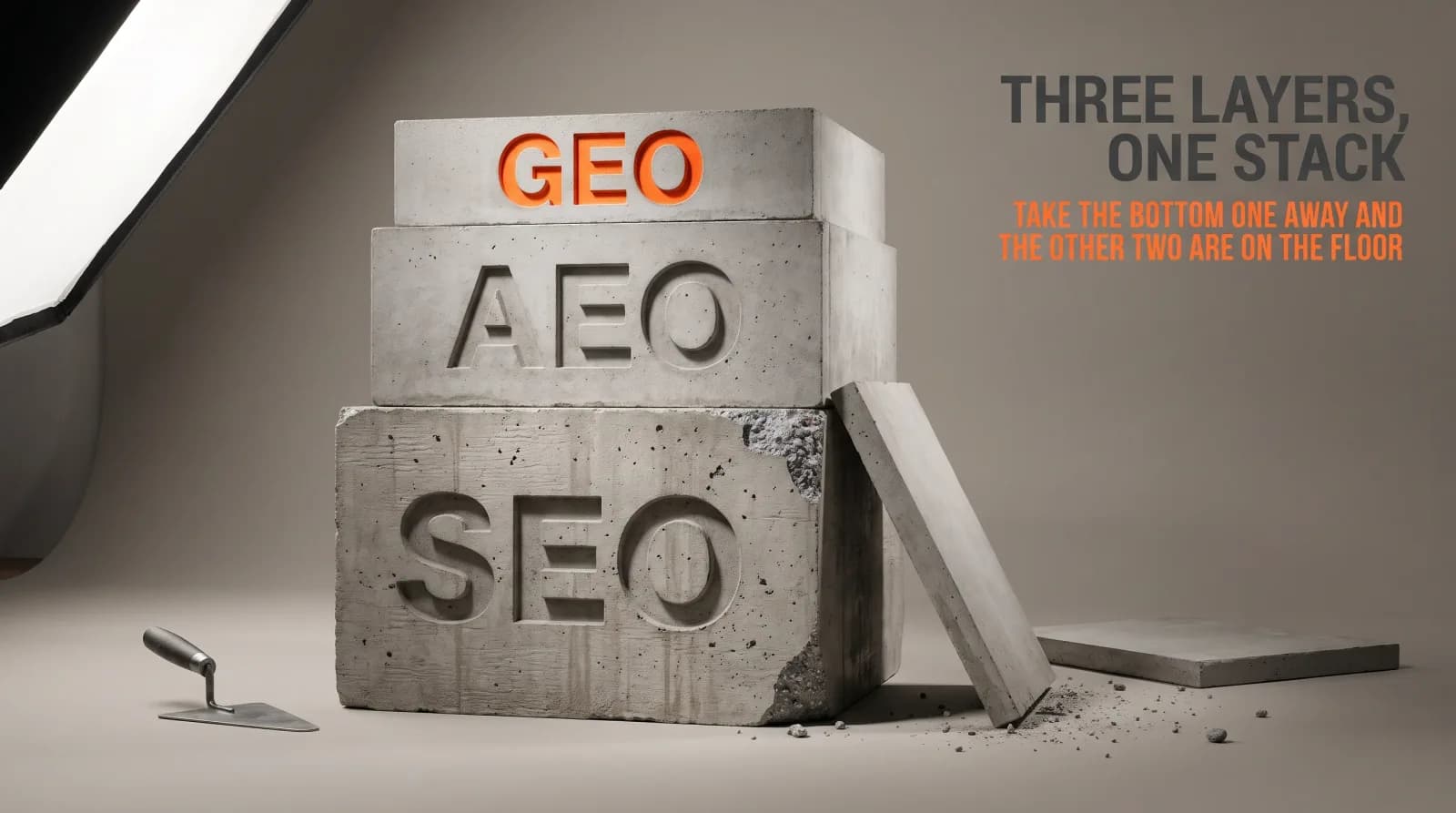
SEO, AEO and GEO. Most people are very confused about what these acronyms and terms actually mean and in fact, a lot of the experts still argue about it to this day. But I can tell you what isn't confusing and that is the result when you get this right, because when it works, it really works. That means being able to rank locally in the map pack and organically and getting cited in the AI Overviews as well.
And this is what happens when you understand the three layers of this new AI search, how they work together and how one doesn't work without the other.
SEO Used to Be a Lot Easier Before Google Started Giving the Answers
We first need to understand why on earth all of these concepts exist. You see, back in the day, SEO was a little bit easier. You would write good content, you would rank very well, you would get a lot of traffic and the traffic would convert into leads or sales. You're kind of done. Bob's your uncle.
Now things are a little bit more difficult, because all of a sudden, around 2014, Google started giving you the answers directly in these featured snippets. And then in 2022 ChatGPT launched and a lot of people started searching on that platform instead of Google. In 2024 Google started rolling out AI Overviews and they started keeping you on their platform more and stopping people from clicking through to your website.
And now in 2026, about 68% of Google searches in the US end up with zero clicks, because we all just get the answer. And that's even higher using AI Mode, where it's about 93% zero click.
The industry's response to all this is essentially three acronyms, three different strategies and way too much confusion. So let's clear this all up right now by starting with the foundations.
SEO Is Still the Base Layer and It Still Works Very Well
First, let's understand what SEO is, if you don't know already. This is search engine optimization, the act of optimizing for any search engine so that you get found easier. And this isn't just optimizing for things like Google, ChatGPT and Perplexity, but it can also refer to optimizing on other platforms like YouTube, TikTok, Instagram and even Pinterest.
So when people say, "Ah, don't worry about SEO, it's all dead," they have no idea what they're talking about, because the act of optimizing yourself to get found easier will almost always exist and right now it still works very well.
And here is a stat to prove that SEO still fundamentally matters. In the Ahrefs study of 1.9 million citations from 2025, 76% of all AI Overview citations came from the top 10 pages of that search result and even when their 2026 update brought that share down to 38%, close to two thirds of the cited pages still ranked somewhere in Google's top 100. Meaning that if you're not ranking well for traditional SEO, you're not going to rank well for AI Overviews. Now, there's always an exception to the rule, but you should always kind of go with the main rules here.
So SEO is our base layer. Without doing this correctly, we're not going to be able to do the next two steps correctly, because trying to do GEO or AEO without the SEO fundamentals is a little bit like saying, you know what, I want to learn how to swim butterfly without even learning how to stay afloat on the water yet. It ain't going to work.
Now, I think SEO can really be summarized into three main fundamentals, at least to keep things nice and easy.
On-Site SEO Covers Your Content, Structure and Conversions
The first one is on-site SEO. This is things like optimizing your content. Is it actually adding any value? Does your website structure make sense? And for me, this also includes the conversion friendliness of your website. Are you actually getting conversions? Because there's no point in ranking a website if you're not getting any sales or leads.
Technical Optimization Is Where Schema, URLs and 404s Come In
Number two is technical optimization and this is where things obviously get a little bit more technical. These are things like your schema. Is your URL structure done correctly? Do you have any errors like 404 not found and things like that?
Off-Site SEO Is Everything You Do Away From Your Website
Number three is off-site SEO, all the things you can do away from your website.
-
Can you get backlinks to your website from another website?
-
Are you getting your brand mentioned somewhere?
-
How's your LinkedIn profile and how's your YouTube profile?
All these things really matter, not only in SEO but to get you higher visibility in the AI search engines. And again, without these three fundamentals of SEO, you're not going anywhere.
AEO Has Been Around a Lot Longer Than You Realize
Now, AEO gets confused a lot. It stands for answer engine optimization and it's actually been around a lot longer than you realize. These are things like the little search snippets. For example, when you look up the weather in New York, you just get the answer right away in a little widget or when you're converting USD to AUD, Google just gives you the answer right away without the need to click through to something like Wise.
This is where things started getting mixed up a little bit, because when ChatGPT and Perplexity started coming out, people started referring to these new search engines as answer engines. And fair enough, they did give you the answer. That was where the line started getting blurred between answer engine optimization meaning optimizing for these featured snippets and it meaning optimizing for things like ChatGPT search and Perplexity.
And for me, AEO will always be optimizing for these featured snippets and also for these People Also Ask boxes and they also get you a lot of traffic if you do get it right.
GEO Gets You Seen, Cited and Recommended by AI Search Engines
Now we can move on to the main one that everyone wants to know how to dominate and that is GEO, or generative engine optimization. For me, this is the act of optimizing your website, your structure, your content and your authority to get seen, cited and recommended by these AI search engines. Things like ChatGPT search, Perplexity and Google AI Overviews, essentially any large language model with access to the internet.
And again, I want to reiterate, one does not work without the other. SEO is the foundation, then comes AEO and once we do all these correctly, we're going to do GEO very, very well. That being said, there are some specific methods that you should probably follow in order to give yourself the highest opportunity to get cited by the AI search engines.
Give Every Service Its Own Page, Then Every Location
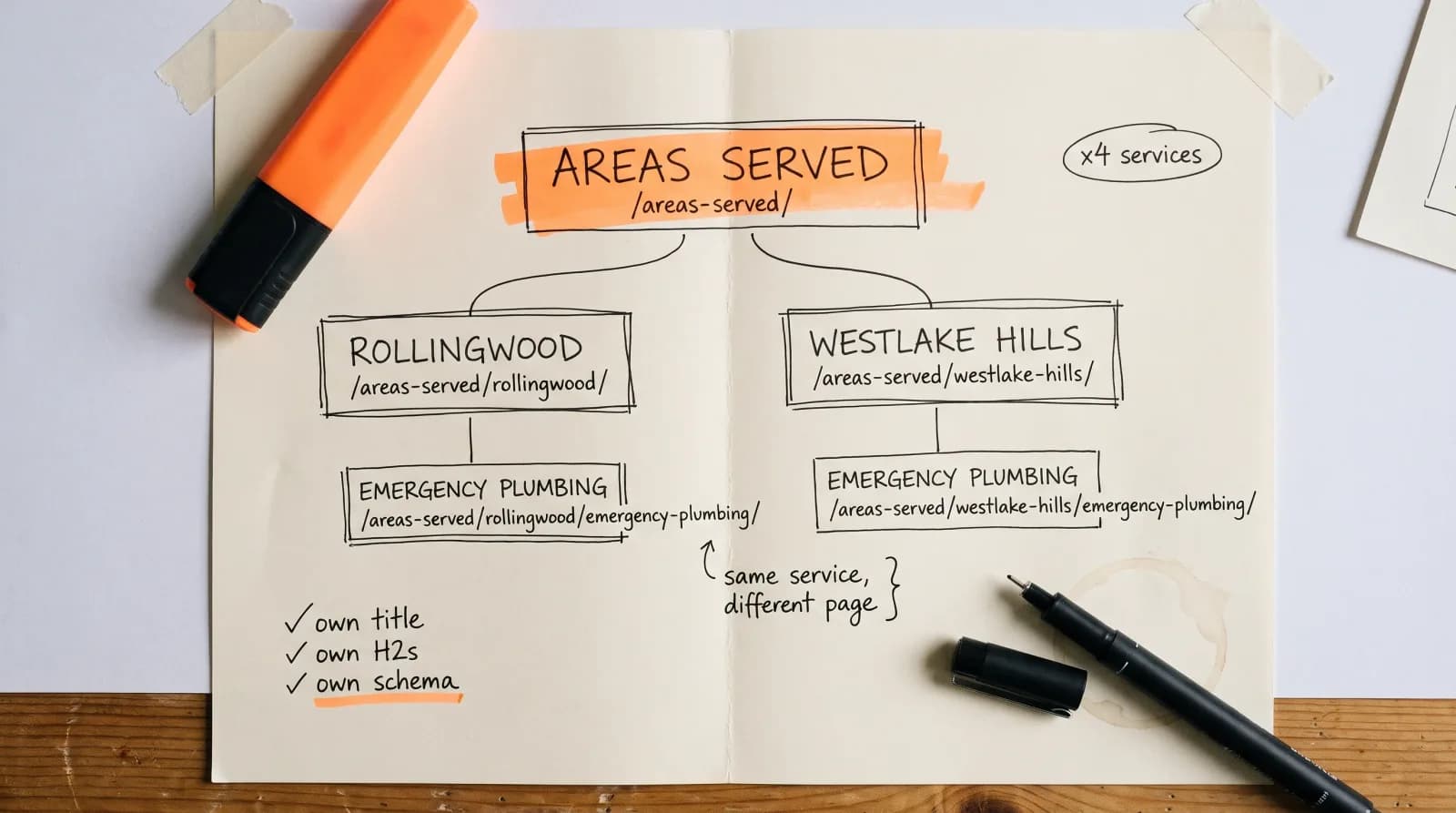
Let's start with your transactional pages and the structure of your website that you cannot get wrong. I like starting with a practical example, because I think it's just easier to kind of map it all out.
So let's say for this instance, you're a local business. You're a plumber in Austin, Texas. And yes, before you ask, this can work for any type of business, I just want to give you a bit of an architecture.
The first thing you need to consider is that you probably have more than one service and for the love of God, do not put all your services in one page. This causes all your services to be competing against each other and you're also not answering the user's search intent as well as you could. In this instance, one plumber might have four services and each one gets its own dedicated page.
-
Emergency plumbing services.
-
Pipe leak repair.
-
Hot water installation.
-
Bathroom renovation.
Now, one thing that a lot of people forget, or probably don't even know, is that it's an absolute must that the content between these four service pages differs 50% from one page to the other. You might think, well, this is a little bit hard, but it isn't at all if you think about it, because we can differentiate in a lot of ways.
-
The title tag of the page.
-
The meta description.
-
The H1s and the H2s.
-
The first part of the sentence.
-
And more importantly, the service schema, relevant to the service on that page.
All of these things are going to make sure that these pages are different enough that they don't get kind of bundled up into one.
Each Location Gets Its Own Page With the Services Under It
Now, if you're a local business, you might offer your services in many locations. Well, we want a parent areas served page. For example, this business has location pages illustrating the locations where they offer their services, places like Rollingwood, Westlake Hills, Hyde Park and Windsor Park. You get the idea.
And if you want to take it a step further and dominate, you want each one of these services below them as a child page, with its dedicated service in that location page. So Rollingwood would have a page dedicated to emergency plumbing in Rollingwood and Westlake Hills would have another page dedicated to emergency plumbing in Westlake Hills.
| Page level | Example page | Example URL |
|---|---|---|
| Parent | Areas served | /areas-served/ |
| Location | Rollingwood | /areas-served/rollingwood/ |
| Location | Westlake Hills | /areas-served/westlake-hills/ |
| Child | Emergency plumbing in Rollingwood | /areas-served/rollingwood/emergency-plumbing/ |
| Child | Emergency plumbing in Westlake Hills | /areas-served/westlake-hills/emergency-plumbing/ |
And again, you might think now, well, that means I've got to do close to 100 pages for my website. Yes and back in the day this was, or maybe still is, referred to as programmatic SEO and it can work very, very well if you do it correctly and if you stick to the fundamentals that we've just gone through, good page structure and content on each one of these pages that differs 50% from the next, with things like the title tag, the schema and all the content there. The schema is the one you cannot miss out on, particularly the service schema.
Blogs Still Matter Because Their Purpose Has Shifted
Now we've figured out your service pages and the structure, but obviously GEO requires a little bit more and part of that is your content, otherwise known as your blog posts. I hear a lot of fluff on the internet saying that blogs are useless and they don't get you traffic anymore and I couldn't disagree more. The purpose of the blogs has shifted, yes.
Their purpose used to be to write a blog, rank it, get you traffic and through internal links, ideally take people through to the pages that would actually convert. And whilst there's still some of that, there's a very important new purpose that blogs bring and that's to turn you into the topical authority figure within your niche.
So how do you become this topical authority figure? Well, you write a lot about a certain topic, ideally without duplicating it. In the same instance of this plumber, you might have a lot of article guides on pipe maintenance, like these.
-
How to prevent frozen pipes in Austin winters (I don't know if you freeze your pipes there, but you get the idea).
-
Signs your pipes need replacing.
-
What to do if your pipes burst at night.
The Capsule Content Technique Lets One Sentence Make Sense by Itself
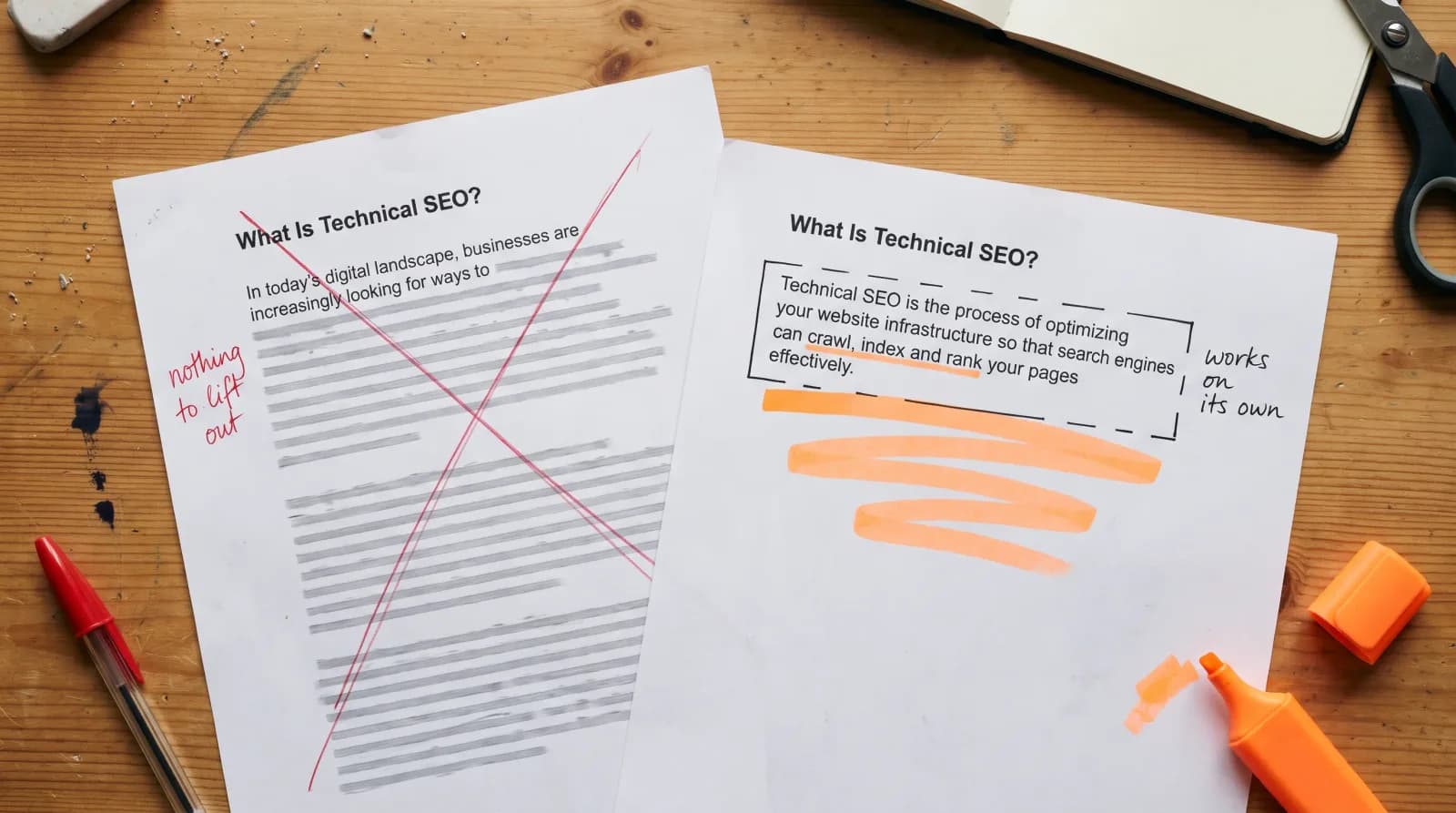
All of this content needs to be written in a very specific format and this format can be referred to as the capsule content technique. It's essentially very simple. If I take a little piece of content out of the blog post I'm reading, that one sentence, will it make sense by itself?
So what you want to do is ideally have the H2 within that blog asking a question. For example, in a blog about what is SEO, I might have an H2 asking, what is technical SEO? A bad example is not answering that right away and saying this:
In today's digital landscape, businesses are increasingly looking for ways to improve, yada yada yada.
That isn't encapsulated, because I'm not answering right away. In a good example, right underneath that H2, I want to get straight to the answer and say this:
Technical SEO is the process of optimizing your website infrastructure so that search engines can crawl, index and rank your pages effectively.
I've encapsulated that little piece of content by itself and this makes it very easy for the AI search engines to grab your sentence and use it as an answer.
Spread One Topic Across YouTube, TikTok and Instagram
So you know about your service pages, your structure and your content. What now? Well, it all comes down to diversification, diversification and a little bit more content diversification. This is simply because the AI search engines are citing a lot of things like YouTube, TikTok, Instagram and a lot more.
So with the blog post that we saw before about taking care of your frozen pipes (there's a naughty metaphor there somewhere, but never mind), you might want to also make a YouTube video about taking care of your frozen pipes and also a Short and a TikTok video and all these things. It might seem like a lot of work, but you can publish short form content on one platform and then have it repurposed for the rest.
The idea here is to spread your digital footprint out to give your brand the highest possibility to get cited, not just from your blog post but from your YouTube videos, from your TikToks and Instagram and so on and so forth.
Good Solid SEO Already Does 70% of the Work
Now, this part should make you feel good about all of this. Don't get overwhelmed with all this work, because in reality, if you just do good solid SEO, you've already done 70% of the work, because it's pretty much all the same. The other 30% goes to the strategies that we just talked about, like the capsule content technique, the structure of your service pages and how you structure your content as well, so you get seen as the subject authority figure within your niche.
And if you ever get people kind of shouting these acronyms at you and you get more confused, this is a quick way that I like to remember it.
-
SEO gets you found by the search engines.
-
AEO allows you to be the answer.
-
GEO gets you recommended.
It's really not that complicated when you think about it. So if you're just starting out with optimizing for the AI search engines, we now know that you need to start with SEO.
Share
You may also like

Send me your site
I'll tell you honestly what's broken. If we can't help, I'll tell you who can.
Free · 45 min · no obligation