


What’s Holding RobesPK Back—and How I’d Lift It
I spent an afternoon inside the data for robespk.com—anchors, backlinks, mobile tests, keyword sets, the whole lot. What follows is my field log: what I saw, what matters and what to fix first. I’m keeping this practical and number-heavy, with short punches where needed. 1) Snapshot: Where the Site
I spent an afternoon inside the data for robespk.com—anchors, backlinks, mobile tests, keyword sets, the whole lot. What follows is my field log: what I saw, what matters and what to fix first. I’m keeping this practical and number-heavy, with short punches where needed.
1) Snapshot: Where the Site Stands (and wobbles)
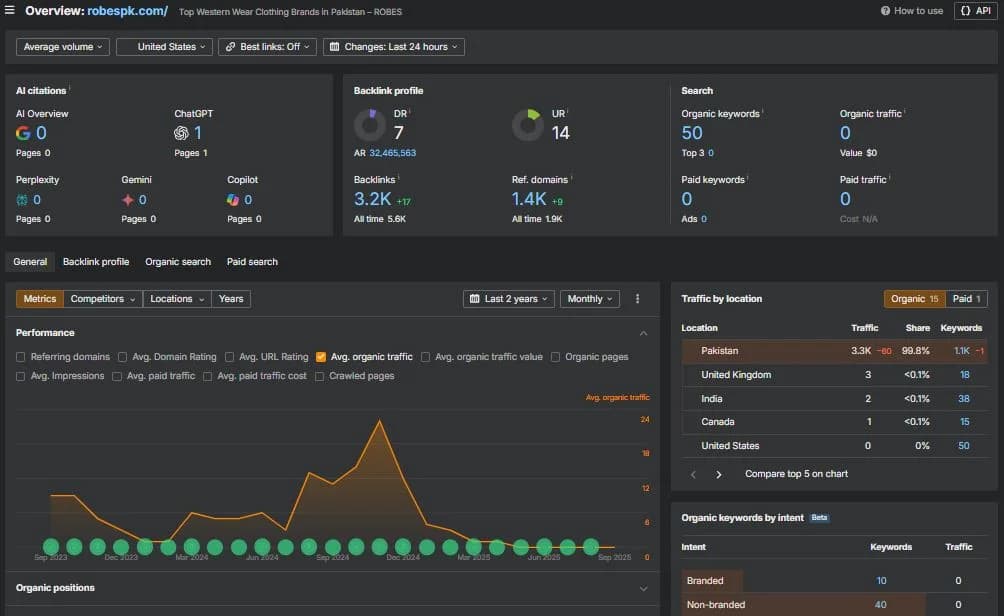
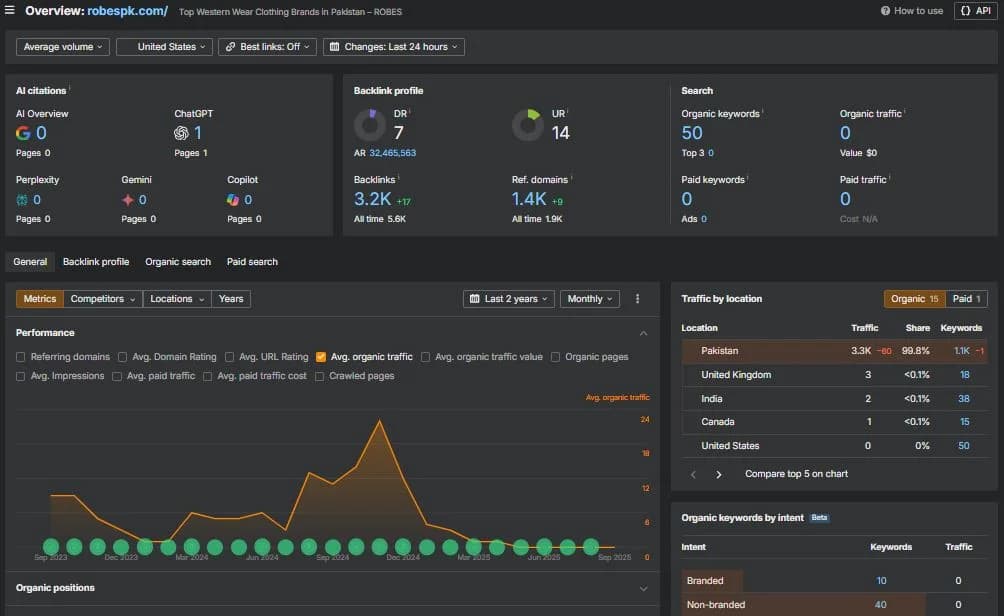
First impressions: the domain has reach, but the engine sputters. Backlinks exist in volume; organic demand is thin and choppy; technical basics slow everything down.
What I’m looking at:
-
Platform fingerprints: Shopify patterns in robots.txt and URL structure.
-
Link profile: many UGC/nofollow placements and promotional blog comments.
-
Visibility: a small set of commercial terms around “long dresses / western dresses in Pakistan.”
-
UX/tech: slow page load, not mobile-friendly per the API test.
Key Numbers I Pulled
Area
Metric
Value / Note
Authority
DR / UR
DR 7, UR 14 (light authority)
Backlinks
Links / Referring Domains
~3.2K links; ~1.4K referring domains (historical total higher)
Organic
Semrush keywords / traffic
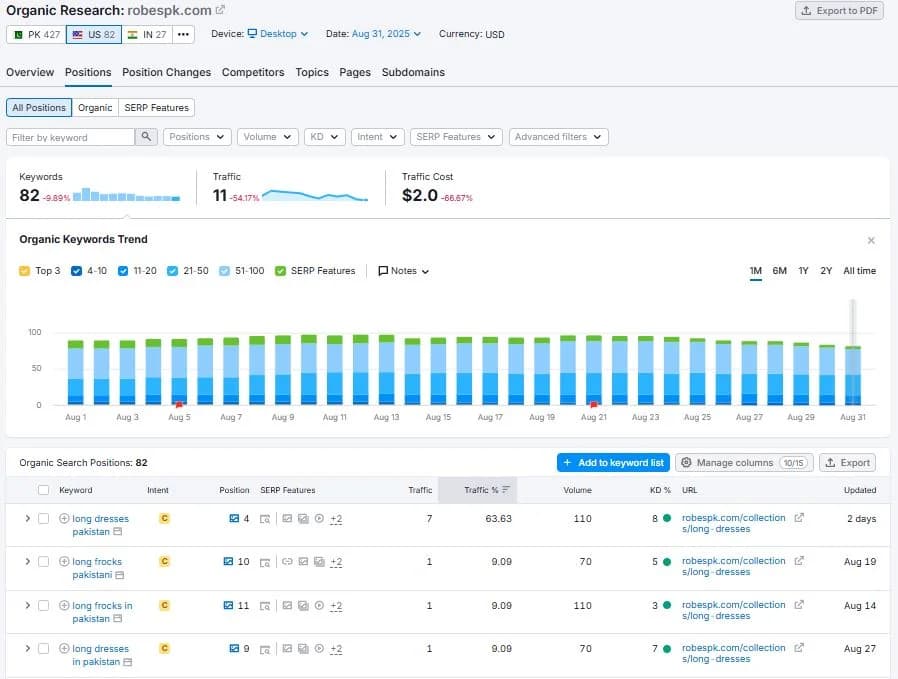
~82 keywords, ~11 visits this month, traffic cost ≈ $2
Organic (Ahrefs set)
Focus terms
“western dresses in pakistan”, “pakistani long dresses”, “hoodies in pakistan” show mid-page positions
Country mix
Top market
Pakistan dominates; long tail in UK/India/US minimal
Mobile
Mobile-friendly test
Not mobile-friendly (flagged)
Speed
Grade / Size / Load
D 66; 6.2 MB; 8.25 s; 244 requests
My read in plain words: the site can rank for intent-ready product terms, but the combination of low authority, thin topical depth, spam-leaning anchors and heavy pages is throttling growth.
2) Backlinks & Anchors: Quantity Shows Up, Quality Doesn’t
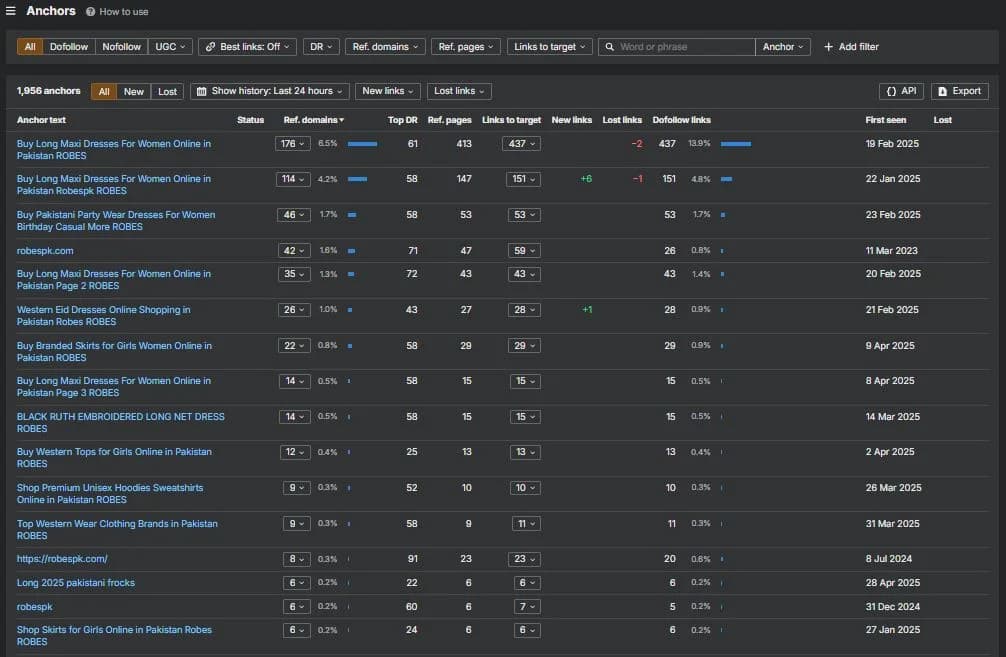
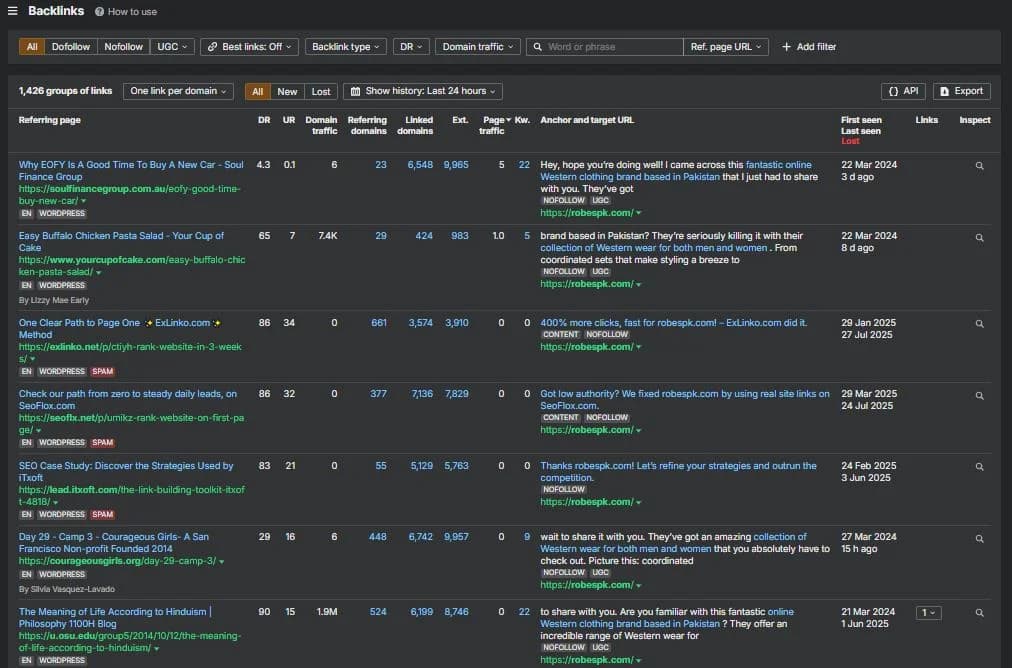
I went through the anchor set and sampled referring pages. A pattern jumps out immediately: promotional comments and inserted blurbs on low-to-mid DR WordPress posts. Many are UGC / NOFOLLOW, some even flagged as spam in the referring page list. That’s link noise, not equity.
Anchor Text Distribution I Saw
-
Money anchors packed with product phrases:
“Buy Long Maxi Dresses For Women Online in Pakistan ROBES”, “Buy Pakistani Party Wear Dresses…”, “Western Eid Dresses Online…” -
Branded mentions: “robespk”, “robespk.com”, but far fewer than the money terms.
Why This Matters?
-
Over-optimized commercial anchors + low-quality placements = risk signals.
-
Too much nofollow/UGC means little authority transfer, even if the counter shows “more links.”
Quick Table From My Notes
Signal
Observation
Risk / Impact
Anchor mix
Heavy exact/partial money terms
Over-optimization, weak trust
Link types
Many UGC / NOFOLLOW
Low equity flow
Referrer quality
Blog comments, generic posts, “we found this brand” blurbs
Algorithmic devaluation likely
Net trend
Links appear, disappear, reappear
Unstable link equity
What I’d Do Next (link side)
-
Anchor reset: pursue branded + natural descriptive anchors from real mentions (features, collaborations, lookbooks, local press).
-
Link pruning & disavow triage: isolate obviously spammy networks; remove if controllable, disavow selectively where removal isn’t realistic.
-
Asset creation: build linkable content (seasonal size guides, fabric care, fit/length charts for Pakistani sizing, city-wise pickup/returns info). Those attract brand-safe anchors naturally.
-
Partnerships that ship: micro-influencer try-ons with measurement charts and real photos. Aim for dofollow editorial, not coupon sites or comment sections.
3) Organic Visibility & Keywords: Small Beachhead, Room to Grow
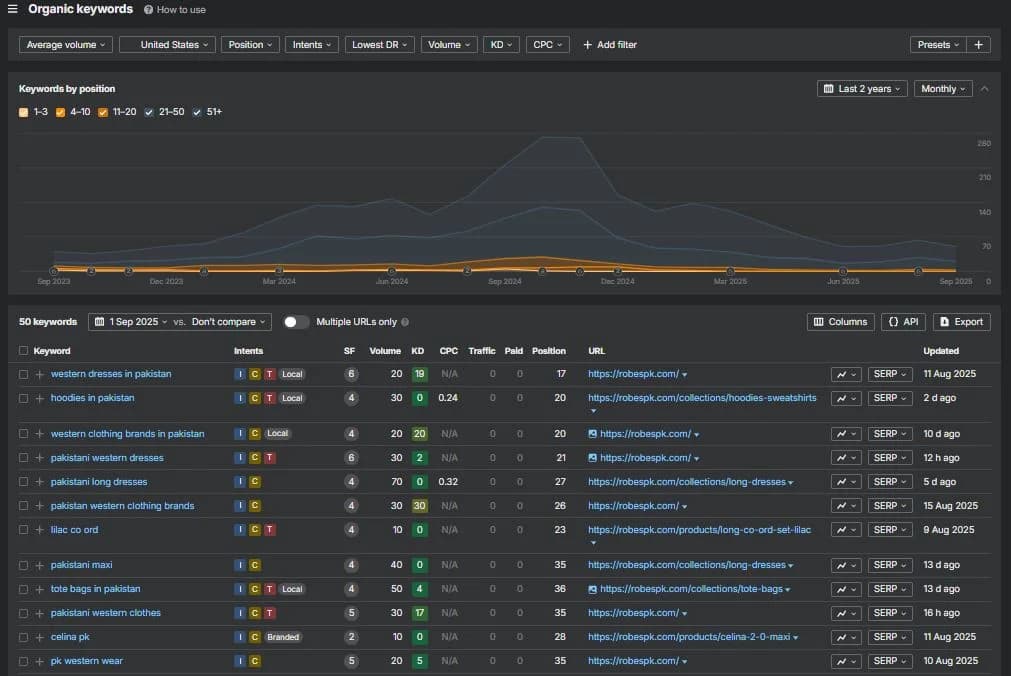
The keyword set is compact and commercial—good starting point. Rankings sit mid-SERP for core phrases; a few collection pages flirt with page one, then slide back.
What Stood Out in the Grids?
-
Phrases like “western dresses in pakistan” (around pos ~17 recently), “pakistani long dresses” (low 20s), “hoodies in pakistan” (around 20).
-
Semrush shows 82 keywords total with ~11 monthly visits right now and a handful of terms where the collection pages (“/collections/long-dresses”) carry the weight.
-
Top pages report shows individual product URLs ranking for tiny, quirky queries (“jade green outfit”, “lilac co ord”)—fragile traffic, not compounding growth.
Strengths
-
The intent is laser-commercial. When you win these, they convert.
-
Collections already map to shopper language (long dresses, hoodies, tote bags).
Gaps
-
Not enough depth per collection: size filters, length options, fabric facets, occasion taxonomy (eid, office, casual, wedding guest) are under-signaled.
-
Bare-bones editorial around products: no lookbooks per season, no trend explainers for “western wear in Pakistan” that could grab supporting keywords.
-
Sparse internal linking from supporting articles to collections: product detail pages lack robust FAQ blocks targeting long-tail.
Simple Plan to Nudge Rankings Upward
-
Collection depth: add 150–300 words of buyer-focused copy per collection (fit notes, length guidance in inches/cm, model height), plus an expandable FAQ.
-
Schema: Product, ItemList on collections and FAQ where relevant.
-
Bridge posts: 6–8 articles that bind intent to catalog, e.g., “How to choose long dresses for Pakistani weddings (length, lining, sleeve options)”, “Western workwear for Karachi summers—breathable fabrics ranked.”
-
Internal links that matter: every guide links to the collection with natural anchors; top products link back to the guide.
-
CRO micro-wins: sizing chart modal, delivery/return badges above the fold, trustproof (UGC photos) to improve engagement signals.
4) Technical foundations (robots, sitemap, site structure)
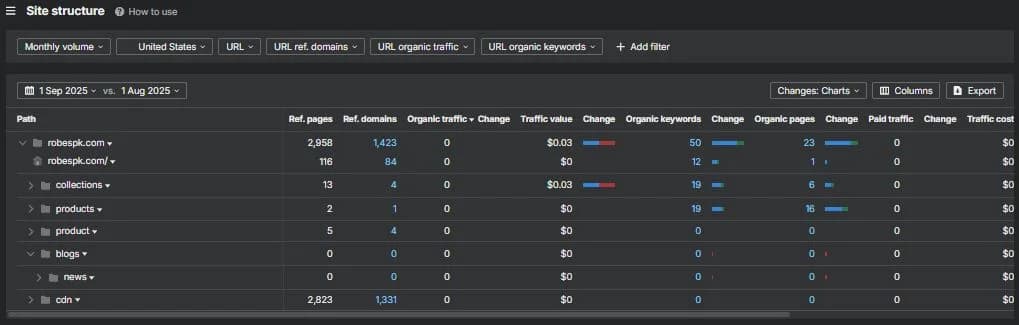
I pulled the robots.txt and read it line by line. It screams “Shopify,” and it’s doing some heavy lifting against duplication. Lots of query/facet blocks (/collections/*sort_by*, /collections/*filter*, various cart/checkout paths). Good instincts there. But one line set worries me: broad Disallow: /blogs/* patterns. That’s a brake on any content-led growth. If bots can’t crawl blogs, you’re forfeiting the easiest route to topical authority, internal link sculpting and long-tail capture.
A quick sketch of what I noted:
Area
What I saw
My take
Crawl control
Aggressive disallows for cart/checkout/accounts and faceted collections
✅ Reduces thin/duplicate URLs
Blogs
Wildcard disallow for /blogs/* (multiple variants)
❌ Blocks all blog posts from indexing
Collections
Sort/filter parameters disallowed
✅ Fine, but still set canonical on base collection URL
Sitemap
Present, 200 OK
✅ Make sure it lists products, collections and blogs
Internal structure
Most organic pages = collections/products; blogs read as zero
⚠️ Symptom of blog blocking
What I’d change this week
-
Remove or narrow the blog disallows. Keep parameterized filters blocked, but allow /blogs/ and /blogs/*/* so posts can index.
-
Ensure canonical on collection pages targets the clean URL (no sort/filter).
-
Confirm sitemap includes /blogs/ entries once you lift the block.
-
Add an HTML sitemap (or a “Shop by Occasion / Fabric / Length” hub) to distribute internal links toward the money collections.
Why I’m pushing the blog so hard: your authority (DR 7) is light. You need surface area—clean, indexable, interlinked articles that feed authority into collections. Robots.txt is currently cutting off that oxygen.
5) Mobile & Speed: The Easy Wins Are Not Yet Taken
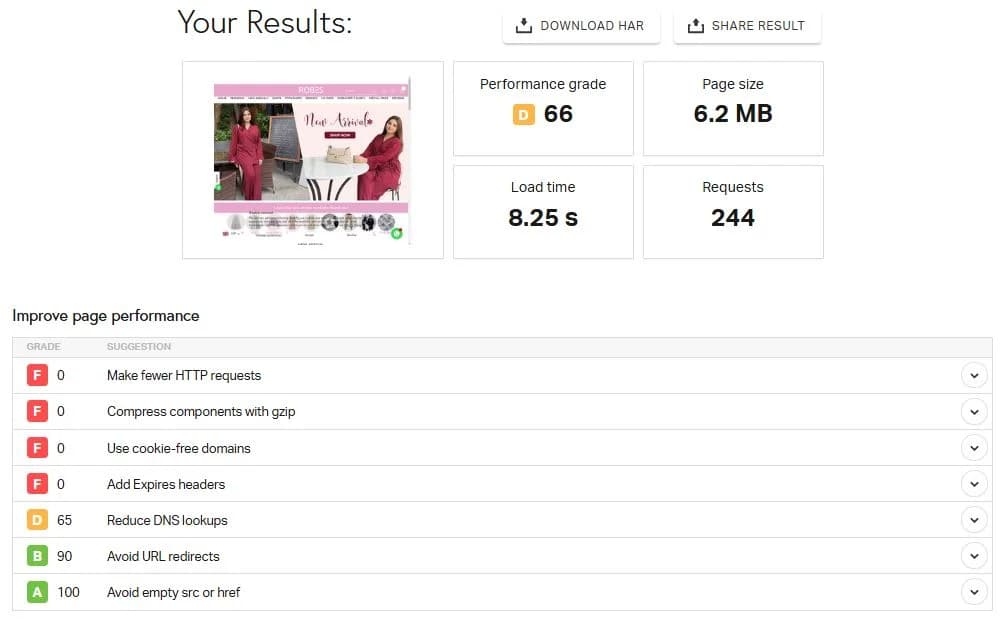
The mobile-friendly API call came back red. That alone can cap rankings in a mobile-first world. Pair that with the performance snapshot—66 (D), 6.2 MB, 8.25 s, 244 requests—and I’m not surprised the keyword set remains shallow. Users bounce when pages drag; Google notices.
What’s Dragging the Site?
-
Too many requests (244): app scripts, trackers, theme bloat, multiple CSS/JS files.
-
Compression off for some components: report explicitly calls for gzip.
-
Static caching headers missing: no Expires / Cache-Control on long-lived assets.
-
Cookie usage on static assets: flagged to “use cookie-free domains.”
-
Redirects are mostly under control, but still an 8+ second load on a retail homepage.
Fix-first list (I’d do it in this order)
-
Turn on Brotli/Gzip for text assets (JS, CSS, JSON, SVG). This is a lever—often 20–70% smaller transfers with a single config.
-
Reduce requests: audit apps; remove what doesn’t drive revenue (duplicate sliders, review widgets showing on every page, chat scripts on all templates). Merge/minify where the theme permits. Defer non-critical JS.
-
Image discipline: serve WebP/AVIF, add srcset/sizes, lazy-load below-the-fold, cap hero images to real display dimensions. Shopify CDN can do most of this—use the right parameters.
-
Cache headers: set long max-age for hashed static assets; enable CDN caching for product/collection images.
-
Fonts: fewer families/weights; preconnect to the font host; consider system fonts for body text.
-
Critical CSS: inline the minimal above-the-fold CSS; push the rest deferred.
-
Mobile viewport & tap targets: confirm meta viewport is responsive, eliminate fixed-width sections, ensure buttons/filters meet touch spacing. This is the likely root of the “not mobile-friendly” flag.
A Quick Impact Map From My Notes:
Fix
Why it matters
How I’d implement
Expected lift
Brotli/Gzip
Cuts transfer size dramatically
Enable at CDN/app proxy
Faster TTFB/transfer
Request slimming
Each file adds overhead
Remove unused apps, combine CSS/JS, defer
Lower blocking time
WebP/AVIF + lazy load
Images dominate retail pages
Shopify CDN formats + loading=”lazy”
Faster LCP
Cache headers
Repeated visits feel instant
Cache-Control: max-age=31536000 on static
Return visitors zoom
Critical CSS
Paint faster
Extract above-the-fold CSS
Better FCP/LCP
Viewport/tap targets
Pass mobile test
Theme adjustments
Rankings + UX
Bottom line: if we halve the requests and trim the page to ~2–3 MB, LCP will drop under 3s on decent 4G. That alone can lift conversion and make every link you build work harder.
6) Top Pages Audit & Content Actions
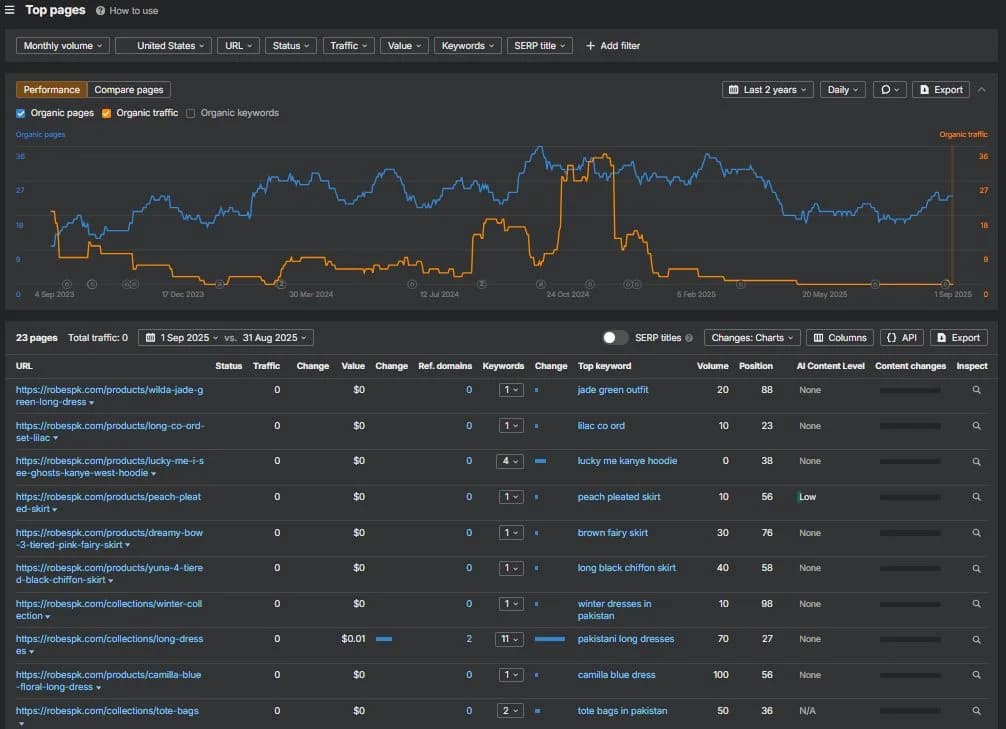
I combed through the “Top pages” view and the pattern was clear: most of the URLs pulling impressions are collections and a sprinkling of single products that rank for ultra-specific color/style queries. Traffic is fragile and a lot of pages sit on page 2–5. That’s fixable.
What I Saw in the Grid? (sample, condensed)
URL (type)
“Top” keyword (paraphrased)
Volume
Position
Notes
/collections/long-dresses/ (collection)
“pakistani long dresses”
70
27
The only row showing any tiny value; copy is thin.
/collections/winter-collection/ (collection)
“winter dresses in pakistan”
10
98
Indexable but buried.
/products/wilde-jade-green-long-dress (product)
“jade green outfit”
20
88
Color-match query; not commercial enough.
/products/lucky-me-kanye-west-hoodie (product)
“lucky me kanye hoodie”
0
38
Trademark adjacency; risky and weak.
/products/peach-pleated-skirt (product)
“peach pleated skirt”
10
56
Low depth PDP; missing FAQs.
/products/4-tier-black-chiffon-skirt (product)
“long black chiffon skirt”
10
56
Same issue as above.
/collections/tote-bags/ (collection)
“tote bags in pakistan”
—
—
Present but under-optimized.
Why Do These Pages Stall?
-
Collection pages carry little buyer guidance (fit/length, fabric weights, occasion tags).
-
Product pages lean on images, not unique copy; no structured FAQs; thin internal links.
-
Color-keyword pages cannibalize each other; the site doesn’t tell Google which URL should win.
Conclusion
I’ve seen enough fashion stores stall at the same junction: thin authority, heavy pages and category copy that says nothing new. robespk.com isn’t stuck—it’s just carrying extra weight. Strip that weight, let the blog breathe, and give buyers the details they actually use (length in cm, fabric feel, lining notes, city-wise delivery). Rankings follow when pages answer real shopping decisions quickly.
Share
You may also like


Send me your site
I'll tell you honestly what's broken. If we can't help, I'll tell you who can.
Free · 45 min · no obligation