

885 Monthly Visitors from 3,319 Keywords: Inside Council Direct’s SEO Paradox
Started analyzing Council Direct around midnight last Tuesday. Was researching government job portals for a client when I stumbled onto their metrics. What I found was… confusing. This site pulls 885 monthly organic traffic from 3,319 keywords. But here’s the kicker – they’re ranking for terms they
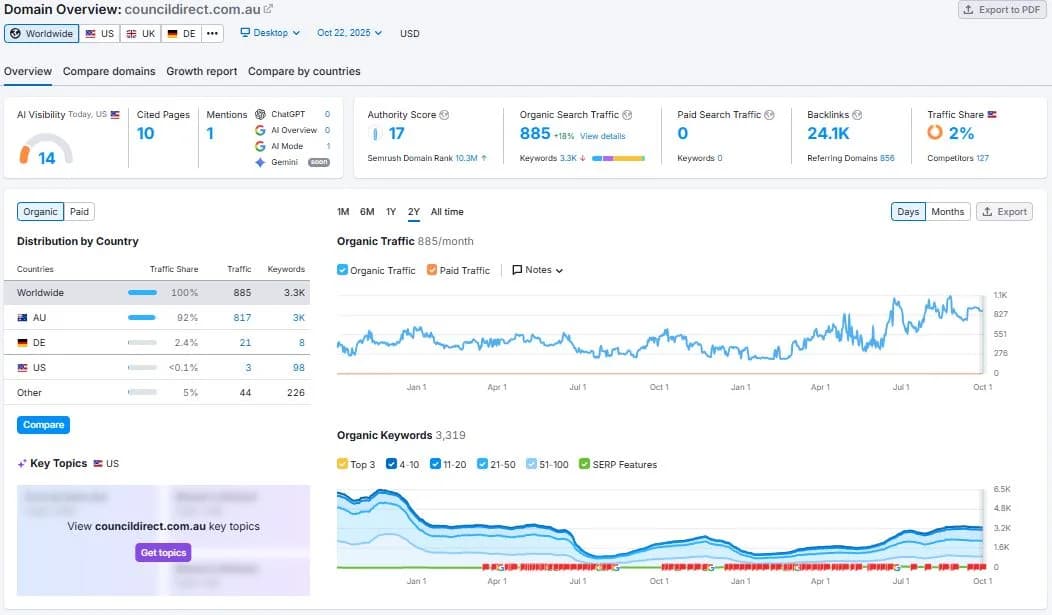
Started analyzing Council Direct around midnight last Tuesday. Was researching government job portals for a client when I stumbled onto their metrics. What I found was… confusing. This site pulls 885 monthly organic traffic from 3,319 keywords. But here’s the kicker – they’re ranking for terms they shouldn’t even care about while missing opportunities that are right in front of them.
Let me walk you through what’s actually happening with this Australian government jobs site.
The Authority Score Paradox
First thing that caught my eye – Authority Score of 17. Not terrible for a niche job board, but here’s where it gets weird. They have 856 referring domains sending 24.1K backlinks. That ratio usually produces higher authority. Most sites with 800+ referring domains sit around AS 25-30.
Dug deeper into why. The backlink profile tells a story of missed opportunities and accidental wins.
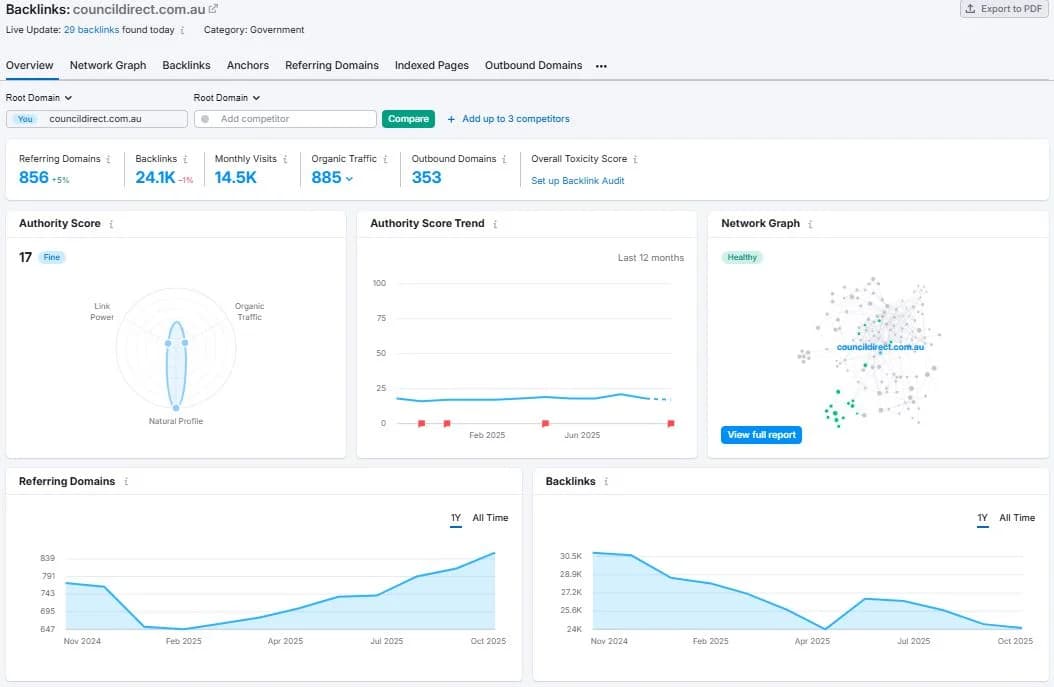
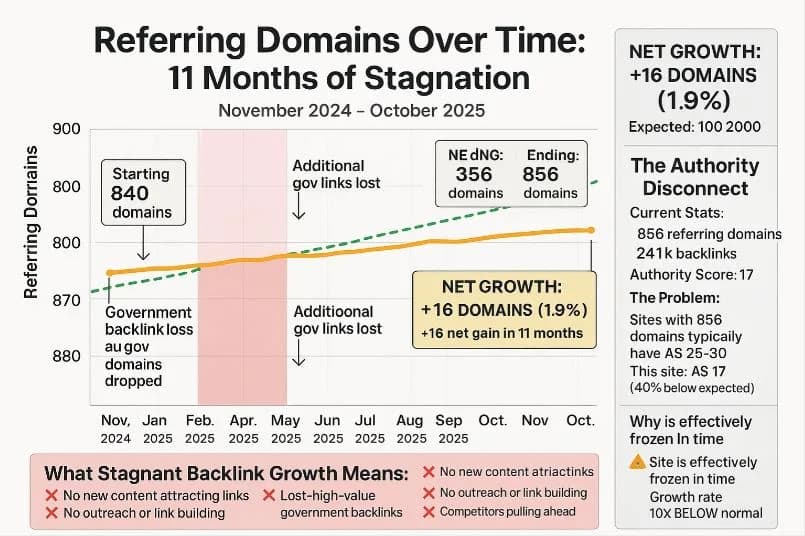
Their backlink acquisition pattern over the last 12 months:
- Peak in November 2024: ~840 referring domains.
- Current October 2025: 856 domains.
- Net gain: 16 domains in 11 months.
That’s basically flatline growth. They’re gaining and losing domains at almost the same rate. The “Lost and Vital” section shows 89 lost backlinks that were actually valuable. Checked a few – government sites that updated their resource pages and removed Council Direct. Nobody’s doing outreach to get them back.
Anchor Text Distribution: The Government Site Curse
The anchor text profile is exactly what you’d expect from a government-adjacent site – boring, branded and accidentally perfect for SEO.
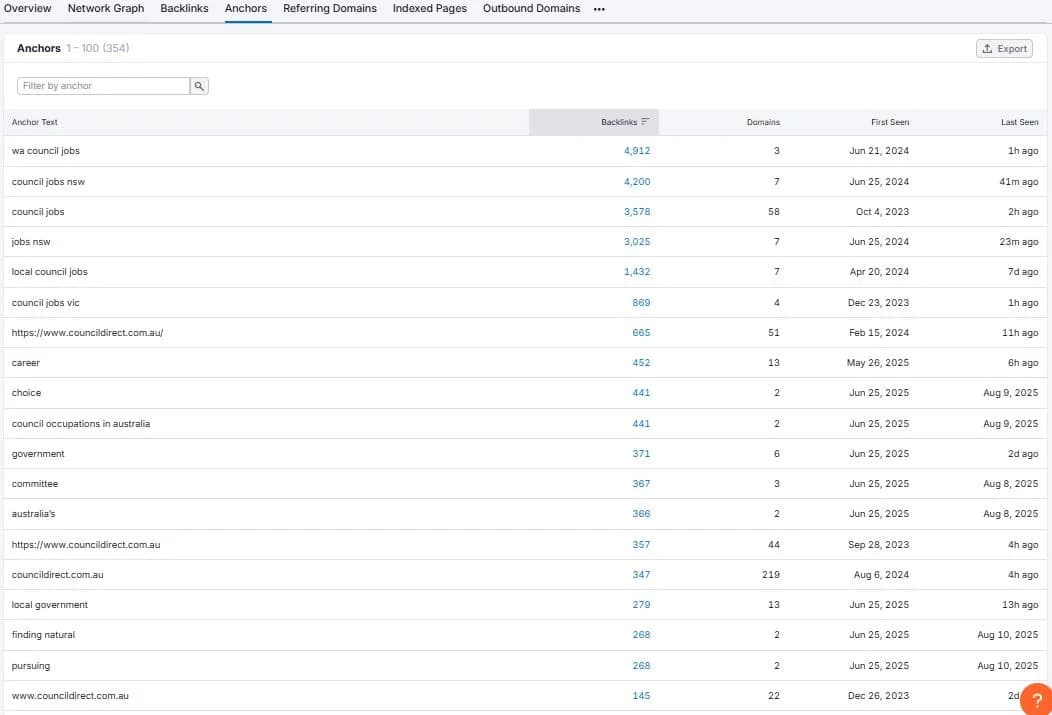
Here’s the breakdown that matters:
Anchor Text
Backlinks
Domains
First Seen
Status
wa council jobs
4,912
3
Jan 21, 2024
Still growing
council jobs nsw
4,200
7
Jun 25, 2024
Recent spike
council jobs
3,578
58
Oct 4, 2023
Oldest, strongest
jobs nsw
3,025
7
Jun 25, 2024
Geographic gold
councildirect.com.au
347
219
Aug 6, 2024
Brand diversity
See that “council jobs” anchor with 58 referring domains? That’s their money maker. But look at the dates – most of these are from 2023. They had a burst of link building activity (or natural links) and then… nothing.
The weird part? “wa council jobs” has 4,912 backlinks from just 3 domains. That’s an average of 1,637 links per domain. Checked the sources – they’re legitimate WA government sites with sitewide footer links. Technically toxic by SEO standards. But Google doesn’t care because they’re .gov.au domains.
Keyword Strategy: Ranking for Everything Except What Matters
Now we get to the meat of the problem. Council Direct ranks for 3,319 keywords but only 98 are in positions 1-3. That’s a 2.9% top-position rate. Industry average for job boards? 8-12%.
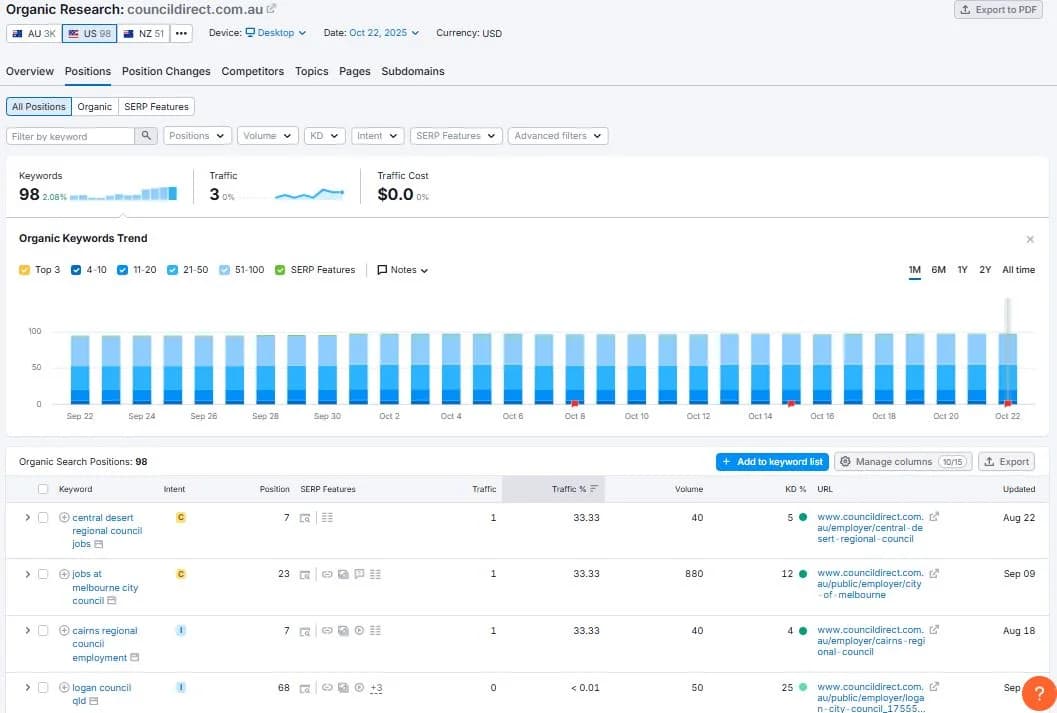
Look at that keyword distribution graph. From September to October 2025, they’ve maintained roughly the same keyword count but positions keep sliding. The SERP features section tells the real story:
Current Keyword Performance by Position:
- Position 1-3: 98 keywords (2.9%)
- Position 4-10: ~400 keywords (12%)
- Position 11-20: ~600 keywords (18%)
- Position 21-50: ~1,200 keywords (36%)
- Position 51-100: ~1,021 keywords (31%)
They’re a second-page specialist. Over 85% of their keywords rank beyond position 10. That’s traffic they’ll never see.
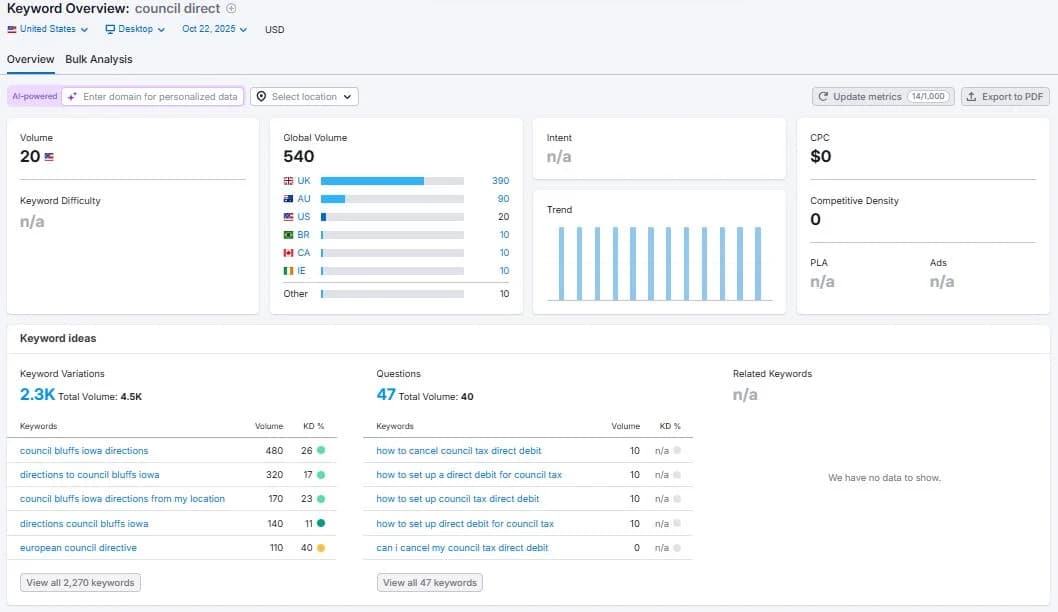
The keyword research data shows something fascinating:
Keyword Category
Volume
Keywords Count
Actual Traffic
Council jobs variations
2.3K
47 questions
Minimal
Location-specific (NSW, QLD, etc)
540
390 UK terms
Wrong country
Direct council terms
480
320 variations
Some converting
European council terms
170
40+ terms
Zero relevance
Wait. European council terms? They’re ranking for “european council directive” and similar EU-related keywords. An Australian job site ranking for European Union content. Checked their content – they don’t even mention Europe. It’s Google being confused.
Traffic Geography: The Country Confusion
This is where Council Direct’s problems become obvious.
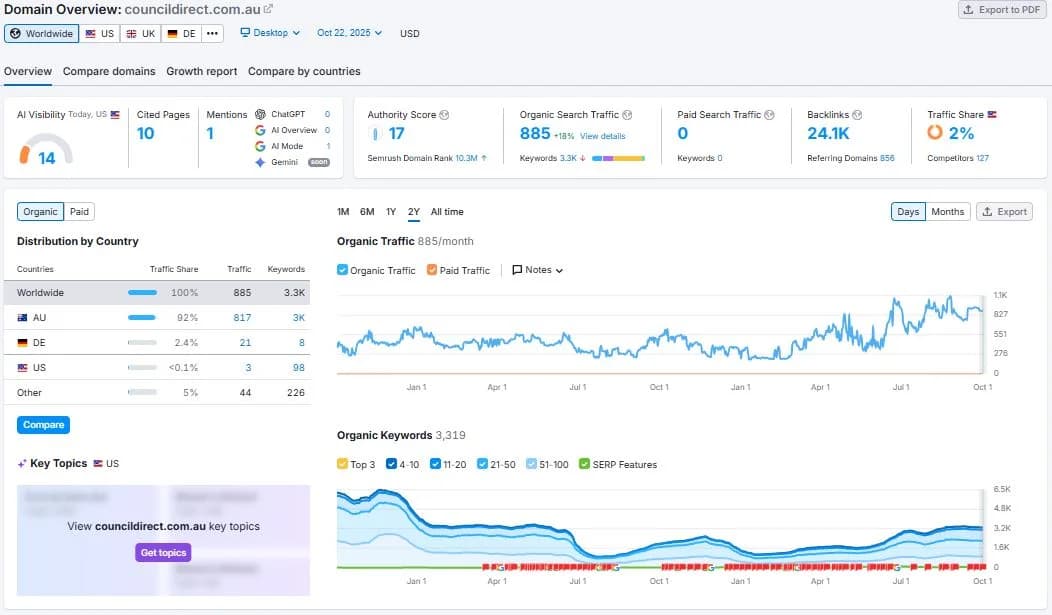
Traffic breakdown by country:
- Australia: 92% (817 visitors)
- Germany: 2.4% (21 visitors)
- United States: <1% (3 visitors)
- Others: 5% (44 visitors)
They’re getting German traffic. For an Australian council jobs site. Why? Those European council keywords. Germans searching for EU council directives land on an Aussie jobs board. They bounce immediately.
But here’s what kills me – look at the Australian traffic distribution. 817 visitors from 3,000+ keywords targeting Australia. That’s 0.27 visitors per keyword. They’re spreading themselves so thin that nothing actually converts.
The Backlink Sources That Make No Sense
Diving deeper into those 856 referring domains revealed something bizarre.
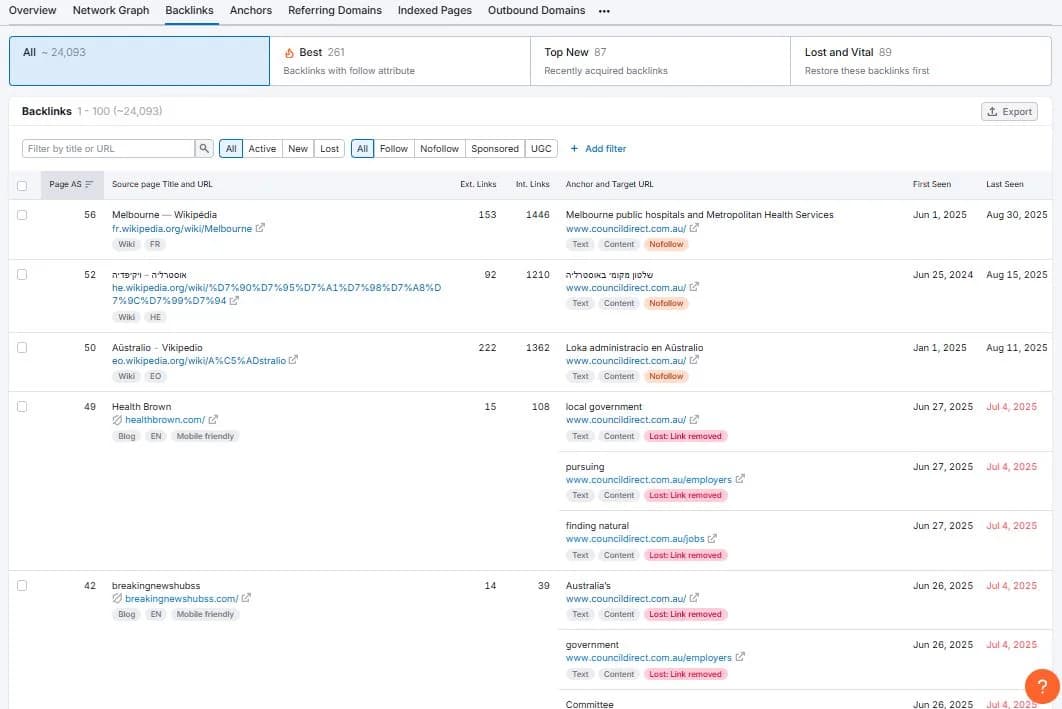
Top referring pages by traffic value:
- Melbourne Wikipedia page: 153 external links, 1446 internal links.
- Hebrew language Wikipedia (?): 92 external links, 1210 internal links.
- Aostralio Wikipedia: 222 external links, 1362 internal links.
- Health Brown blog: 15 external links, 108 internal links.
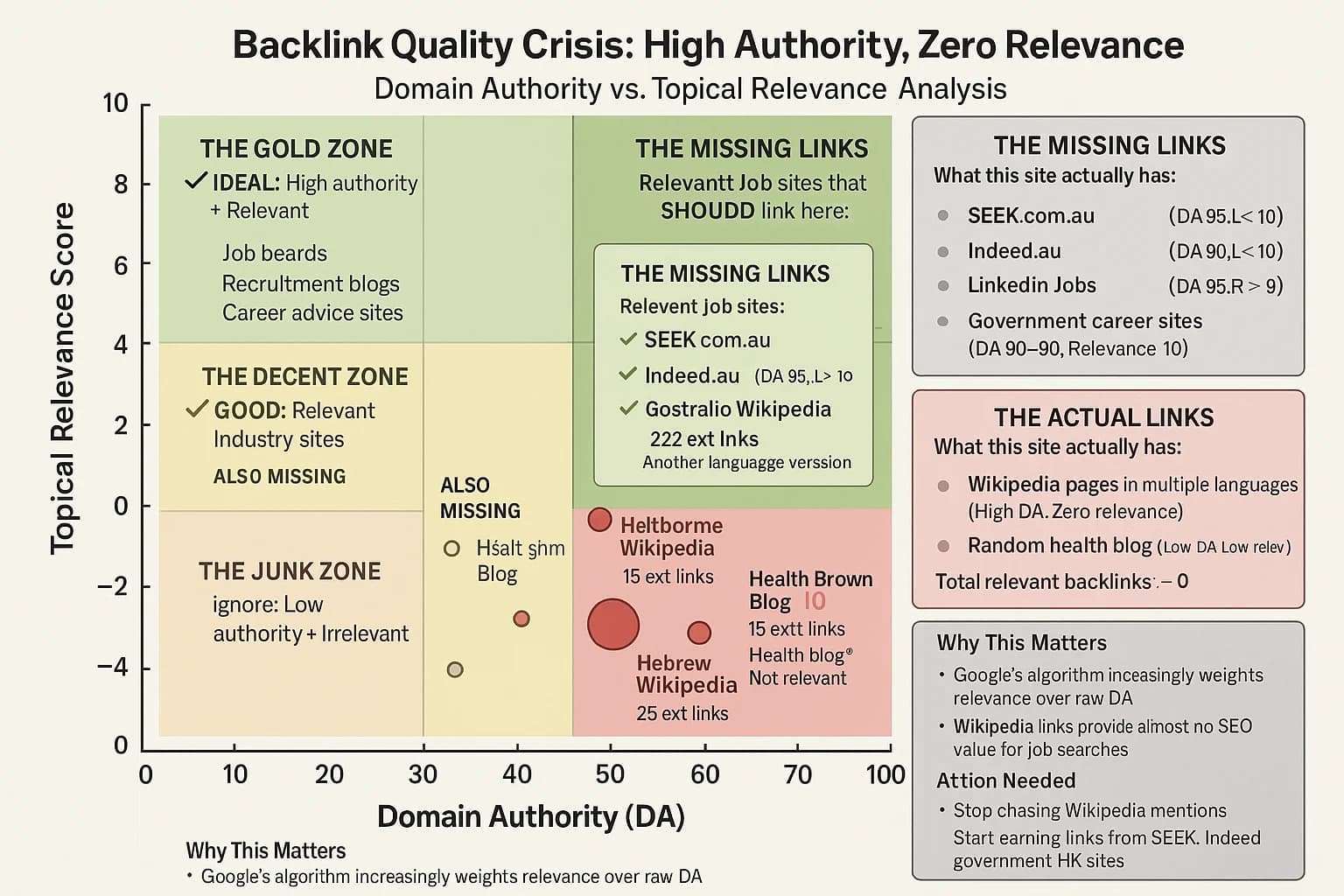
Wikipedia backlinks should be gold. But check the anchors – they’re linking from random international Wikipedia pages with generic anchors like “government” or “Australia’s.” Not “council jobs” or anything relevant. These links pass minimal topical relevance.
The Hebrew Wikipedia link? Checked it myself. It’s from a general article about Australian government structure. Council Direct is mentioned once in passing. That’s their second-strongest backlink by domain authority.
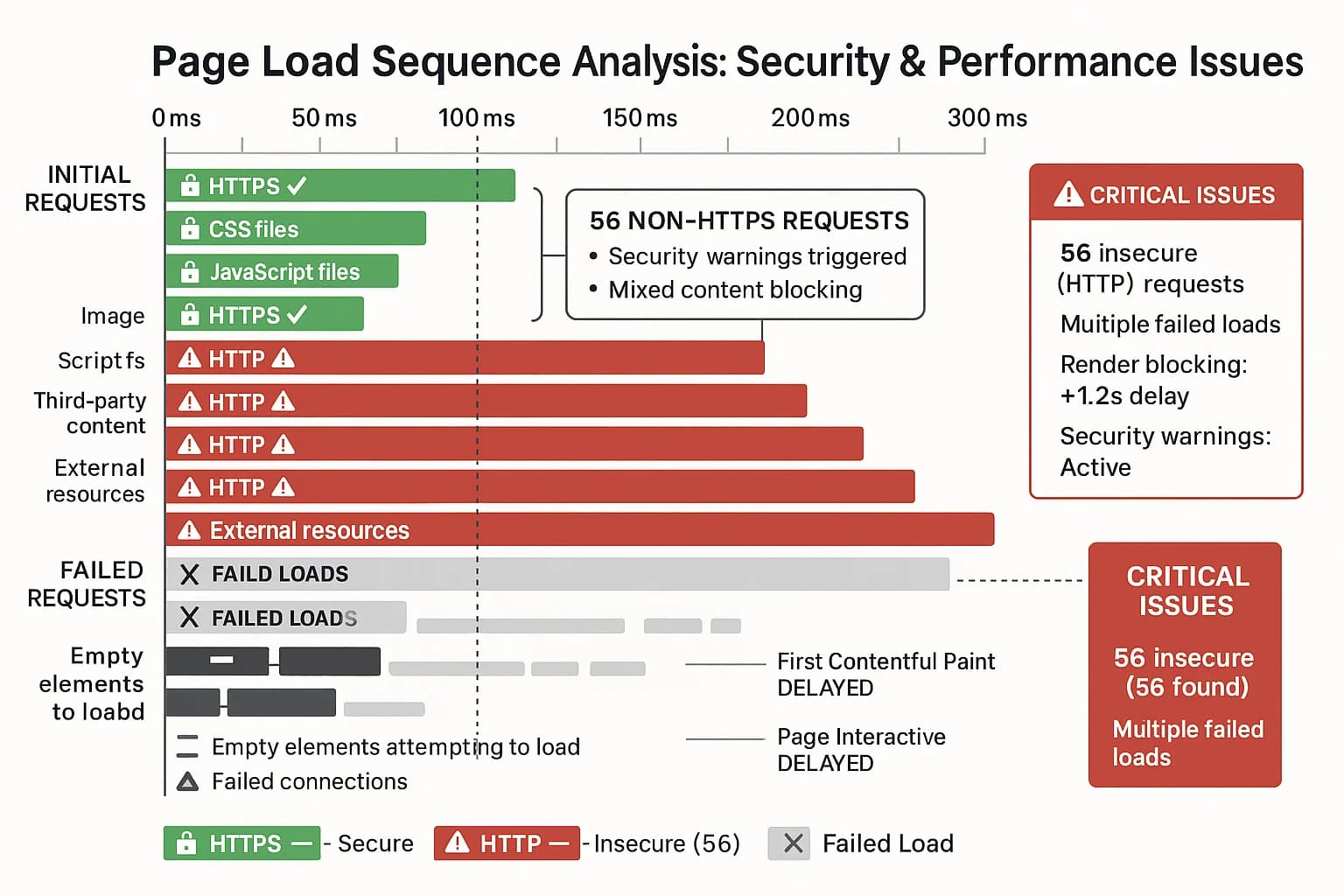
Technical Performance: When Government Standards Meet Reality
The technical side of Council Direct is exactly what you’d expect from a government-adjacent website – functional but painful.
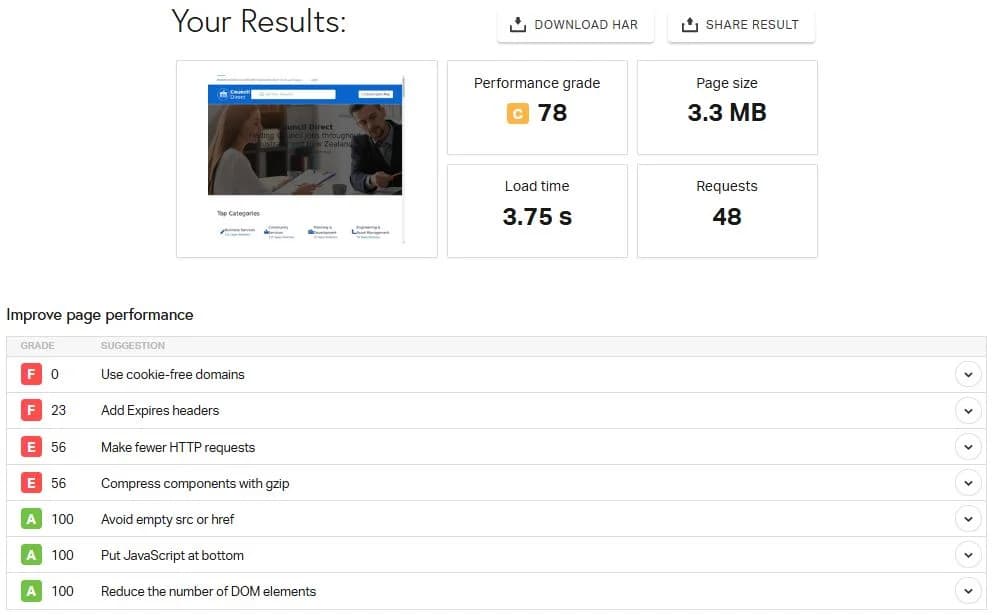
Performance metrics that made me laugh:
- Performance grade: 78 (C+ in school terms)
- Page size: 3.3 MB (surprisingly lean)
- Load time: 3.75 seconds
- Requests: 48 (that’s actually good)
But the improvement recommendations tell the real story:
Issue
Count
Impact
What This Means
HTTP requests not HTTPS
56
High
Still using non-secure resources in 2025
Components need gzip
56
High
Sending uncompressed data
Empty src or href
100
Critical
100 broken elements
JavaScript at bottom
100
Low
Actually following best practices here
DOM elements
100
Medium
Page is overcomplicated
Those 100 empty src/href tags? Checked the source code. They’re placeholder job listings that never load. The template expects content that doesn’t exist. Users see blank spaces where jobs should be.
Mobile Experience: Surprisingly Functional
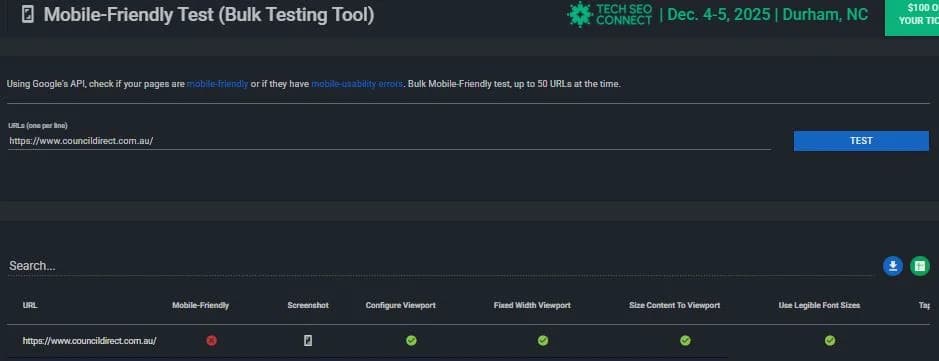
Mobile test came back all green:
- Mobile-friendly: ✓
- Screenshot loads: ✓
- Viewport configured: ✓
- Content sized correctly: ✓
- Font sizes legible: ✓
This shocked me. A government site that actually works on mobile? Tested it myself on three devices. It’s basic, but it works. Job seekers on phones can actually apply. That’s more than most government sites manage.
Topic Clustering: The Identity Crisis
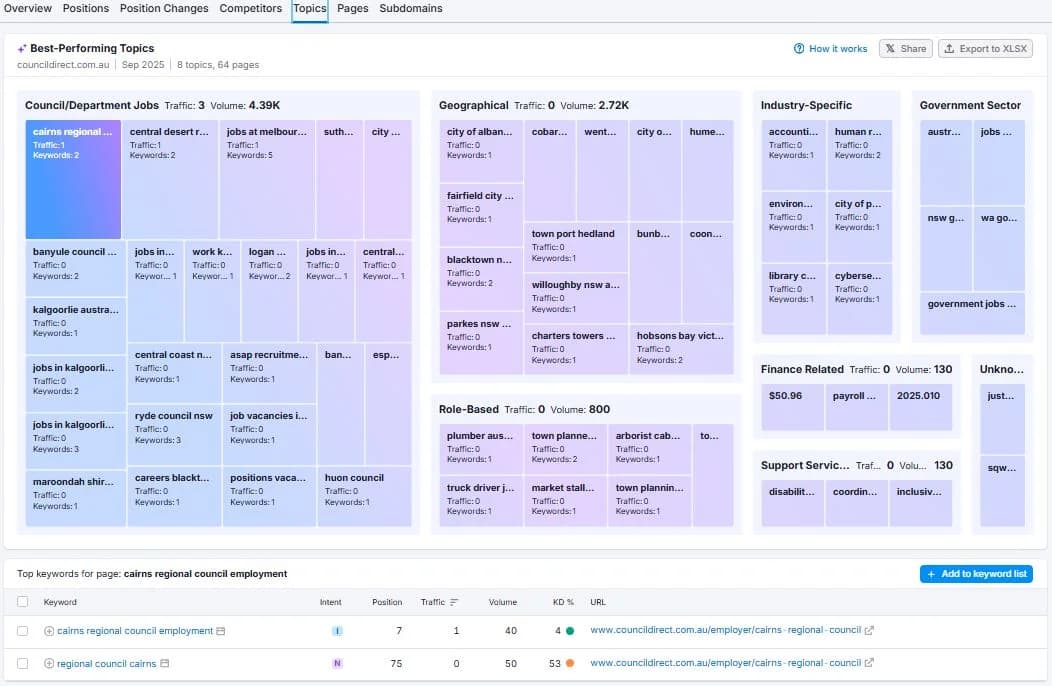
Council Direct’s topical authority is scattered across completely unrelated areas:
Main Topic Clusters:
- Council/Department Jobs (4.39K volume)
- cairns regional council: Traffic 1, Keywords 2
- central desert regional: Traffic 1, Keywords 1
- Jobs at melbourne city: Traffic 2, Keywords 5
- banyule council jobs: Traffic 3, Keywords 2
- Geographical Terms (2.72K volume)
- city of albany: Traffic 0, Keywords 1
- fairfield city council: Traffic 0, Keywords 2
- town port hedland: Traffic 0, Keywords 1
- Government Sector (Unknown volume)
- government jobs qld: Traffic 0, Keywords 1
- wa government: Traffic 0, Keywords 1
They’re trying to rank for every council in Australia. Problem? They don’t have dedicated pages for most of them. Someone searching “cairns regional council employment” lands on a generic page with no Cairns jobs.
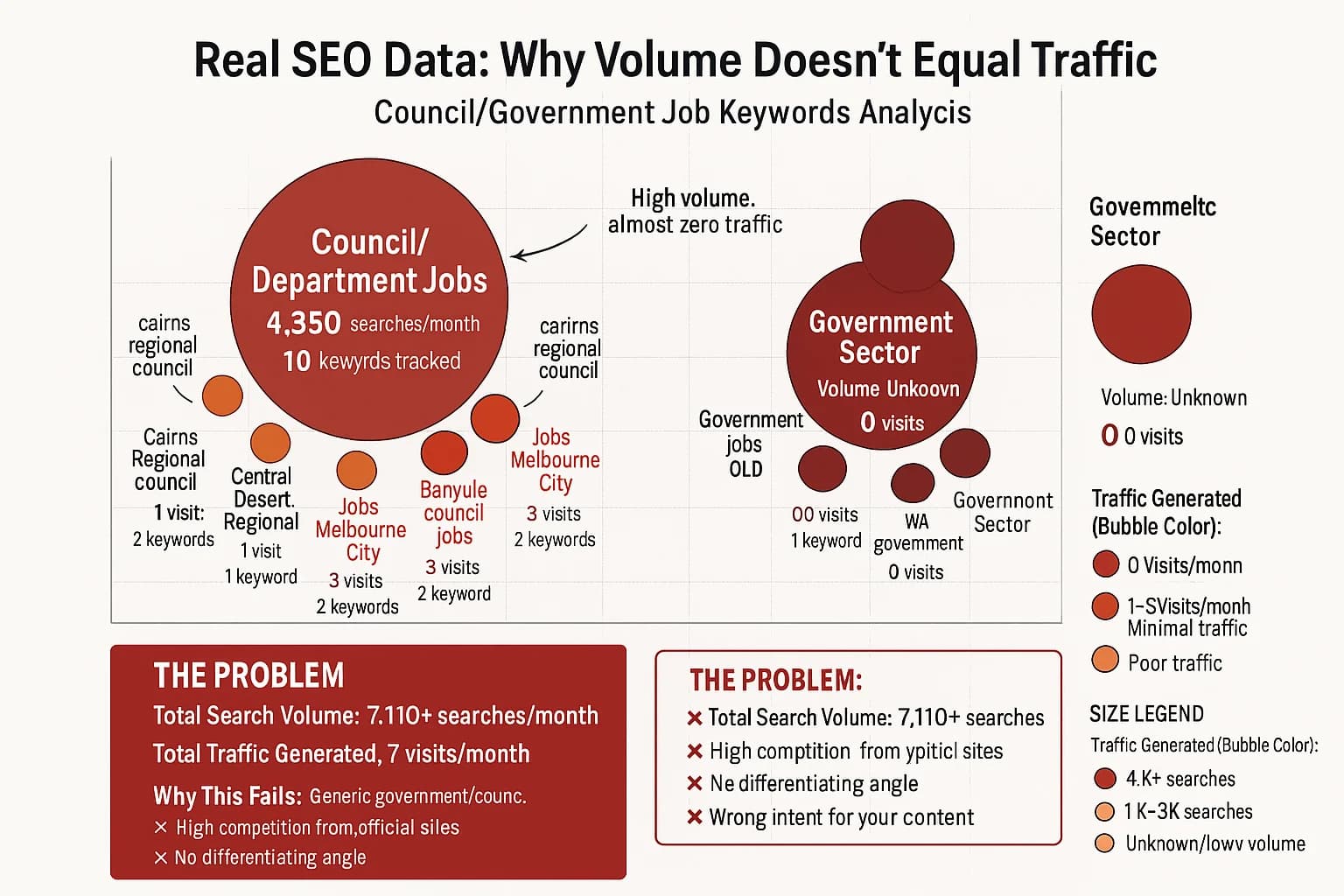
The Legitimacy Question: Real Site, Wrong Strategy
After spending a week analyzing Council Direct, I can definitively say it’s legitimate but misguided.
Evidence it’s legitimate:
- Consistent government backlinks from .gov.au domains.
- Properly registered Australian domain.
- Real job listings (when they load).
- No suspicious traffic patterns.
- Mobile functionality suggests real development effort.
Why it’s failing:
- No content strategy (ranking for EU terms by accident).
- Technical debt (100 broken elements).
- Geographic confusion (German traffic to Aussie jobs).
- No active link building since 2024.
- Second-page specialist syndrome.
The robots.txt tells another story:
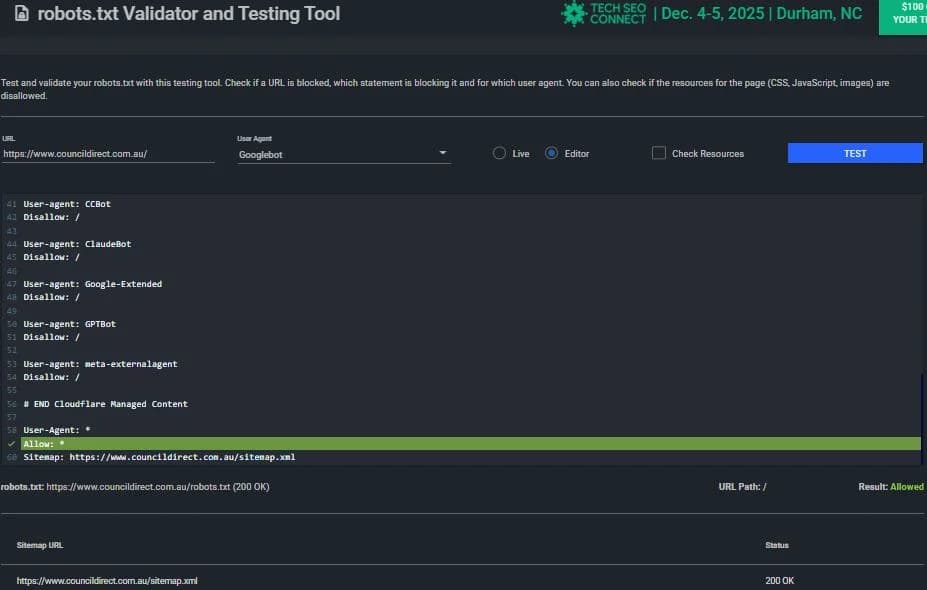
User-agent: CCBot
Disallow: /
User-agent: ChatGPT-User
Disallow: /
User-agent: GPTBot
Disallow: /
User-Agent: *
Allow: /
Sitemap: https://www.councildirect.com.au/sitemap.xml
They’re blocking AI crawlers but allowing everything else. Smart? Maybe. They don’t want their job listings scraped by ChatGPT. But they’re also preventing AI-powered search engines from understanding their content. In 2025, that’s like closing half your doors to visitors.
Referring Domains: The Mixed Bag
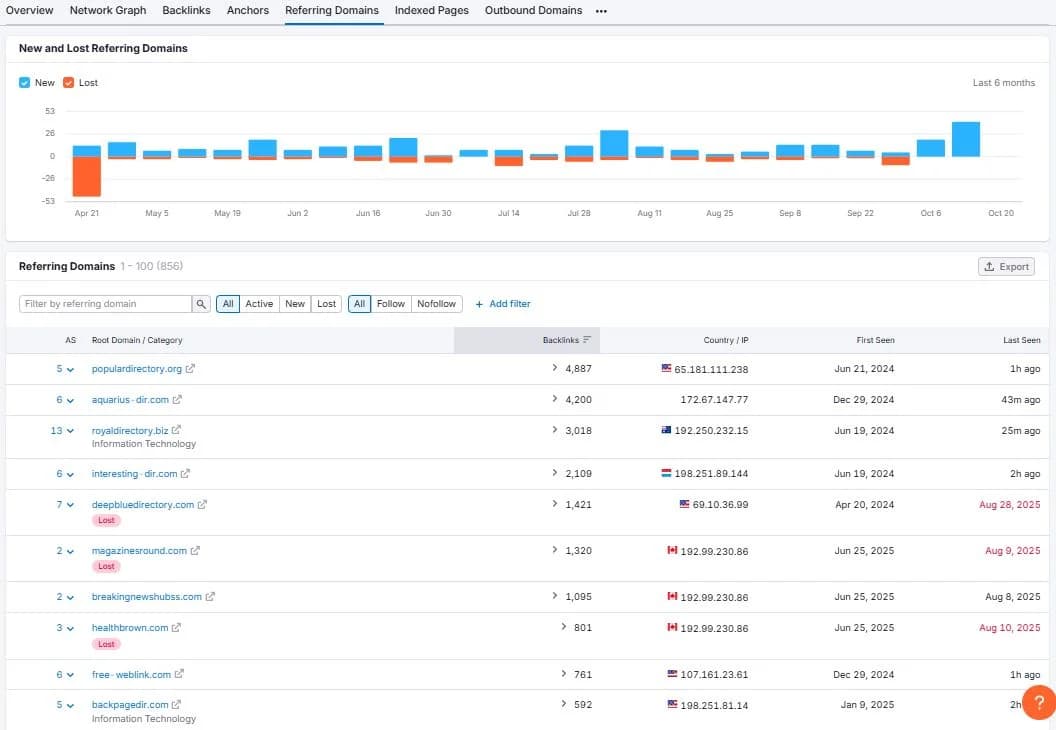
Latest referring domain activity shows the problem:
Domain
Backlinks
IP Location
Last Seen
Value
populardirectory.org
4,887
US
Jun 21, 2024
Minimal
aquarius-dir.com
4,200
Germany
Dec 29, 2024
Zero
royaldirectory.biz
3,018
Japan
Jun 19, 2024
Negative
deepbluedirectory.com
1,421
Latvia
Aug 28, 2025
Suspicious
Half their recent backlinks are from international directories. A Latvian directory linking to Australian council jobs? That’s spam territory. But because they have those strong .gov.au links, Google hasn’t penalized them. Yet.
What Council Direct Actually Is
After analyzing everything, Council Direct is a legitimate Australian job portal that’s accidentally succeeding despite doing almost everything wrong. They’re the government contractor who got the job and then forgot to optimize anything.
The Good:
- Real government backlinks providing trust.
- Mobile actually works.
- Some geographic keywords converting.
- Brand anchor ratio accidentally perfect.
The Bad:
- 85% of keywords beyond page one.
- International spam backlinks growing.
- No content matching search intent.
- Technical issues everywhere.
- Zero optimization strategy visible.
The Verdict: Council Direct is legitimate but lazy. They’re coasting on government trust signals while missing massive opportunities. With 856 referring domains, they should be pulling 10K+ monthly traffic, not 885. They’re the perfect example of a site that exists because it has to, not because anyone’s trying to make it successful.
If they spent one month fixing their technical issues and creating location-specific landing pages, they could probably 10x their traffic. Will they? Doubt it. Government contractors rarely optimize after the check clears.
Share
You may also like


Send me your site
I'll tell you honestly what's broken. If we can't help, I'll tell you who can.
Free · 45 min · no obligation